Artículo
Utilization of kañawa (chenopodium pallidicaule aellen) flour in pasta making

Fecha de publicación:
02/2019
Editorial:
Hindawi Limited
Revista:
Journal of Chemistry
ISSN:
2090-9071
e-ISSN:
2090-9071
Idioma:
Inglés
Tipo de recurso:
Artículo publicado
Clasificación temática:
Resumen
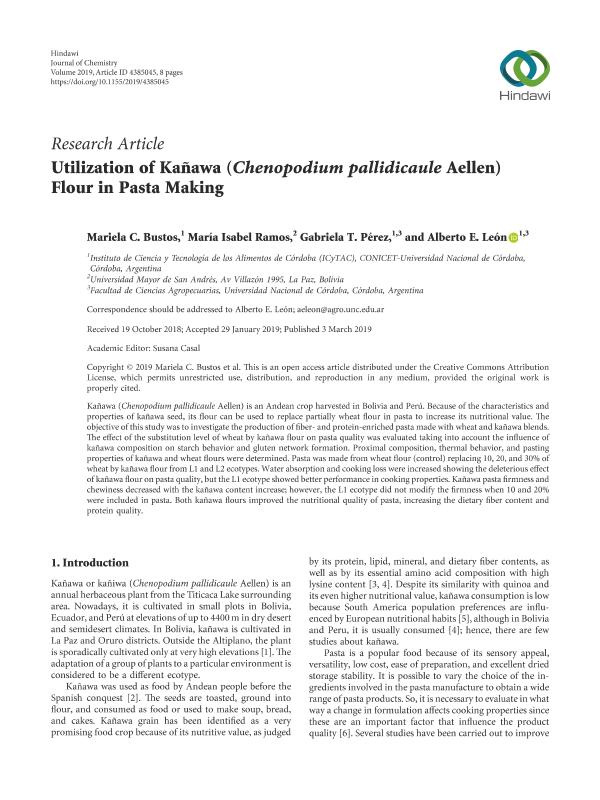
Kañawa (Chenopodium pallidicaule Aellen) is an Andean crop harvested in Bolivia and Perú. Because of the characteristics and properties of kañawa seed, its flour can be used to replace partially wheat flour in pasta to increase its nutritional value. The objective of this study was to investigate the production of fiber- and protein-enriched pasta made with wheat and kañawa blends. The effect of the substitution level of wheat by kañawa flour on pasta quality was evaluated taking into account the influence of kañawa composition on starch behavior and gluten network formation. Proximal composition, thermal behavior, and pasting properties of kañawa and wheat flours were determined. Pasta was made from wheat flour (control) replacing 10, 20, and 30% of wheat by kañawa flour from L1 and L2 ecotypes. Water absorption and cooking loss were increased showing the deleterious effect of kañawa flour on pasta quality, but the L1 ecotype showed better performance in cooking properties. Kañawa pasta firmness and chewiness decreased with the kañawa content increase; however, the L1 ecotype did not modify the firmness when 10 and 20% were included in pasta. Both kañawa flours improved the nutritional quality of pasta, increasing the dietary fiber content and protein quality.
Palabras clave:
Kañawa
,
Pasta quality
,
Starch
,
Protein
Archivos asociados

Tamaño:
2.513Mb
Formato:
PDF
Licencia
 Excepto donde se diga explícitamente, este item se publica bajo la siguiente descripción:
Creative Commons Attribution-NonCommercial-ShareAlike 2.5 Unported (CC BY-NC-SA 2.5)
Excepto donde se diga explícitamente, este item se publica bajo la siguiente descripción:
Creative Commons Attribution-NonCommercial-ShareAlike 2.5 Unported (CC BY-NC-SA 2.5)
Identificadores
Colecciones
Articulos(ICYTAC)
Articulos de INST. DE CIENCIA Y TECNOLOGIA DE ALIMENTOS CORDOBA
Articulos de INST. DE CIENCIA Y TECNOLOGIA DE ALIMENTOS CORDOBA
Citación
Bustos Shmidt, Mariela Cecilia; Ramos, María Isabel; Perez, Gabriela Teresa; Leon, Alberto Edel; Utilization of kañawa (chenopodium pallidicaule aellen) flour in pasta making; Hindawi Limited; Journal of Chemistry; 2019; ID 4385045 ; 2-2019; 1-8
Compartir


Altmétricas