Artículo
New insights into bacterial bile resistance mechanisms: the role of bile salt hydrolase and its impact on human health

Fecha de publicación:
10/2018
Editorial:
Elsevier Science
Revista:
Food Research International
ISSN:
0963-9969
e-ISSN:
1873-7145
Idioma:
Inglés
Tipo de recurso:
Artículo publicado
Clasificación temática:
Resumen
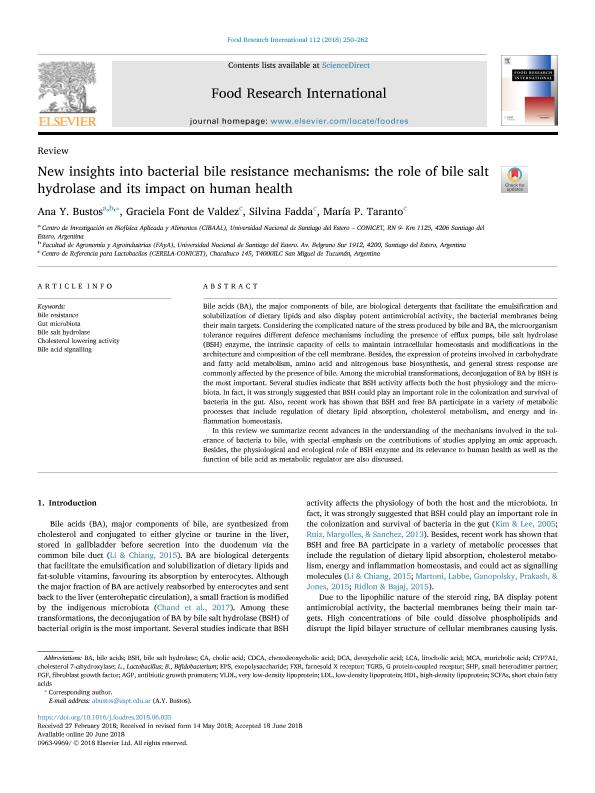
Bile acids (BA), the major components of bile, are biological detergents that facilitate the emulsification and solubilization of dietary lipids and also display potent antimicrobial activity, the bacterial membranes being their main targets. Considering the complicated nature of the stress produced by bile and BA, the microorganism tolerance requires different defence mechanisms including the presence of efflux pumps, bile salt hydrolase (BSH) enzyme, the intrinsic capacity of cells to maintain intracellular homeostasis and modifications in the architecture and composition of the cell membrane. Besides, the expression of proteins involved in carbohydrate and fatty acid metabolism, amino acid and nitrogenous base biosynthesis, and general stress response are commonly affected by the presence of bile. Among the microbial transformations, deconjugation of BA by BSH is the most important. Several studies indicate that BSH activity affects both the host physiology and the microbiota. In fact, it was strongly suggested that BSH could play an important role in the colonization and survival of bacteria in the gut. Also, recent work has shown that BSH and free BA participate in a variety of metabolic processes that include regulation of dietary lipid absorption, cholesterol metabolism, and energy and inflammation homeostasis. In this review we summarize recent advances in the understanding of the mechanisms involved in the tolerance of bacteria to bile, with special emphasis on the contributions of studies applying an omic approach. Besides, the physiological and ecological role of BSH enzyme and its relevance to human health as well as the function of bile acid as metabolic regulator are also discussed.
Archivos asociados

Tamaño:
1.883Mb
Formato:
PDF
Licencia
 Excepto donde se diga explícitamente, este item se publica bajo la siguiente descripción:
Creative Commons Attribution-NonCommercial-ShareAlike 2.5 Unported (CC BY-NC-SA 2.5)
Excepto donde se diga explícitamente, este item se publica bajo la siguiente descripción:
Creative Commons Attribution-NonCommercial-ShareAlike 2.5 Unported (CC BY-NC-SA 2.5)
Identificadores
Colecciones
Articulos(CERELA)
Articulos de CENTRO DE REFERENCIA PARA LACTOBACILOS (I)
Articulos de CENTRO DE REFERENCIA PARA LACTOBACILOS (I)
Citación
Bustos, Ana Yanina; Font, Graciela Maria; Fadda, Silvina G.; Taranto, Maria Pia; New insights into bacterial bile resistance mechanisms: the role of bile salt hydrolase and its impact on human health; Elsevier Science; Food Research International; 112; 10-2018; 250-262
Compartir


Altmétricas