Artículo
Whey protein gelation induced by enzymatic hydrolysis and heat treatment: Comparison of creep and recovery behavior

Fecha de publicación:
02/2017
Editorial:
Elsevier
Revista:
Food Hydrocolloids
ISSN:
0268-005X
Idioma:
Inglés
Tipo de recurso:
Artículo publicado
Clasificación temática:
Resumen
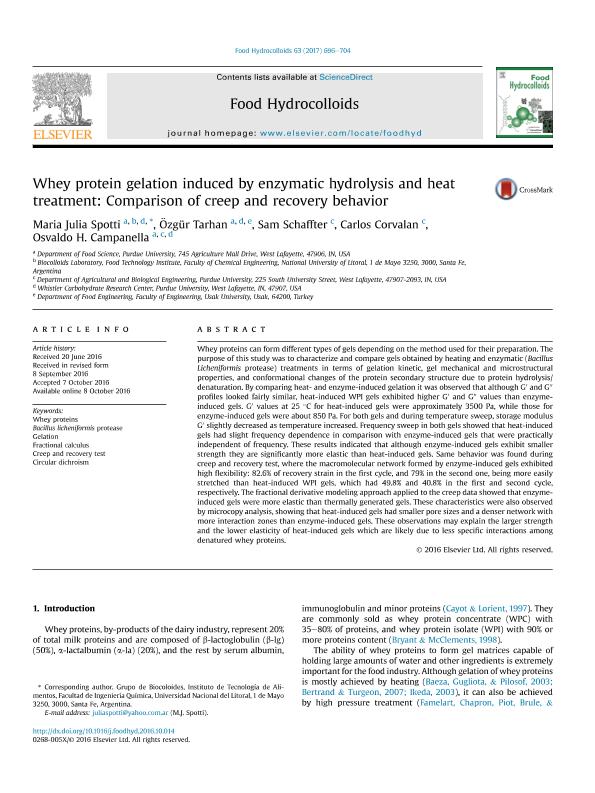
Whey proteins can form different types of gels depending on the method used for their preparation. The purpose of this study was to characterize and compare gels obtained by heating and enzymatic (Bacillus Licheniformis protease) treatments in terms of gelation kinetic, gel mechanical and microstructural properties, and conformational changes of the protein secondary structure due to protein hydrolysis/denaturation. By comparing heat- and enzyme-induced gelation it was observed that although G′ and G″ profiles looked fairly similar, heat-induced WPI gels exhibited higher G′ and G″ values than enzyme-induced gels. G′ values at 25 °C for heat-induced gels were approximately 3500 Pa, while those for enzyme-induced gels were about 850 Pa. For both gels and during temperature sweep, storage modulus G′ slightly decreased as temperature increased. Frequency sweep in both gels showed that heat-induced gels had slight frequency dependence in comparison with enzyme-induced gels that were practically independent of frequency. These results indicated that although enzyme-induced gels exhibit smaller strength they are significantly more elastic than heat-induced gels. Same behavior was found during creep and recovery test, where the macromolecular network formed by enzyme-induced gels exhibited high flexibility: 82.6% of recovery strain in the first cycle, and 79% in the second one, being more easily stretched than heat-induced WPI gels, which had 49.8% and 40.8% in the first and second cycle, respectively. The fractional derivative modeling approach applied to the creep data showed that enzyme-induced gels were more elastic than thermally generated gels. These characteristics were also observed by microcopy analysis, showing that heat-induced gels had smaller pore sizes and a denser network with more interaction zones than enzyme-induced gels. These observations may explain the larger strength and the lower elasticity of heat-induced gels which are likely due to less specific interactions among denatured whey proteins.
Archivos asociados

Tamaño:
1.701Mb
Formato:
PDF
Licencia
 Excepto donde se diga explícitamente, este item se publica bajo la siguiente descripción:
Atribución-NoComercial-SinDerivadas 2.5 Argentina (CC BY-NC-ND 2.5 AR)
Excepto donde se diga explícitamente, este item se publica bajo la siguiente descripción:
Atribución-NoComercial-SinDerivadas 2.5 Argentina (CC BY-NC-ND 2.5 AR)
Identificadores
Colecciones
Articulos(CCT - SANTA FE)
Articulos de CTRO.CIENTIFICO TECNOL.CONICET - SANTA FE
Articulos de CTRO.CIENTIFICO TECNOL.CONICET - SANTA FE
Citación
Spotti, Maria Julia; Tarhan, Özgür; Schaffter, Sam; Corvalan, Carlos; Osvaldo Roberto, Campanella; Whey protein gelation induced by enzymatic hydrolysis and heat treatment: Comparison of creep and recovery behavior; Elsevier; Food Hydrocolloids; 63; 2-2017; 696-704
Compartir


Altmétricas