Artículo
Valorization of industrial by-products, okara and beer bagasse, to design balanced laboratory animal feed
Marchioni, Sofia ; Campderrós, Mercedes Edith; Castro, Gabriel Emiliano
; Ostermann Porcel, María Victoria
; Campderrós, Mercedes Edith; Castro, Gabriel Emiliano
; Ostermann Porcel, María Victoria
; Campderrós, Mercedes Edith; Castro, Gabriel Emiliano
; Ostermann Porcel, María Victoria
Fecha de publicación:
07/2025
Editorial:
Rebrapa
Revista:
Brazilian Journal of Food Research
ISSN:
2448-3184
Idioma:
Inglés
Tipo de recurso:
Artículo publicado
Clasificación temática:
Resumen
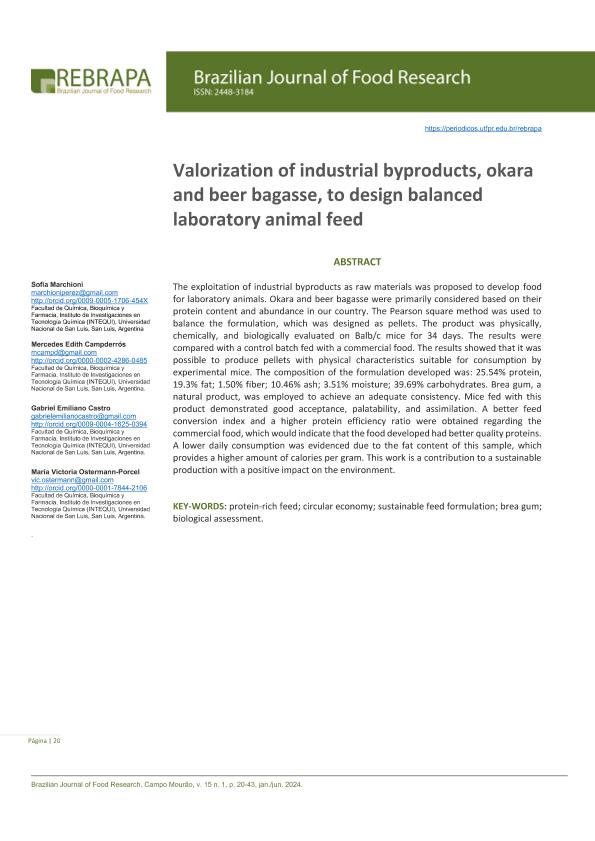
The exploitation of industrial byproducts as raw materials was proposed to develop food for laboratory animals. Okara and beer bagasse were primarily considered based on their protein content and abundance in our country. The Pearson square method was used to balance the formulation, which was designed as pellets. The product was physically, chemically, and biologically evaluated on Balb/c mice for 34 days. The results were compared with a control batch fed with a commercial food. The results showed that it was possible to produce pellets with physical characteristics suitable for consumption by experimental mice. The composition of the formulation developed was: 25.54% protein, 19.3% fat; 1.50% fiber; 10.46% ash; 3.51% moisture; 39.69% carbohydrates. Brea gum, a natural product, was employed to achieve an adequate consistency. Mice fed with this product demonstrated good acceptance, palatability, and assimilation. A better feed conversion index and a higher protein efficiency ratio were obtained regarding the commercial food, which would indicate that the food developed had better quality proteins. A lower daily consumption was evidenced due to the fat content of this sample, which provides a higher amount of calories per gram. This work is a contribution to a sustainable production with a positive impact on the environment.
Archivos asociados

Tamaño:
1.105Mb
Formato:
PDF
Licencia
 Excepto donde se diga explícitamente, este item se publica bajo la siguiente descripción:
Creative Commons Attribution 2.5 Unported (CC BY 2.5)
Excepto donde se diga explícitamente, este item se publica bajo la siguiente descripción:
Creative Commons Attribution 2.5 Unported (CC BY 2.5)
Identificadores
Colecciones
Articulos(INTEQUI)
Articulos de INST. DE INVEST. EN TECNOLOGIA QUIMICA
Articulos de INST. DE INVEST. EN TECNOLOGIA QUIMICA
Citación
Marchioni, Sofia; Campderrós, Mercedes Edith; Castro, Gabriel Emiliano; Ostermann Porcel, María Victoria; Valorization of industrial by-products, okara and beer bagasse, to design balanced laboratory animal feed; Rebrapa; Brazilian Journal of Food Research; 15; 1; 7-2025; 20-43
Compartir


Altmétricas