Artículo
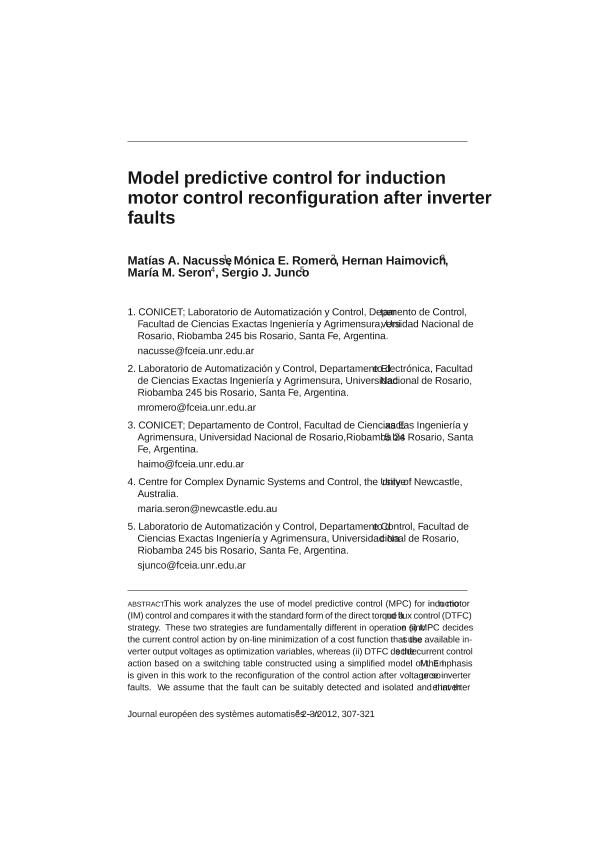
This work analyzes the use of model predictive control (MPC) for induction motor (IM) control and compares it with the standard form of the direct torque and flux control (DTFC) strategy. These two strategies are fundamentally different in operation since (i) MPC decides the current control action by on-line minimization of a cost function that uses the available inverter output voltages as optimization variables, whereas (ii) DTFC decides the current control action based on a switching table constructed using a simplified model of the IM. Emphasis is given in this work to the reconfiguration of the control action after voltage source inverter faults. We assume that the fault can be suitably detected and isolated and that the inverter can be reconfigured after the specific fault to continue operation, albeit with a reduced set of achievable output vectors. Based on this reduced set of vectors, we propose to reconfigure the induction motor control algorithm by (i) providing the reduced set of inverter vectors as the reconfigured constraint set of optimization variables for MPC or (ii) instructing DTFC to use a reconfigured switching table. Simulation results show that MPC with prediction horizon N = 1 considerably outperforms DTFC at a modest increment of computational cost. Moreover, this increment is less pronounced under fault since the number of optimization variables is reduced. Cet article présente l’application de la commande prédictive (MPC) à la machine asynchrone (MA) et sa comparaison avec la forme standard du contrôle direct du flux et du couple (DTFC) de cette machine. Ces deux stratégies de commande ont une différence fondamentale dans leur opération vu que (i) la commande MPC décide l’action de contrôle du courant par voie de minimisation en temps réel d’une fonction de coût qu’utilisent les vecteurs de tension de l’onduleur en tant que variables d’optimisation, tandis que (ii) la commande DTFC décide l’action mentionnée sur la base d’une table de commutation construite d’après un modèle simplifié de la MA. Dans ce travail on met l’accent sur la reconfiguration de l’actionneur (l’onduleur) et de sa commande suite à l’apparition de fautes chez l’onduleur. On suppose que les fautes peuvent être détectées et isolées d’une façon convenable, et que l’onduleur continue d’être opérationnel après sa reconfiguration, même avec un ensemble réduit des vecteurs de tension. Compte tenu de cet ensemble réduit de vecteurs nous proposons de reconfigurer la loi de commande de la machine asynchrone de deux façons alternatives : (i) avec une approche MPC qu’utilise l’ensemble des nouveaux vecteurs comme variables d’optimisation et (ii) avec une approche DTC qu’utilise une nouvelle table de commutation adaptée à la reconfiguration de l’onduleur. Des résultats de simulation montrent que la performance de l’approche MPC surpasse celle de la commande DTFC n’ayant qu’un faible coût additionnel de calcul. En outre, lors de l’utilisation de l’onduleur reconfiguré, cet incrément est plus faible encore puisque le nombre des variables (vecteurs) d’optimisation est réduit.
Model predictive control for induction motor control reconfiguration after inverter faults
Nacusse, Matías Antonio ; Romero, Mónica Elena; Haimovich, Hernan
; Seron, Maria Marta; Junco, Sergio Jose
; Romero, Mónica Elena; Haimovich, Hernan
; Seron, Maria Marta; Junco, Sergio Jose
; Romero, Mónica Elena; Haimovich, Hernan
; Seron, Maria Marta; Junco, Sergio Jose
Fecha de publicación:
05/2012
Editorial:
International Information and Engineering Technology Association
Revista:
Journal Européen des Systèmes Automatisés
ISSN:
0296-1598
e-ISSN:
1269-6935
Idioma:
Inglés
Tipo de recurso:
Artículo publicado
Clasificación temática:
Resumen
Archivos asociados

Tamaño:
794.4Kb
Formato:
PDF
Licencia
 Excepto donde se diga explícitamente, este item se publica bajo la siguiente descripción:
Creative Commons Attribution-NonCommercial-ShareAlike 2.5 Unported (CC BY-NC-SA 2.5)
Excepto donde se diga explícitamente, este item se publica bajo la siguiente descripción:
Creative Commons Attribution-NonCommercial-ShareAlike 2.5 Unported (CC BY-NC-SA 2.5)
Identificadores
Colecciones
Articulos(CCT - ROSARIO)
Articulos de CTRO.CIENTIFICO TECNOL.CONICET - ROSARIO
Articulos de CTRO.CIENTIFICO TECNOL.CONICET - ROSARIO
Citación
Nacusse, Matías Antonio; Romero, Mónica Elena; Haimovich, Hernan; Seron, Maria Marta; Junco, Sergio Jose; Model predictive control for induction motor control reconfiguration after inverter faults; International Information and Engineering Technology Association; Journal Européen des Systèmes Automatisés; 46; 2-3; 5-2012; 307-321
Compartir


Altmétricas