Artículo
Interactions of hydrocolloids and sonicated-gluten proteins

Fecha de publicación:
01/2005
Editorial:
Elsevier
Revista:
Food Hydrocolloids
ISSN:
0268-005X
Idioma:
Inglés
Tipo de recurso:
Artículo publicado
Clasificación temática:
Resumen
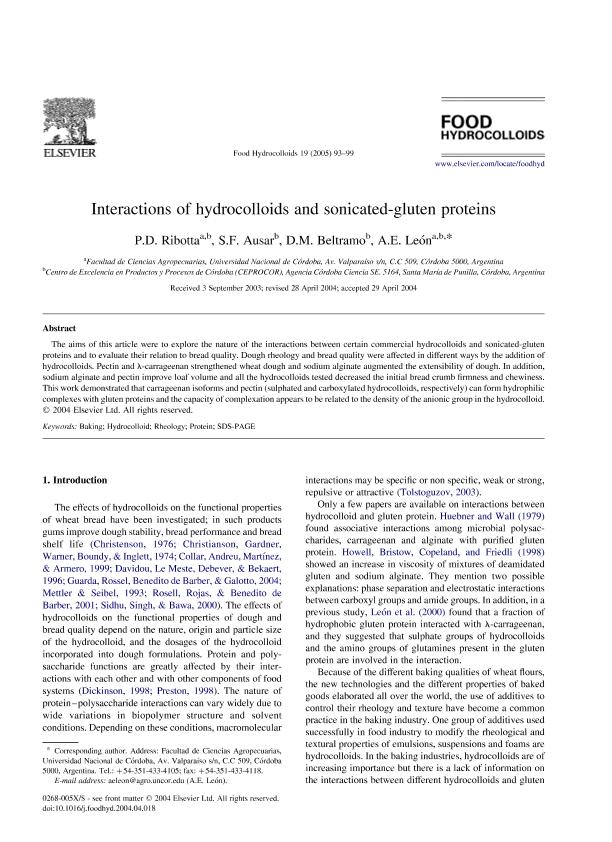
The aims of this article were to explore the nature of the interactions between certain commercial hydrocolloids and sonicated-gluten proteins and to evaluate their relation to bread quality. Dough rheology and bread quality were affected in different ways by the addition of hydrocolloids. Pectin and l-carrageenan strengthened wheat dough and sodium alginate augmented the extensibility of dough. In addition, sodium alginate and pectin improve loaf volume and all the hydrocolloids tested decreased the initial bread crumb firmness and chewiness. This work demonstrated that carrageenan isoforms and pectin (sulphated and carboxylated hydrocolloids, respectively) can form hydrophilic complexes with gluten proteins and the capacity of complexation appears to be related to the density of the anionic group in the hydrocolloidl-carrageenan strengthened wheat dough and sodium alginate augmented the extensibility of dough. In addition, sodium alginate and pectin improve loaf volume and all the hydrocolloids tested decreased the initial bread crumb firmness and chewiness. This work demonstrated that carrageenan isoforms and pectin (sulphated and carboxylated hydrocolloids, respectively) can form hydrophilic complexes with gluten proteins and the capacity of complexation appears to be related to the density of the anionic group in the hydrocolloid.
Palabras clave:
BAKING
,
HYDROCOLLOID
,
RHEOLOGY
,
PROTEIN
Archivos asociados

Tamaño:
269.3Kb
Formato:
PDF
Licencia
 Excepto donde se diga explícitamente, este item se publica bajo la siguiente descripción:
Creative Commons Attribution-NonCommercial-ShareAlike 2.5 Unported (CC BY-NC-SA 2.5)
Excepto donde se diga explícitamente, este item se publica bajo la siguiente descripción:
Creative Commons Attribution-NonCommercial-ShareAlike 2.5 Unported (CC BY-NC-SA 2.5)
Identificadores
Colecciones
Articulos(CCT - CORDOBA)
Articulos de CTRO.CIENTIFICO TECNOL.CONICET - CORDOBA
Articulos de CTRO.CIENTIFICO TECNOL.CONICET - CORDOBA
Articulos(ICYTAC)
Articulos de INST. DE CIENCIA Y TECNOLOGIA DE ALIMENTOS CORDOBA
Articulos de INST. DE CIENCIA Y TECNOLOGIA DE ALIMENTOS CORDOBA
Citación
Ribotta, Pablo Daniel; Ausar, S. F.; Beltramo, Dante Miguel; León, A. E.; Interactions of hydrocolloids and sonicated-gluten proteins; Elsevier; Food Hydrocolloids; 19; 1; 1-2005; 93-99
Compartir


Altmétricas