Artículo
Raphanus sativus functional potential: Impact of the analytical extraction technique on the bioaccessibility interpretation
Ramirez, Daniela Andrea ; Beretta, Hebe Vanesa
; Torres Palazzolo, Carolina Andrea
; Camargo, Alejandra Beatriz
; Beretta, Hebe Vanesa
; Torres Palazzolo, Carolina Andrea
; Camargo, Alejandra Beatriz
; Beretta, Hebe Vanesa
; Torres Palazzolo, Carolina Andrea
; Camargo, Alejandra Beatriz
Fecha de publicación:
07/2023
Editorial:
Wiley
Revista:
Food Safety and Health
ISSN:
2835-1096
e-ISSN:
2835-1096
Idioma:
Inglés
Tipo de recurso:
Artículo publicado
Clasificación temática:
Resumen
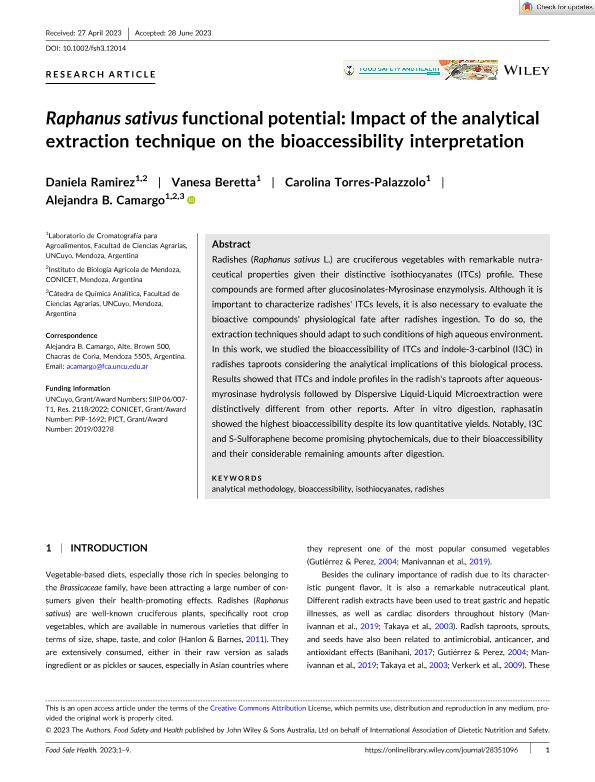
Radishes (Raphanus sativus L.) are cruciferous vegetables with remarkable nutraceutical properties given their distinctive isothiocyanates (ITCs) profile. These compounds are formed after glucosinolates-Myrosinase enzymolysis. Although it is important to characterize radishes´ ITCs levels, it is also necessary to evaluate the bioactive compounds´ physiological fate after radishes ingestion. To do so, the extraction techniques should adapt to such conditions of high aqueous environment. In this work, we studied the bioaccessibility of ITCs and indole-3-carbinol (I3C) in radishes taproots considering the analytical implications of this biological process. Results showed that ITCs and indole profiles in the radish´s taproots after aqueous-myrosinase hydrolysis followed by Dispersive Liquid-Liquid Microextraction were distinctively different from other reports. After in vitro digestion, raphasatin showed the highest bioaccessibility despite its low quantitative yields. Notably, I3C and S-Sulforaphene become promising phytochemicals, due to their bioaccessibility and their considerable remaining amounts after digestion.
Palabras clave:
ANALITYCAL METHODOLOGY
,
BIOACCESSIBILITY
,
ISOTHIOCYANATES
,
RADISHES
Archivos asociados

Tamaño:
489.3Kb
Formato:
PDF
Licencia
 Excepto donde se diga explícitamente, este item se publica bajo la siguiente descripción:
Creative Commons Attribution 2.5 Unported (CC BY 2.5)
Excepto donde se diga explícitamente, este item se publica bajo la siguiente descripción:
Creative Commons Attribution 2.5 Unported (CC BY 2.5)
Identificadores
Colecciones
Articulos(CCT - MENDOZA)
Articulos de CTRO.CIENTIFICO TECNOL.CONICET - MENDOZA
Articulos de CTRO.CIENTIFICO TECNOL.CONICET - MENDOZA
Articulos(IBAM)
Articulos de INST.DE BIOLOGIA AGRICOLA DE MENDOZA
Articulos de INST.DE BIOLOGIA AGRICOLA DE MENDOZA
Citación
Ramirez, Daniela Andrea; Beretta, Hebe Vanesa; Torres Palazzolo, Carolina Andrea; Camargo, Alejandra Beatriz; Raphanus sativus functional potential: Impact of the analytical extraction technique on the bioaccessibility interpretation; Wiley; Food Safety and Health; 7-2023; 1-9
Compartir


Altmétricas