Artículo
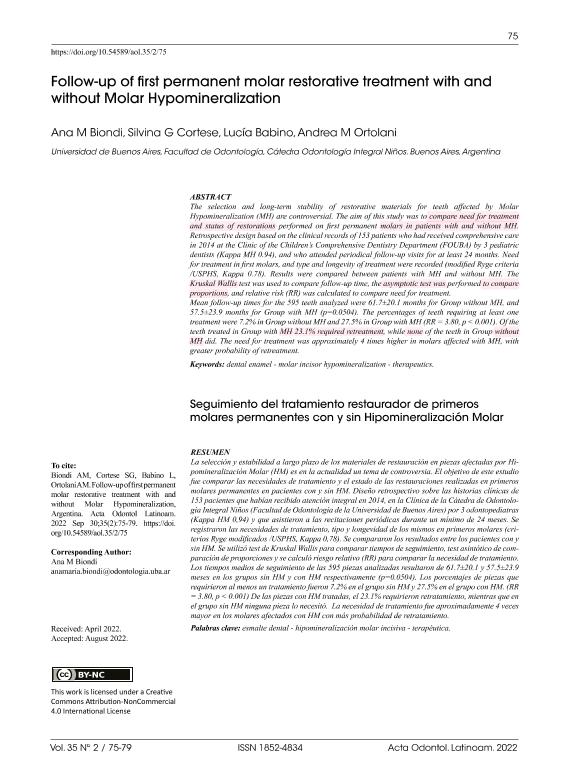
La selección y estabilidad a largo plazo de los materiales de restauración en piezas afectadas por Hipomineralización Molar (HM) es en la actualidad un tema de controversia. El objetivo de este estudio fue comparar las necesidades de tratamiento y el estado de las restauraciones realizadas en primeros molares permanentes en pacientes con y sin HM. Diseño retrospectivo sobre las historias clínicas de 153 pacientes que habían recibido atención integral en 2014, en la Clínica de la Cátedra de Odontología Integral Niños (Facultad de Odontología de la Universidad de Buenos Aires) por 3 odontopediatras (Kappa HM 0,94) y que asistieron a las recitaciones periódicas durante un mínimo de 24 meses. Se registraron las necesidades de tratamiento, tipo y longevidad de los mismos en primeros molares (criterios Ryge modificados /USPHS, Kappa 0,78). Se compararon los resultados entre los pacientes con y sin HM. Se utilizó test de Kruskal Wallis para comparar tiempos de seguimiento, test asintótico de comparación de proporciones y se calculó riesgo relativo (RR) para comparar la necesidad de tratamiento. Los tiempos medios de seguimiento de las 595 piezas analizadas resultaron de 61.7±20.1 y 57.5±23.9 meses en los grupos sin HM y con HM respectivamente (p=0.0504). Los porcentajes de piezas que requirieron al menos un tratamiento fueron 7.2% en el grupo sin HM y 27.5% en el grupo con HM. (RR = 3.80, p < 0.001) De las piezas con HM tratadas, el 23.1% requirieron retratamiento, mientras que en el grupo sin HM ninguna pieza lo necesitó. La necesidad de tratamiento fue aproximadamente 4 veces mayor en los molares afectados con HM con más probabilidad de retratamiento. The selection and long-term stability of restorative materials for teeth affected by MolarHypomineralization (MH) are controversial. The aim of this study was to compare need for treatmentand status of restorations performed on first permanent molars in patients with and without MH.Retrospective design based on the clinical records of 153 patients who had received comprehensive carein 2014 at the Clinic of the Children’s Comprehensive Dentistry Department (FOUBA) by 3 pediatricdentists (Kappa MH 0.94), and who attended periodical follow-up visits for at least 24 months. Needfor treatment in first molars, and type and longevity of treatment were recorded (modified Ryge criteria/USPHS, Kappa 0.78). Results were compared between patients with MH and without MH. TheKruskal Wallis test was used to compare follow-up time, the asymptotic test was performed to compareproportions, and relative risk (RR) was calculated to compare need for treatment.Mean follow-up times for the 595 teeth analyzed were 61.7±20.1 months for Group without MH, and57.5±23.9 months for Group with MH (p=0.0504). The percentages of teeth requiring at least onetreatment were 7.2% in Group without MH and 27.5% in Group with MH (RR = 3.80, p < 0.001). Of theteeth treated in Group with MH 23.1% required retreatment, while none of the teeth in Group withoutMH did. The need for treatment was approximately 4 times higher in molars affected with MH, withgreater probability of retreatment.
Follow-up of first permanent molar restorative treatment with and without Molar Hypomineralization
Título:
Seguimiento del tratamiento restaurador de primeros molares permanentes con y sin Hipomineralización Molar

Fecha de publicación:
09/2022
Editorial:
Sociedad Argentina de Investigación Odontológica
Revista:
Acta Odontológica Latinoamericana
ISSN:
1852-4834
Idioma:
Inglés
Tipo de recurso:
Artículo publicado
Clasificación temática:
Resumen
Palabras clave:
DENTAL ENAMEL
,
MOLAR INCISOR HYPOMINERALIZATION
,
THERAPEUTICS
Archivos asociados

Tamaño:
596.8Kb
Formato:
PDF
Licencia
 Excepto donde se diga explícitamente, este item se publica bajo la siguiente descripción:
Creative Commons Attribution-NonCommercial-ShareAlike 2.5 Unported (CC BY-NC-SA 2.5)
Excepto donde se diga explícitamente, este item se publica bajo la siguiente descripción:
Creative Commons Attribution-NonCommercial-ShareAlike 2.5 Unported (CC BY-NC-SA 2.5)
Identificadores
Colecciones
Articulos(IEGEBA)
Articulos de INSTITUTO DE ECOLOGIA, GENETICA Y EVOLUCION DE BS. AS
Articulos de INSTITUTO DE ECOLOGIA, GENETICA Y EVOLUCION DE BS. AS
Citación
Biondi, Ana; Cortese, Silvina Gabriela; Babino, Lucía; Ortolani, Andrea; Follow-up of first permanent molar restorative treatment with and without Molar Hypomineralization; Sociedad Argentina de Investigación Odontológica; Acta Odontológica Latinoamericana; 35; 2; 9-2022; 75-79
Compartir


Altmétricas