Artículo
Spray-Dried Infant Formula Emulsion Stability as Affected by Pre-Heat Treatment and Total Solids Content of the Feed
Rodríguez Arzuaga, Mariana; Abraham, Analia Graciela ; Ahrné, Lilia; Pérez Montes, Marvia G.; Añon, Maria Cristina
; Ahrné, Lilia; Pérez Montes, Marvia G.; Añon, Maria Cristina
Fecha de publicación:
12/2022
Editorial:
MDPI
Revista:
Foods
e-ISSN:
2304-8158
Idioma:
Inglés
Tipo de recurso:
Artículo publicado
Clasificación temática:
Resumen
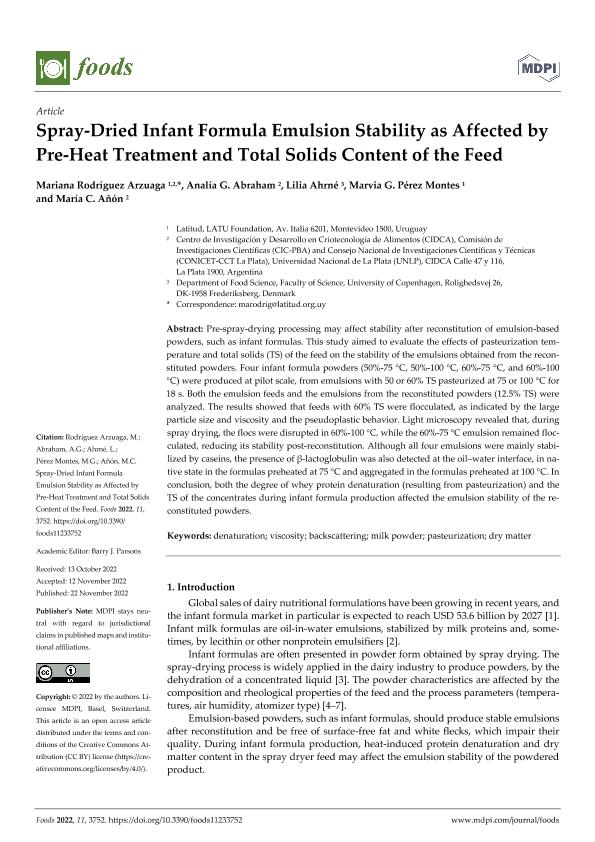
Pre-spray-drying processing may affect stability after reconstitution of emulsion-based powders, such as infant formulas. This study aimed to evaluate the effects of pasteurization temperature and total solids (TS) of the feed on the stability of the emulsions obtained from the reconstituted powders. Four infant formula powders (50%-75 °C, 50%-100 °C, 60%-75 °C, and 60%-100 °C) were produced at pilot scale, from emulsions with 50 or 60% TS pasteurized at 75 or 100 °C for 18 s. Both the emulsion feeds and the emulsions from the reconstituted powders (12.5% TS) were analyzed. The results showed that feeds with 60% TS were flocculated, as indicated by the large particle size and viscosity and the pseudoplastic behavior. Light microscopy revealed that, during spray drying, the flocs were disrupted in 60%-100 °C, while the 60%-75 °C emulsion remained flocculated, reducing its stability post-reconstitution. Although all four emulsions were mainly stabilized by caseins, the presence of β-lactoglobulin was also detected at the oil–water interface, in native state in the formulas preheated at 75 °C and aggregated in the formulas preheated at 100 °C. In conclusion, both the degree of whey protein denaturation (resulting from pasteurization) and the TS of the concentrates during infant formula production affected the emulsion stability of the reconstituted powders.
Palabras clave:
BACKSCATTERING
,
DENATURATION
,
DRY MATTER
,
MILK POWDER
,
PASTEURIZATION
,
VISCOSITY
Archivos asociados

Tamaño:
1.371Mb
Formato:
PDF
Licencia
 Excepto donde se diga explícitamente, este item se publica bajo la siguiente descripción:
Creative Commons Attribution 2.5 Unported (CC BY 2.5)
Excepto donde se diga explícitamente, este item se publica bajo la siguiente descripción:
Creative Commons Attribution 2.5 Unported (CC BY 2.5)
Identificadores
Colecciones
Articulos(CIDCA)
Articulos de CENTRO DE INV EN CRIOTECNOLOGIA DE ALIMENTOS (I)
Articulos de CENTRO DE INV EN CRIOTECNOLOGIA DE ALIMENTOS (I)
Citación
Rodríguez Arzuaga, Mariana; Abraham, Analia Graciela; Ahrné, Lilia; Pérez Montes, Marvia G.; Añon, Maria Cristina; Spray-Dried Infant Formula Emulsion Stability as Affected by Pre-Heat Treatment and Total Solids Content of the Feed; MDPI; Foods; 11; 23; 12-2022; 1-15
Compartir


Altmétricas