Artículo
Proteins and carbohydrates from red seaweeds: Evidence for beneficial effects on gut function and microbiota

Fecha de publicación:
08/2015
Editorial:
Molecular Diversity Preservation International
Revista:
Marine Drugs
ISSN:
1660-3397
Idioma:
Inglés
Tipo de recurso:
Artículo publicado
Clasificación temática:
Resumen
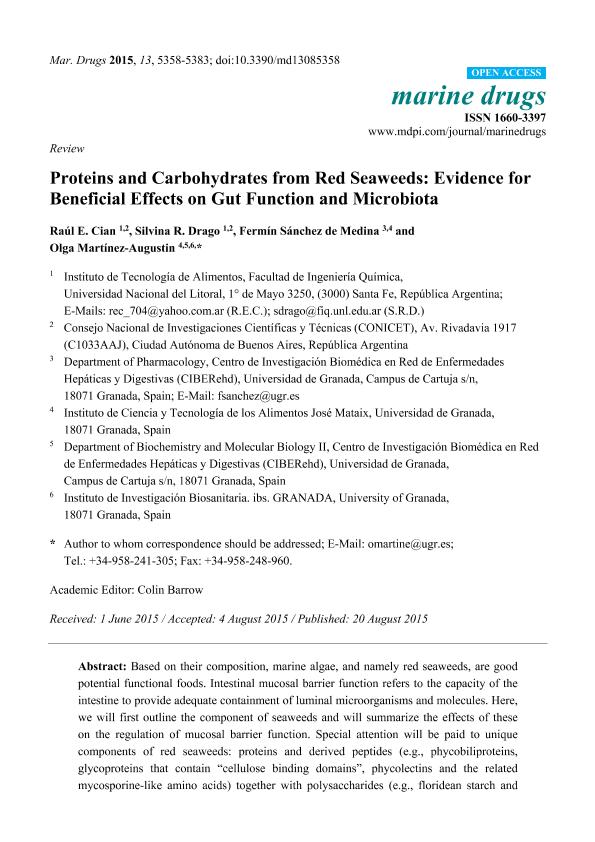
Based on their composition, marine algae, and namely red seaweeds, are good potential functional foods. Intestinal mucosal barrier function refers to the capacity of the intestine to provide adequate containment of luminal microorganisms and molecules. Here, we will first outline the component of seaweeds and will summarize the effects of these on the regulation of mucosal barrier function. Special attention will be paid to unique components of red seaweeds: proteins and derived peptides (e.g., phycobiliproteins, glycoproteins that contain "cellulose binding domains", phycolectins and the related mycosporine-like amino acids) together with polysaccharides (e.g., floridean starch and sulfated galactans, such as carrageenans, agarans and "DL-hybrid") and minerals. These compounds have been shown to exert prebiotic effects, to regulate intestinal epithelial cell, macrophage and lymphocyte proliferation and differentiation and to modulate the immune response. Molecular mechanisms of action of peptides and polysaccharides are starting to be elucidated, and evidence indicating the involvement of epidermal growth factor receptor (EGFR), insulin-like growth factor receptor (IGFR), Toll-like receptors (TLR) and signal transduction pathways mediated by protein kinase B (PKB or AKT), nuclear factor-κB (NF-κB) and mitogen activated protein kinases (MAPK) will also be summarized. The need for further research is clear, but in vivo experiments point to an overall antiinflammatory effect of these algae, indicating that they can reinforce membrane barrier function.
Archivos asociados

Tamaño:
296.1Kb
Formato:
PDF
Licencia
 Excepto donde se diga explícitamente, este item se publica bajo la siguiente descripción:
Creative Commons Attribution 2.5 Unported (CC BY 2.5)
Excepto donde se diga explícitamente, este item se publica bajo la siguiente descripción:
Creative Commons Attribution 2.5 Unported (CC BY 2.5)
Identificadores
Colecciones
Articulos(CCT - SANTA FE)
Articulos de CTRO.CIENTIFICO TECNOL.CONICET - SANTA FE
Articulos de CTRO.CIENTIFICO TECNOL.CONICET - SANTA FE
Citación
Cian, Raúl Esteban; Drago, Silvina Rosa; Sánchez de Medina, Fermin; Martínez Augustin, Olga; Proteins and carbohydrates from red seaweeds: Evidence for beneficial effects on gut function and microbiota; Molecular Diversity Preservation International; Marine Drugs; 13; 8; 8-2015; 5358-5383
Compartir


Altmétricas