Artículo
Fluid intelligence is supported by the multiple-demand system not the language system

Fecha de publicación:
03/2018
Editorial:
Nature Publishing Group
Revista:
Nature Human Behaviour
ISSN:
2397-3374
Idioma:
Inglés
Tipo de recurso:
Artículo publicado
Clasificación temática:
Resumen
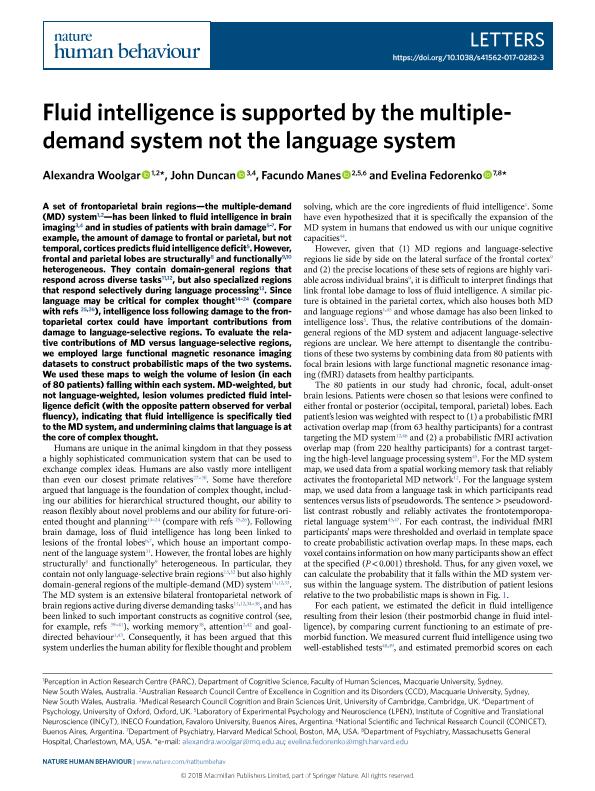
A set of frontoparietal brain regions-the multiple-demand (MD) system 1,2-has been linked to fluid intelligence in brain imaging 3,4 and in studies of patients with brain damage 5-7 . For example, the amount of damage to frontal or parietal, but not temporal, cortices predicts fluid intelligence deficit 5 . However, frontal and parietal lobes are structurally 8 and functionally 9,10 heterogeneous. They contain domain-general regions that respond across diverse tasks 11,12, but also specialized regions that respond selectively during language processing 13 . Since language may be critical for complex thought 14-24 (compare with refs 25,26 ), intelligence loss following damage to the frontoparietal cortex could have important contributions from damage to language-selective regions. To evaluate the relative contributions of MD versus language-selective regions, we employed large functional magnetic resonance imaging datasets to construct probabilistic maps of the two systems. We used these maps to weigh the volume of lesion (in each of 80 patients) falling within each system. MD-weighted, but not language-weighted, lesion volumes predicted fluid intelligence deficit (with the opposite pattern observed for verbal fluency), indicating that fluid intelligence is specifically tied to the MD system, and undermining claims that language is at the core of complex thought.
Palabras clave:
FLUID INTELLIGENCE
,
MULTIPLE DEMAND SYSTEM
Archivos asociados

Tamaño:
1.215Mb
Formato:
PDF
Licencia
 Excepto donde se diga explícitamente, este item se publica bajo la siguiente descripción:
Creative Commons Attribution-NonCommercial-ShareAlike 2.5 Unported (CC BY-NC-SA 2.5)
Excepto donde se diga explícitamente, este item se publica bajo la siguiente descripción:
Creative Commons Attribution-NonCommercial-ShareAlike 2.5 Unported (CC BY-NC-SA 2.5)
Identificadores
Colecciones
Articulos(INCYT)
Articulos de INSTITUTO DE NEUROCIENCIAS COGNITIVAS Y TRASLACIONAL
Articulos de INSTITUTO DE NEUROCIENCIAS COGNITIVAS Y TRASLACIONAL
Citación
Woolgar, Alexandra; Duncan, John; Manes, Facundo Francisco; Fedorenko, Evelina; Fluid intelligence is supported by the multiple-demand system not the language system; Nature Publishing Group; Nature Human Behaviour; 2; 3; 3-2018; 200-204
Compartir


Altmétricas