Artículo
Pesticide effects on crabs. How environmental concentrations of endosulfan and chlorpyrifos affect embryos
Negro, Carlos Leandro ; Senkman, Lidia Eloisa
; Marino, Fernanda
; Lorenzatti, Eduardo Antonio
; Collins, Pablo Agustin
; Senkman, Lidia Eloisa
; Marino, Fernanda
; Lorenzatti, Eduardo Antonio
; Collins, Pablo Agustin
; Senkman, Lidia Eloisa
; Marino, Fernanda
; Lorenzatti, Eduardo Antonio
; Collins, Pablo Agustin
Fecha de publicación:
02/2015
Editorial:
Taylor & Francis
Revista:
Journal Of Environmental Science And Health. Part B: Pesticides, Food Contaminants, And Agricultural Wastes
ISSN:
0360-1234
Idioma:
Inglés
Tipo de recurso:
Artículo publicado
Clasificación temática:
Resumen
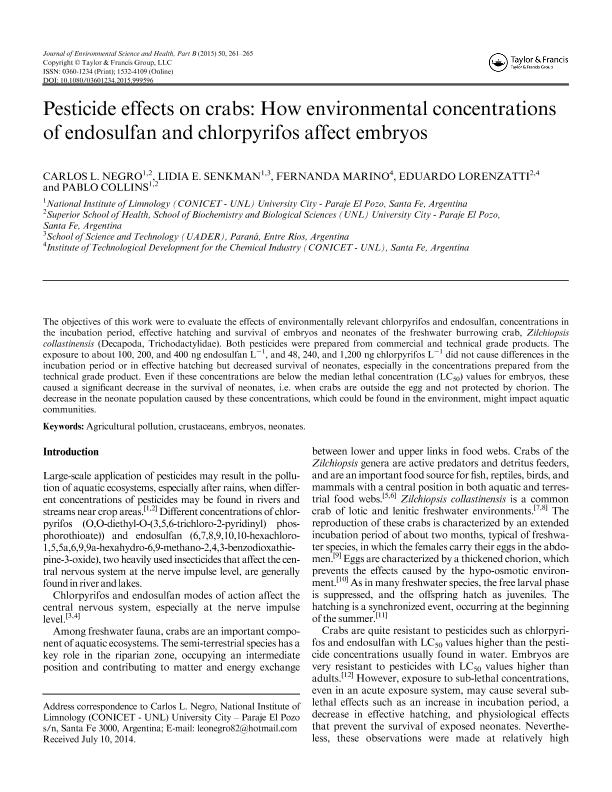
The use of pesticides in modern agricultural methods may result in the pollution of aquatic ecosystems. Different chlorpyrifos (O,O-diethyl-O-(3,5,6-trichloro-2-pyridinyl) phosphorothioate)) and endosulfan (6,7,8,9,10,10-hexachloro-1,5,5a,6,9,9a-hexahydro-6,9-methano-2,4,3-benzodioxathiepine-3-oxide) concentrations, two heavily used insecticides, are generally found in river and lakes. The objectives of this work were to evaluate the effects of environmentally relevant pesticide concentrations in the incubation period, effective hatching and survival of embryos and neonates of the freshwater burrowing crab, Zilchiopsis collastinensis (Decapoda, Trichodactylidae). Both pesticides were prepared from commercial and technical grade products. The exposure to about 100, 200 and 400 ng endosulfan/L; and 48, 240 and 1200 ng chlorpyrifos/L did not cause differences in the incubation period or in effective hatching, but decreased survival of neonates, especially in the concentrations prepared from the technical grade product. Even if these concentrations are below the median lethal concentration (LC50) values for embryos, they caused a significant decrease in the survival of the neonates, i. e., when crabs are outside the egg and not protected by the chorion. The decrease in the neonate population caused by these concentrations, which could be found in the environment, might impact aquatic communities.
Palabras clave:
Agricultural Pollution
,
Crustaceans
,
Embryos
,
Neonates
Archivos asociados

Tamaño:
248.9Kb
Formato:
PDF
Licencia
 Excepto donde se diga explícitamente, este item se publica bajo la siguiente descripción:
Creative Commons Attribution-NonCommercial-ShareAlike 2.5 Unported (CC BY-NC-SA 2.5)
Excepto donde se diga explícitamente, este item se publica bajo la siguiente descripción:
Creative Commons Attribution-NonCommercial-ShareAlike 2.5 Unported (CC BY-NC-SA 2.5)
Identificadores
Colecciones
Articulos(INTEC)
Articulos de INST.DE DES.TECNOL.PARA LA IND.QUIMICA (I)
Articulos de INST.DE DES.TECNOL.PARA LA IND.QUIMICA (I)
Citación
Negro, Carlos Leandro; Senkman, Lidia Eloisa; Marino, Fernanda; Lorenzatti, Eduardo Antonio; Collins, Pablo Agustin; Pesticide effects on crabs. How environmental concentrations of endosulfan and chlorpyrifos affect embryos; Taylor & Francis; Journal Of Environmental Science And Health. Part B: Pesticides, Food Contaminants, And Agricultural Wastes; 50; 2-2015; 261-265
Compartir


Altmétricas