Artículo
PyNTTTTGT and CpG immunostimulatory oligonucleotides: effect on granulocyte/monocyte colony-stimulating factor (GM-CSF) secretion by human CD56+ (NK and NKT) cells
Rodriguez, Juan M.; Marchicio, José; López, Mariela; Ziblat, Andrea ; Elias, Fernanda; Fló, Juan; López, Ricardo A.; Horn, David; Zorzopulos, Jorge; Montaner, Alejandro Daniel
; Elias, Fernanda; Fló, Juan; López, Ricardo A.; Horn, David; Zorzopulos, Jorge; Montaner, Alejandro Daniel
Fecha de publicación:
23/02/2015
Editorial:
Public Library Of Science
Revista:
Plos One
ISSN:
1932-6203
e-ISSN:
1932-6203
Idioma:
Inglés
Tipo de recurso:
Artículo publicado
Clasificación temática:
Resumen
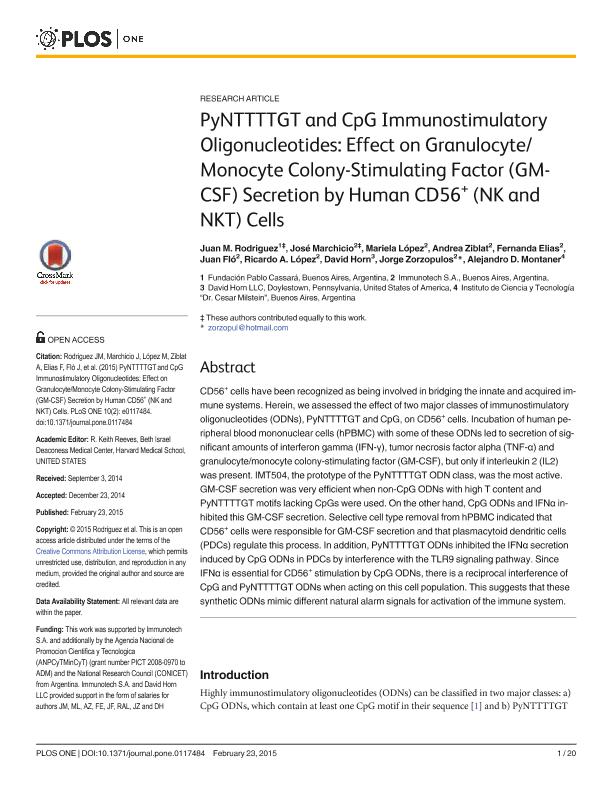
CD56+ cells have been recognized as being involved in bridging the innate and acquired immune systems. Herein, we assessed the effect of two major classes of immunostimulatory oligonucleotides (ODNs), PyNTTTTGT and CpG, on CD56+ cells. Incubation of human peripheral blood mononuclear cells (hPBMC) with some of these ODNs led to secretion of significant amounts of interferon gamma (IFN-γ), tumor necrosis factor alpha (TNF-α) and granulocyte/monocyte colony-stimulating factor (GM-CSF), but only if interleukin 2 (IL2) was present. IMT504, the prototype of the PyNTTTTGT ODN class, was the most active. GM-CSF secretion was very efficient when non-CpG ODNs with high T content and PyNTTTTGT motifs lacking CpGs were used. On the other hand, CpG ODNs and IFNα inhibited this GM-CSF secretion. Selective cell type removal from hPBMC indicated that CD56+ cells were responsible for GM-CSF secretion and that plasmacytoid dendritic cells (PDCs) regulate this process. In addition, PyNTTTTGT ODNs inhibited the IFNα secretion induced by CpG ODNs in PDCs by interference with the TLR9 signaling pathway. Since IFNα is essential for CD56+ stimulation by CpG ODNs, there is a reciprocal interference of CpG and PyNTTTTGT ODNs when acting on this cell population. This suggests that these synthetic ODNs mimic different natural alarm signals for activation of the immune system.
Palabras clave:
Oligonucleotides
,
Cpg
,
Gm-Csf
,
Cd56 Cells
Archivos asociados

Tamaño:
4.542Mb
Formato:
PDF
Licencia
 Excepto donde se diga explícitamente, este item se publica bajo la siguiente descripción:
Creative Commons Attribution-NonCommercial-ShareAlike 2.5 Unported (CC BY-NC-SA 2.5)
Excepto donde se diga explícitamente, este item se publica bajo la siguiente descripción:
Creative Commons Attribution-NonCommercial-ShareAlike 2.5 Unported (CC BY-NC-SA 2.5)
Identificadores
Colecciones
Articulos(IBYME)
Articulos de INST.DE BIOLOGIA Y MEDICINA EXPERIMENTAL (I)
Articulos de INST.DE BIOLOGIA Y MEDICINA EXPERIMENTAL (I)
Citación
Rodriguez, Juan M.; Marchicio, José; López, Mariela; Ziblat, Andrea; Elias, Fernanda; et al.; PyNTTTTGT and CpG immunostimulatory oligonucleotides: effect on granulocyte/monocyte colony-stimulating factor (GM-CSF) secretion by human CD56+ (NK and NKT) cells; Public Library Of Science; Plos One; 10; 2; 23-2-2015; e0117484.-e0117484
Compartir


Altmétricas