Artículo
Trypanosoma cruzi tryparedoxin II interacts with different peroxiredoxins under physiological andoxidative stress conditions.
Dias, L.; Peloso, E.F.; Leme, A.F.P.; Carnielli, C.M.; Pereira, C.N.; Werneck, C.C.; Guerrero, Sergio Adrian ; Gadelha, F.R.
; Gadelha, F.R.
Fecha de publicación:
01/2018
Editorial:
Academic Press Inc Elsevier Science
Revista:
Experimental Parasitology
ISSN:
0014-4894
Idioma:
Inglés
Tipo de recurso:
Artículo publicado
Clasificación temática:
Resumen
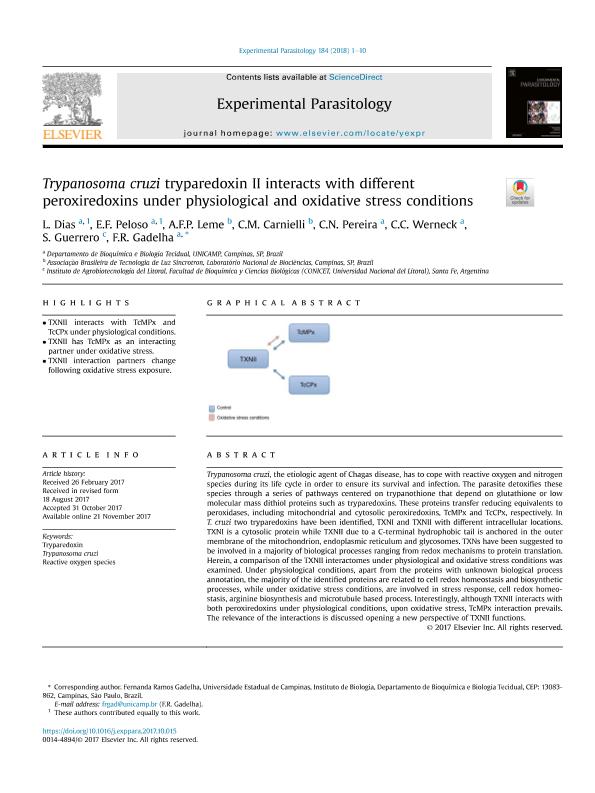
Trypanosoma cruzi, the etiologic agent of Chagas disease, has to cope with reactive oxygen and nitrogen species during its life cycle in order to ensure its survival and infection. The parasite detoxifies these species through a series of pathways centered on trypanothione that depend on glutathione or low molecular mass dithiol proteins such as tryparedoxins. These proteins transfer reducing equivalents to peroxidases, including mitochondrial and cytosolic peroxiredoxins, TcMPx and TcCPx, respectively. In T. cruzi two tryparedoxins have been identified, TXNI and TXNII with different intracellular locations. TXNI is a cytosolic protein while TXNII due to a C-terminal hydrophobic tail is anchored in the outer membrane of the mitochondrion, endoplasmic reticulum and glycosomes. TXNs have been suggested to be involved in a majority of biological processes ranging from redox mechanisms to protein translation. Herein, a comparison of the TXNII interactomes under physiological and oxidative stress conditions was examined. Under physiological conditions, apart from the proteins with unknown biological process annotation, the majority of the identified proteins are related to cell redox homeostasis and biosynthetic processes, while under oxidative stress conditions, are involved in stress response, cell redox homeostasis, arginine biosynthesis and microtubule based process. Interestingly, although TXNII interacts with both peroxiredoxins under physiological conditions, upon oxidative stress, TcMPx interaction prevails. The relevance of the interactions is discussed opening a new perspective of TXNII functions.
Palabras clave:
Trypanosoma
,
Tryparedoxin
,
Peroxiredoxin
Archivos asociados

Tamaño:
1.168Mb
Formato:
PDF
Licencia
 Excepto donde se diga explícitamente, este item se publica bajo la siguiente descripción:
Creative Commons Attribution-NonCommercial-ShareAlike 2.5 Unported (CC BY-NC-SA 2.5)
Excepto donde se diga explícitamente, este item se publica bajo la siguiente descripción:
Creative Commons Attribution-NonCommercial-ShareAlike 2.5 Unported (CC BY-NC-SA 2.5)
Identificadores
Colecciones
Articulos(IAL)
Articulos de INSTITUTO DE AGROBIOTECNOLOGIA DEL LITORAL
Articulos de INSTITUTO DE AGROBIOTECNOLOGIA DEL LITORAL
Citación
Dias, L.; Peloso, E.F.; Leme, A.F.P.; Carnielli, C.M.; Pereira, C.N.; et al.; Trypanosoma cruzi tryparedoxin II interacts with different peroxiredoxins under physiological andoxidative stress conditions.; Academic Press Inc Elsevier Science; Experimental Parasitology; 184; 1-2018; 1-10
Compartir


Altmétricas