Artículo
Most cleaved anti-müllerian hormone binds its receptor in human follicular fluid but little is competent in serum
Pierre, Alice; Racine, Chrystèle; Rey, Rodolfo Alberto ; Fanchin, Renato; Taieb, Joëlle; Cohen Tannoudji, Joëlle; Carmillo, Paul; Pepinsky, R. Blake; Cate, Richard L.; Di Clemente, Nathalie
; Fanchin, Renato; Taieb, Joëlle; Cohen Tannoudji, Joëlle; Carmillo, Paul; Pepinsky, R. Blake; Cate, Richard L.; Di Clemente, Nathalie
Fecha de publicación:
12/2016
Editorial:
Endocrine Society
Revista:
Journal of Clinical Endocrinology and Metabolism
ISSN:
0021-972X
Idioma:
Inglés
Tipo de recurso:
Artículo publicado
Clasificación temática:
Resumen
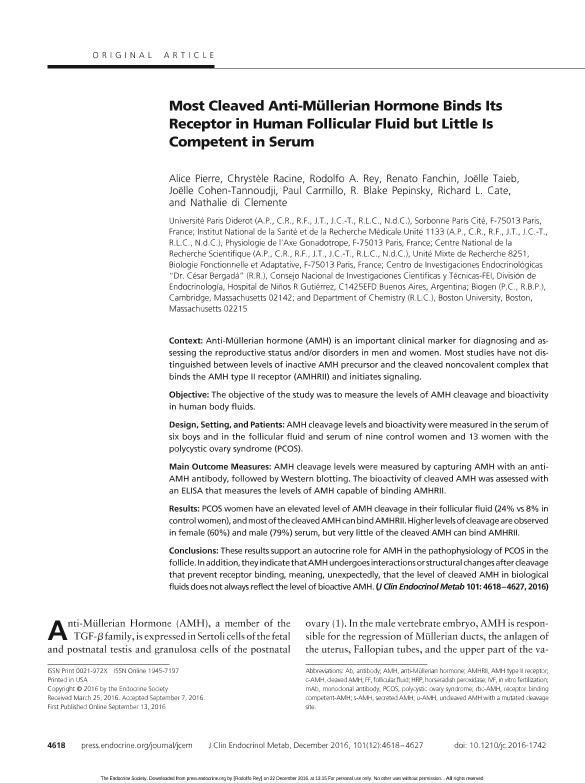
Context: Anti-Müllerian hormone (AMH) is an important clinical marker for diagnosing and assessing the reproductive status and/or disorders in men and women. Most studies have not distinguished between levels of inactive AMH precursor and the cleaved noncovalent complex that binds the AMH type II receptor (AMHRII) and initiates signaling. Objective: The objective of the study was to measure the levels of AMH cleavage and bioactivity in human body fluids. Design, Setting, and Patients: AMH cleavage levels and bioactivity were measured in the serum of six boys and in the follicular fluid and serum of nine control women and 13 women with the polycystic ovary syndrome (PCOS). Main Outcome Measures: AMH cleavage levels were measured by capturing AMH with an anti- AMH antibody, followed by Western blotting. The bioactivity of cleaved AMH was assessed with an ELISA that measures the levels of AMH capable of binding AMHRII. Results: PCOS women have an elevated level of AMH cleavage in their follicular fluid (24% vs 8% in controlwomen),andmostofthecleavedAMHcanbindAMHRII.Higherlevels of cleavage areobserved in female (60%) and male (79%) serum, but very little of the cleaved AMH can bind AMHRII. Conclusions: These results support an autocrine role for AMH in the pathophysiology of PCOS in the follicle. In addition,theyindicate thatAMHundergoesinteractions or structuralchangesaftercleavage that prevent receptor binding, meaning, unexpectedly, that the level of cleaved AMH in biological fluids does not always reflect the level of bioactive AMH.
Palabras clave:
AMH
,
Cleavage
,
PCOS
,
testis
Archivos asociados

Tamaño:
1.200Mb
Formato:
PDF
Licencia
 Excepto donde se diga explícitamente, este item se publica bajo la siguiente descripción:
Creative Commons Attribution-NonCommercial-ShareAlike 2.5 Unported (CC BY-NC-SA 2.5)
Excepto donde se diga explícitamente, este item se publica bajo la siguiente descripción:
Creative Commons Attribution-NonCommercial-ShareAlike 2.5 Unported (CC BY-NC-SA 2.5)
Identificadores
Colecciones
Articulos(CEDIE)
Articulos de CENTRO DE INVESTIGACIONES ENDOCRINOLOGICAS "DR. CESAR BERGADA"
Articulos de CENTRO DE INVESTIGACIONES ENDOCRINOLOGICAS "DR. CESAR BERGADA"
Citación
Pierre, Alice; Racine, Chrystèle; Rey, Rodolfo Alberto; Fanchin, Renato; Taieb, Joëlle; et al.; Most cleaved anti-müllerian hormone binds its receptor in human follicular fluid but little is competent in serum; Endocrine Society; Journal of Clinical Endocrinology and Metabolism; 101; 12; 12-2016; 4618-4627
Compartir


Altmétricas