Artículo
Selforganization of modular activity of grid cells

Fecha de publicación:
11/2017
Editorial:
Wiley-liss, Div John Wiley & Sons Inc
Revista:
Hippocampus
ISSN:
1050-9631
Idioma:
Inglés
Tipo de recurso:
Artículo publicado
Clasificación temática:
Resumen
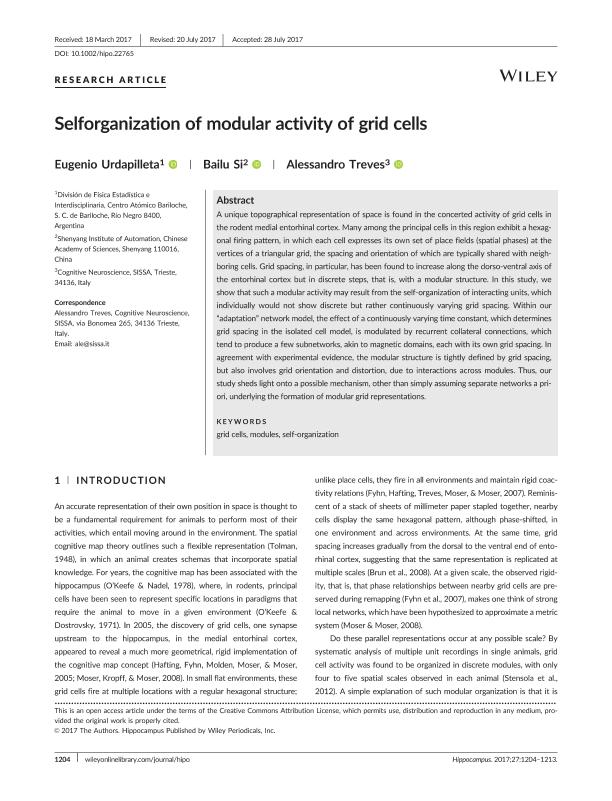
A unique topographical representation of space is found in the concerted activity of grid cells in the rodent medial entorhinal cortex. Many among the principal cells in this region exhibit a hexagonal firing pattern, in which each cell expresses its own set of place fields (spatial phases) at the vertices of a triangular grid, the spacing and orientation of which are typically shared with neighboring cells. Grid spacing, in particular, has been found to increase along the dorso-ventral axis of the entorhinal cortex but in discrete steps, that is, with a modular structure. In this study, we show that such a modular activity may result from the self-organization of interacting units, which individually would not show discrete but rather continuously varying grid spacing. Within our “adaptation” network model, the effect of a continuously varying time constant, which determines grid spacing in the isolated cell model, is modulated by recurrent collateral connections, which tend to produce a few subnetworks, akin to magnetic domains, each with its own grid spacing. In agreement with experimental evidence, the modular structure is tightly defined by grid spacing, but also involves grid orientation and distortion, due to interactions across modules. Thus, our study sheds light onto a possible mechanism, other than simply assuming separate networks a priori, underlying the formation of modular grid representations.
Palabras clave:
Grid Cells
,
Modules
,
Self-Organization
Archivos asociados

Tamaño:
760.9Kb
Formato:
PDF
Licencia
 Excepto donde se diga explícitamente, este item se publica bajo la siguiente descripción:
Creative Commons Attribution 2.5 Unported (CC BY 2.5)
Excepto donde se diga explícitamente, este item se publica bajo la siguiente descripción:
Creative Commons Attribution 2.5 Unported (CC BY 2.5)
Identificadores
Colecciones
Articulos(CCT - PATAGONIA NORTE)
Articulos de CTRO.CIENTIFICO TECNOL.CONICET - PATAGONIA NORTE
Articulos de CTRO.CIENTIFICO TECNOL.CONICET - PATAGONIA NORTE
Citación
Urdapilleta, Eugenio; Si, Bailu; Treves, Alessandro; Selforganization of modular activity of grid cells; Wiley-liss, Div John Wiley & Sons Inc; Hippocampus; 27; 11; 11-2017; 1204-1213
Compartir


Altmétricas