Artículo
A eukaryotic nicotinate-inducible gene cluster: Convergent evolution in fungi and bacteria
Ámon, Judit; Fernández y Martín, Rafael ; Bokor, Eszter; Cultrone, Antonietta; Kelly, Joan M.; Flipphi, Michel; Scazzocchio, Claudio; Hamari, Zsuzsanna
; Bokor, Eszter; Cultrone, Antonietta; Kelly, Joan M.; Flipphi, Michel; Scazzocchio, Claudio; Hamari, Zsuzsanna
Fecha de publicación:
12/2017
Editorial:
Royal Society Publishing
Revista:
Open Biology
ISSN:
2046-2441
Idioma:
Inglés
Tipo de recurso:
Artículo publicado
Clasificación temática:
Resumen
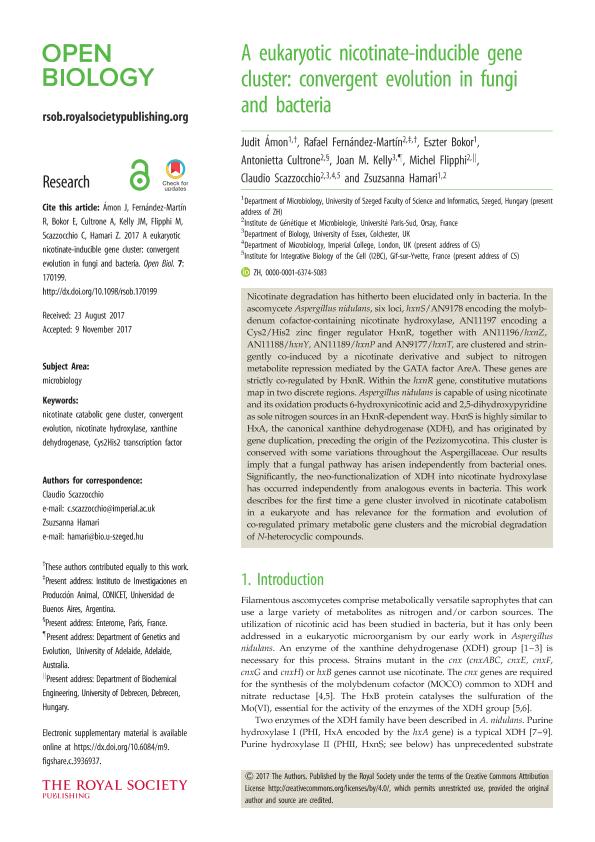
Nicotinate degradation has hitherto been elucidated only in bacteria. In the ascomycete Aspergillus nidulans, six loci, hxnS/AN9178 encoding the molybdenum cofactor-containing nicotinate hydroxylase, AN11197 encoding a Cys2/His2 zinc finger regulator HxnR, together with AN11196/hxnZ, AN11188/hxnY, AN11189/hxnP and AN9177/hxnT, are clustered and stringently co-induced by a nicotinate derivative and subject to nitrogen metabolite repression mediated by the GATA factor AreA. These genes are strictly co-regulated by HxnR. Within the hxnR gene, constitutive mutations map in two discrete regions. Aspergillus nidulans is capable of using nicotinate and its oxidation products 6-hydroxynicotinic acid and 2,5-dihydroxypyridine as sole nitrogen sources in an HxnR-dependent way. HxnS is highly similar to HxA, the canonical xanthine dehydrogenase (XDH), and has originated by gene duplication, preceding the origin of the Pezizomycotina. This cluster is conserved with some variations throughout the Aspergillaceae. Our results imply that a fungal pathway has arisen independently from bacterial ones. Significantly, the neo-functionalization of XDH into nicotinate hydroxylase has occurred independently from analogous events in bacteria. This work describes for the first time a gene cluster involved in nicotinate catabolism in a eukaryote and has relevance for the formation and evolution of co-regulated primary metabolic gene clusters and the microbial degradation of N-heterocyclic compounds.
Archivos asociados

Tamaño:
1.904Mb
Formato:
PDF
Licencia
 Excepto donde se diga explícitamente, este item se publica bajo la siguiente descripción:
Creative Commons Attribution-NonCommercial-ShareAlike 2.5 Unported (CC BY-NC-SA 2.5)
Excepto donde se diga explícitamente, este item se publica bajo la siguiente descripción:
Creative Commons Attribution-NonCommercial-ShareAlike 2.5 Unported (CC BY-NC-SA 2.5)
Identificadores
Colecciones
Articulos(INPA)
Articulos de UNIDAD EJECUTORA DE INVESTIGACIONES EN PRODUCCION ANIMAL
Articulos de UNIDAD EJECUTORA DE INVESTIGACIONES EN PRODUCCION ANIMAL
Citación
Ámon, Judit; Fernández y Martín, Rafael; Bokor, Eszter; Cultrone, Antonietta; Kelly, Joan M.; et al.; A eukaryotic nicotinate-inducible gene cluster: Convergent evolution in fungi and bacteria; Royal Society Publishing; Open Biology; 7; 12; 12-2017; 1-17
Compartir


Altmétricas