Artículo
Fasciola hepatica: Histological changes in the somatic and reproductive tissues of liver fluke following closantel treatment of experimentally-infected sheep

Fecha de publicación:
01/2016
Editorial:
Elsevier Science
Revista:
Veterinary Parasitology
ISSN:
0304-4017
Idioma:
Inglés
Tipo de recurso:
Artículo publicado
Clasificación temática:
Resumen
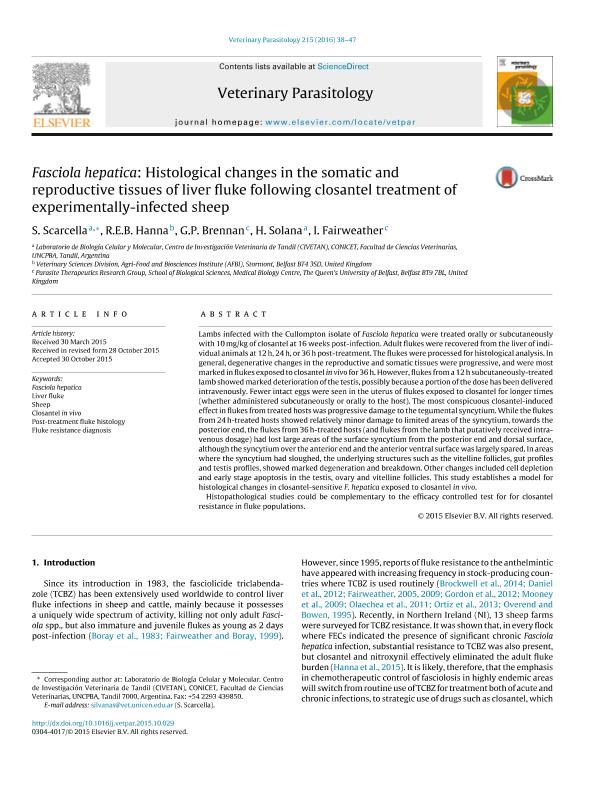
Lambs infected with the Cullompton isolate of Fasciola hepatica were treated orally or subcutaneously with 10 mg/kg of closantel at 16 weeks post-infection. Adult flukes were recovered from the liver of individual animals at 12 h, 24 h, or 36 h post-treatment. The flukes were processed for histological analysis. In general, degenerative changes in the reproductive and somatic tissues were progressive, and were most marked in flukes exposed to closantel in vivo for 36 h. However, flukes from a 12 h subcutaneously-treated lamb showed marked deterioration of the testis, possibly because a portion of the dose has been delivered intravenously. Fewer intact eggs were seen in the uterus of flukes exposed to closantel for longer times (whether administered subcutaneously or orally to the host). The most conspicuous closantel-induced effect in flukes from treated hosts was progressive damage to the tegumental syncytium. While the flukes from 24 h-treated hosts showed relatively minor damage to limited areas of the syncytium, towards the posterior end, the flukes from 36 h-treated hosts (and flukes from the lamb that putatively received intravenous dosage) had lost large areas of the surface syncytium from the posterior end and dorsal surface, although the syncytium over the anterior end and the anterior ventral surface was largely spared. In areas where the syncytium had sloughed, the underlying structures such as the vitelline follicles, gut profiles and testis profiles, showed marked degeneration and breakdown. Other changes included cell depletion and early stage apoptosis in the testis, ovary and vitelline follicles. This study establishes a model for histological changes in closantel-sensitive F. hepatica exposed to closantel in vivo.Histopathological studies could be complementary to the efficacy controlled test for for closantel resistance in fluke populations.
Archivos asociados

Tamaño:
3.885Mb
Formato:
PDF
Licencia
 Excepto donde se diga explícitamente, este item se publica bajo la siguiente descripción:
Atribución-NoComercial-SinDerivadas 2.5 Argentina (CC BY-NC-ND 2.5 AR)
Excepto donde se diga explícitamente, este item se publica bajo la siguiente descripción:
Atribución-NoComercial-SinDerivadas 2.5 Argentina (CC BY-NC-ND 2.5 AR)
Identificadores
Colecciones
Articulos(CIVETAN)
Articulos de CENTRO DE INVESTIGACION VETERINARIA DE TANDIL
Articulos de CENTRO DE INVESTIGACION VETERINARIA DE TANDIL
Citación
Scarcella, Silvana Andrea; Hanna, R. E. B.; Brennan, G. P.; Solana, Hugo Daniel; Fairweather, I.; Fasciola hepatica: Histological changes in the somatic and reproductive tissues of liver fluke following closantel treatment of experimentally-infected sheep; Elsevier Science; Veterinary Parasitology; 215; 1-2016; 38-47
Compartir


Altmétricas