Mostrar el registro sencillo del ítem
dc.contributor.author
Lertora Mendoza, Celina Ana
dc.date.available
2018-08-22T20:17:52Z
dc.date.issued
2015-06
dc.identifier.citation
Lertora Mendoza, Celina Ana; El método derivativo en la Escolástica: formas de disputatio y estrategias argumentativas; Universidad del Norte Santo Tomas de Aquino; Studium; 18; 35; 6-2015; 87-99
dc.identifier.issn
0329-8930
dc.identifier.uri
http://hdl.handle.net/11336/56726
dc.description.abstract
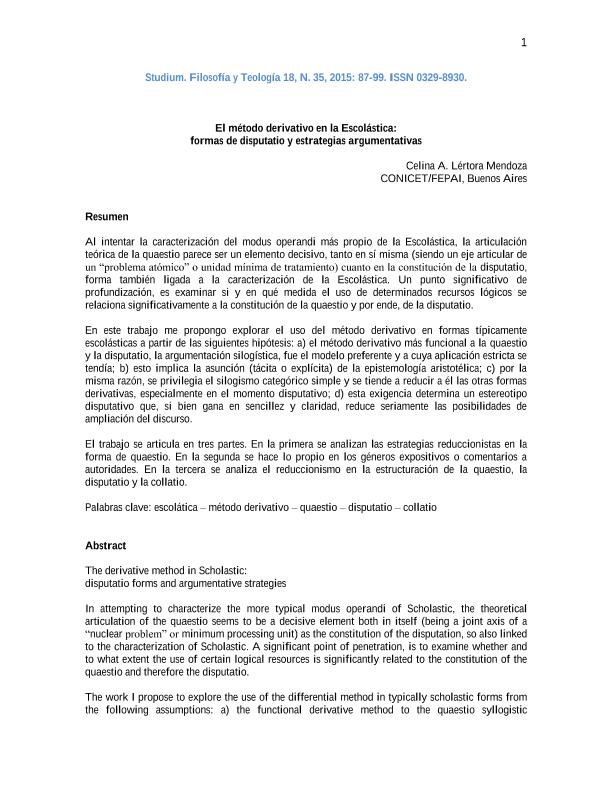
Al intentar la caracterización del modus operandi más propio de la Escolástica, la articulación teórica de la quaestio parece ser un elemento decisivo, tanto en sí misma (siendo un eje articular de un “problema atómico” o unidad mínima de tratamiento) cuanto en la constitución de la disputatio, forma también ligada a la caracterización de la Escolástica. Un punto significativo de profundización, es examinar si y en qué medida el uso de determinados recursos lógicos se relaciona significativamente a la constitución de la quaestio y por ende, de la disputatio. En este trabajo me propongo explorar el uso del método derivativo en formas típicamente escolásticas a partir de las siguientes hipótesis: a) el método derivativo más funcional a la quaestio y la disputatio, la argumentación silogística, fue el modelo preferente y a cuya aplicación estricta se tendía; b) esto implica la asunción (tácita o explícita) de la epistemología aristotélica; c) por la misma razón, se privilegia el silogismo categórico simple y se tiende a reducir a él las otras formas derivativas, especialmente en el momento disputativo; d) esta exigencia determina un estereotipo disputativo que, si bien gana en sencillez y claridad, reduce seriamente las posibilidades de ampliación del discurso. El trabajo se articula en tres partes. En la primera se analizan las estrategias reduccionistas en la forma de quaestio. En la segunda se hace lo propio en los géneros expositivos o comentarios a autoridades. En la tercera se analiza el reduccionismo en la estructuración de la quaestio, la disputatio y la collatio.
dc.description.abstract
In attempting to characterize the more typical modus operandi of Scholastic, the theoretical articulation of the quaestio seems to be a decisive element both in itself (being a joint axis of a “nuclear problem” or minimum processing unit) as the constitution of the disputation, so also linked to the characterization of Scholastic. A significant point of penetration, is to examine whether and to what extent the use of certain logical resources is significantly related to the constitution of the quaestio and therefore the disputatio. The work I propose to explore the use of the differential method in typically scholastic forms from the following assumptions: a) the functional derivative method to the quaestio syllogistic 2 disputation and argument, and was the preferred model tended rigorously enforced; b) this implies the assumption (implicit or explicit) of Aristotelian epistemology; c) for the same reason, the simple categorical syllogism is privileged and it tends to reduce other derivative forms, especially in the disputative time; d) This requirement determines a disputative stereotype that while gains in simplicity and clarity, severely limiting scalability of speech. The work is divided into three parts. In the first reductionist strategies are analyzed in the form of quaestio. The second does the same in expository genres or comments to authorities. In the third reductionism in structuring the quaestio, the disputatio and the collatio is analyzed.
dc.format
application/pdf
dc.language.iso
spa
dc.publisher
Universidad del Norte Santo Tomas de Aquino
dc.rights
info:eu-repo/semantics/openAccess
dc.rights.uri
https://creativecommons.org/licenses/by-nc-sa/2.5/ar/
dc.subject
Filosofia Medieval
dc.subject
Argumentacion Disputativa
dc.subject
Metodo Derivativo
dc.subject
Escolastica
dc.subject
Quaestio
dc.subject
Disputatio
dc.subject
Collatio
dc.subject.classification
Estudios Religiosos
dc.subject.classification
Filosofía, Ética y Religión
dc.subject.classification
HUMANIDADES
dc.title
El método derivativo en la Escolástica: formas de disputatio y estrategias argumentativas
dc.title
The derivative method in Scholastic:disputatio forms and argumentative strategies
dc.type
info:eu-repo/semantics/article
dc.type
info:ar-repo/semantics/artículo
dc.type
info:eu-repo/semantics/publishedVersion
dc.date.updated
2018-07-20T17:57:06Z
dc.journal.volume
18
dc.journal.number
35
dc.journal.pagination
87-99
dc.journal.pais
Argentina
dc.journal.ciudad
Tucumán
dc.description.fil
Fil: Lertora Mendoza, Celina Ana. Consejo Nacional de Investigaciones Científicas y Técnicas; Argentina. undación para el Estudio del Pensamiento Argentino e Iberoamericano; Argentina
dc.journal.title
Studium
dc.relation.alternativeid
info:eu-repo/semantics/altIdentifier/url/http://www.unsta.edu.ar/lertora-mendoza-celina-revista-studium/
Archivos asociados

Tamaño:
187.7Kb
Formato:
PDF