Artículo
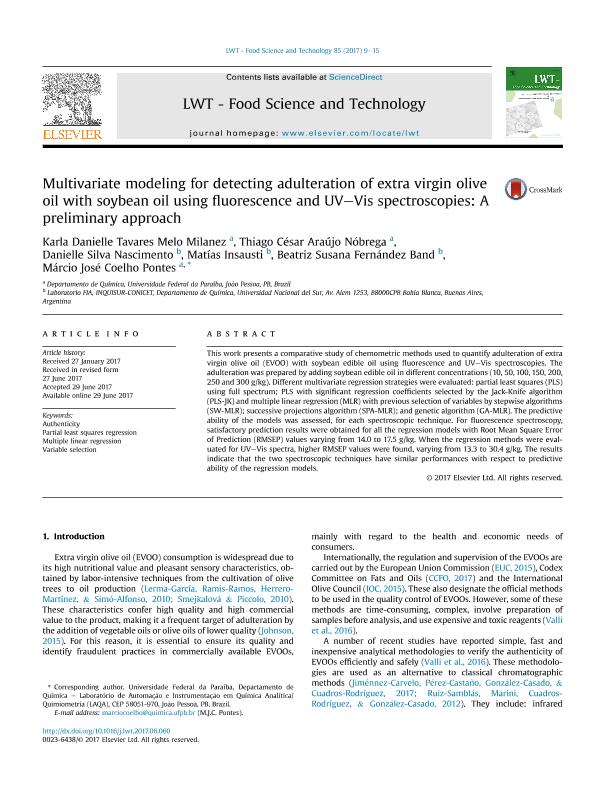
Multivariate modeling for detecting adulteration of extra virgin olive oil with soybean oil using fluorescence and UV–Vis spectroscopies: A preliminary approach
Melo Milanez, Karla Danielle Tavares de; Nóbrega, Thiago César Araújo; Silva Do Nascimento, Danielle ; Insausti, Matías
; Fernández Band, Beatriz Susana
; Pontes, Márcio José Coelho
; Insausti, Matías
; Fernández Band, Beatriz Susana
; Pontes, Márcio José Coelho
; Insausti, Matías
; Fernández Band, Beatriz Susana
; Pontes, Márcio José Coelho
Fecha de publicación:
11/2017
Editorial:
Elsevier Science
Revista:
LWT - Food Science and Technology
ISSN:
0023-6438
Idioma:
Inglés
Tipo de recurso:
Artículo publicado
Clasificación temática:
Resumen
This work presents a comparative study of chemometric methods used to quantify adulteration of extra virgin olive oil (EVOO) with soybean edible oil using fluorescence and UV–Vis spectroscopies. The adulteration was prepared by adding soybean edible oil in different concentrations (10, 50, 100, 150, 200, 250 and 300 g/kg). Different multivariate regression strategies were evaluated: partial least squares (PLS) using full spectrum; PLS with significant regression coefficients selected by the Jack-Knife algorithm (PLS-JK) and multiple linear regression (MLR) with previous selection of variables by stepwise algorithms (SW-MLR); successive projections algorithm (SPA-MLR); and genetic algorithm (GA-MLR). The predictive ability of the models was assessed, for each spectroscopic technique. For fluorescence spectroscopy, satisfactory prediction results were obtained for all the regression models with Root Mean Square Error of Prediction (RMSEP) values varying from 14.0 to 17.5 g/kg. When the regression methods were evaluated for UV–Vis spectra, higher RMSEP values were found, varying from 13.3 to 30.4 g/kg. The results indicate that the two spectroscopic techniques have similar performances with respect to predictive ability of the regression models.
Archivos asociados

Tamaño:
1.059Mb
Formato:
PDF
Licencia
 Excepto donde se diga explícitamente, este item se publica bajo la siguiente descripción:
Atribución-NoComercial-SinDerivadas 2.5 Argentina (CC BY-NC-ND 2.5 AR)
Excepto donde se diga explícitamente, este item se publica bajo la siguiente descripción:
Atribución-NoComercial-SinDerivadas 2.5 Argentina (CC BY-NC-ND 2.5 AR)
Identificadores
Colecciones
Articulos(INQUISUR)
Articulos de INST.DE QUIMICA DEL SUR
Articulos de INST.DE QUIMICA DEL SUR
Citación
Melo Milanez, Karla Danielle Tavares de; Nóbrega, Thiago César Araújo; Silva Do Nascimento, Danielle; Insausti, Matías; Fernández Band, Beatriz Susana; et al.; Multivariate modeling for detecting adulteration of extra virgin olive oil with soybean oil using fluorescence and UV–Vis spectroscopies: A preliminary approach; Elsevier Science; LWT - Food Science and Technology; 85; Parte A; 11-2017; 9-15
Compartir


Altmétricas