Artículo
Study on Single-bin Sliding DFT algorithms: Comparison, stability issues and frequency adaptivity

Fecha de publicación:
06/2015
Editorial:
Elsevier
Revista:
Measurement
ISSN:
0263-2241
Idioma:
Inglés
Tipo de recurso:
Artículo publicado
Clasificación temática:
Resumen
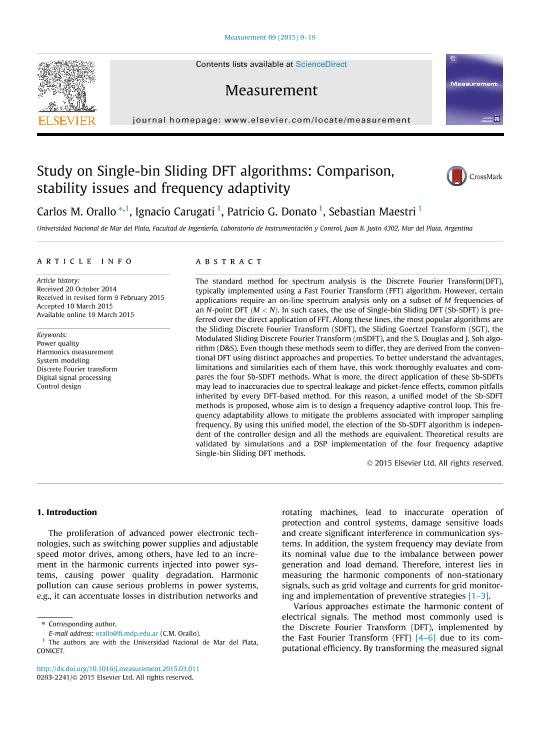
The standard method for spectrum analysis is the Discrete Fourier Transform(DFT), typically implemented using a Fast Fourier Transform (FFT) algorithm. However, certain applications require an on-line spectrum analysis only on a subset of M frequencies of an N-point DFT ðM < NÞ. In such cases, the use of Single-bin Sliding DFT (Sb-SDFT) is preferred over the direct application of FFT. Along these lines, the most popular algorithms are the Sliding Discrete Fourier Transform (SDFT), the Sliding Goertzel Transform (SGT), the Modulated Sliding Discrete Fourier Transform (mSDFT), and the S. Douglas and J. Soh algorithm (D&S). Even though these methods seem to differ, they are derived from the conventional DFT using distinct approaches and properties. To better understand the advantages, limitations and similarities each of them have, this work thoroughly evaluates and compares the four Sb-SDFT methods. What is more, the direct application of these Sb-SDFTs may lead to inaccuracies due to spectral leakage and picket-fence effects, common pitfalls inherited by every DFT-based method. For this reason, a unified model of the Sb-SDFT methods is proposed, whose aim is to design a frequency adaptive control loop. This frequency adaptability allows to mitigate the problems associated with improper sampling frequency. By using this unified model, the election of the Sb-SDFT algorithm is independent of the controller design and all the methods are equivalent. Theoretical results are validated by simulations and a DSP implementation of the four frequency adaptive Single-bin Sliding DFT methods.
Archivos asociados

Tamaño:
1.787Mb
Formato:
PDF
Licencia
 Excepto donde se diga explícitamente, este item se publica bajo la siguiente descripción:
Atribución-NoComercial-SinDerivadas 2.5 Argentina (CC BY-NC-ND 2.5 AR)
Excepto donde se diga explícitamente, este item se publica bajo la siguiente descripción:
Atribución-NoComercial-SinDerivadas 2.5 Argentina (CC BY-NC-ND 2.5 AR)
Identificadores
Colecciones
Articulos(CCT - MAR DEL PLATA)
Articulos de CTRO.CIENTIFICO TECNOL.CONICET - MAR DEL PLATA
Articulos de CTRO.CIENTIFICO TECNOL.CONICET - MAR DEL PLATA
Citación
Orallo, Carlos Martin; Carugati, Ignacio; Donato, Patricio Gabriel; Maestri, Sebastian Oscar; Study on Single-bin Sliding DFT algorithms: Comparison, stability issues and frequency adaptivity; Elsevier; Measurement; 69; 6-2015; 9-19
Compartir


Altmétricas