Artículo
Zebra alphaherpesviruses (EHV-1 and EHV-9): Genetic diversity, Latency and co-infections
Abdelgawad, Azza; Damiani, Armando Mario ; Ho, Simón Y. W.; Strauss, Gunter; Szentiks, Claudia A.; East, Marion L.; Osterrieder, Nikolaus; Alex Greenwood
; Ho, Simón Y. W.; Strauss, Gunter; Szentiks, Claudia A.; East, Marion L.; Osterrieder, Nikolaus; Alex Greenwood
Fecha de publicación:
09/2016
Editorial:
MDPI
Revista:
Viruses
ISSN:
1999-4915
Idioma:
Inglés
Tipo de recurso:
Artículo publicado
Clasificación temática:
Resumen
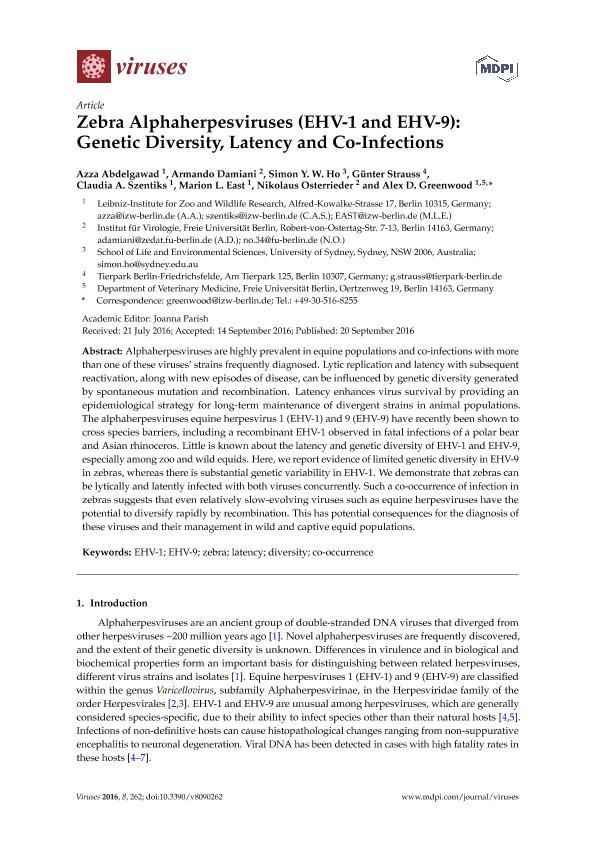
Alphaherpesviruses are highly prevalent in equine populations and co-infections with more than one of these viruses’ strains frequently diagnosed. Lytic replication and latency with subsequent reactivation, along with new episodes of disease, can be influenced by genetic diversity generated by spontaneous mutation and recombination. Latency enhances virus survival by providing an epidemiological strategy for long-term maintenance of divergent strains in animal populations. The alphaherpesviruses equine herpesvirus 1 (EHV-1) and 9 (EHV-9) have recently been shown to cross species barriers, including a recombinant EHV-1 observed in fatal infections of a polar bear and Asian rhinoceros. Little is known about the latency and genetic diversity of EHV-1 and EHV-9, especially among zoo and wild equids. Here, we report evidence of limited genetic diversity in EHV-9 in zebras, whereas there is substantial genetic variability in EHV-1. We demonstrate that zebras can be lytically and latently infected with both viruses concurrently. Such a co-occurrence of infection in zebras suggests that even relatively slow-evolving viruses such as equine herpesviruses have the potential to diversify rapidly by recombination. This has potential consequences for the diagnosis of these viruses and their management in wild and captive equid populations.
Palabras clave:
Co-Occurrence
,
Diversity
,
Ehv-1
,
Ehv-9
,
Latency
,
Zebra
Archivos asociados

Tamaño:
1.535Mb
Formato:
PDF
Licencia
 Excepto donde se diga explícitamente, este item se publica bajo la siguiente descripción:
Creative Commons Attribution-NonCommercial-ShareAlike 2.5 Unported (CC BY-NC-SA 2.5)
Excepto donde se diga explícitamente, este item se publica bajo la siguiente descripción:
Creative Commons Attribution-NonCommercial-ShareAlike 2.5 Unported (CC BY-NC-SA 2.5)
Identificadores
Colecciones
Articulos(IMBECU)
Articulos de INST. DE MEDICINA Y BIO. EXP. DE CUYO
Articulos de INST. DE MEDICINA Y BIO. EXP. DE CUYO
Citación
Abdelgawad, Azza; Damiani, Armando Mario; Ho, Simón Y. W.; Strauss, Gunter; Szentiks, Claudia A.; et al.; Zebra alphaherpesviruses (EHV-1 and EHV-9): Genetic diversity, Latency and co-infections; MDPI; Viruses; 8; 9; 9-2016; 1-13
Compartir


Altmétricas