Artículo
Extreme learning machines for reverse engineering of gene regulatory networks from expression time series

Fecha de publicación:
11/2017
Editorial:
Oxford University Press
Revista:
Bioinformatics (Oxford, England)
ISSN:
1367-4803
Idioma:
Inglés
Tipo de recurso:
Artículo publicado
Clasificación temática:
Resumen
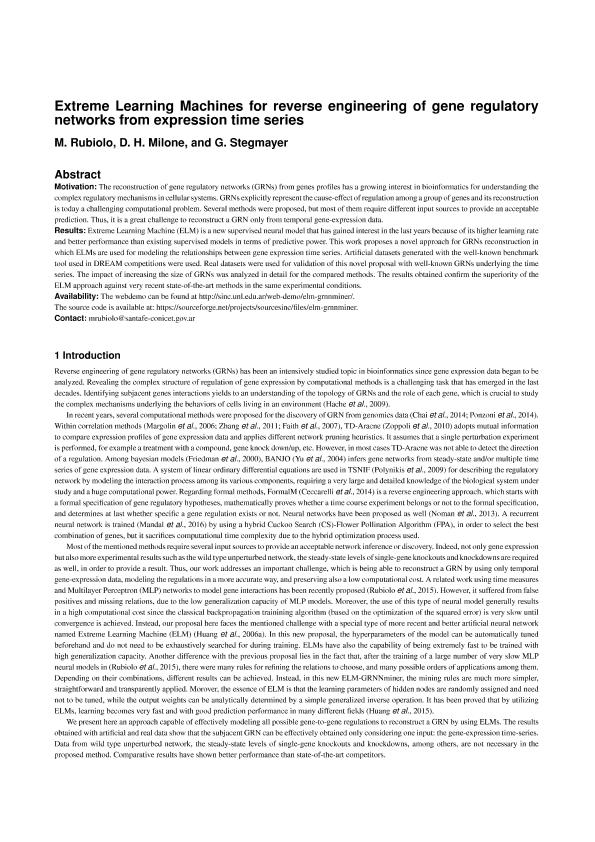
The reconstruction of gene regulatory networks (GRNs) from genes profiles has a growing interest in bioinformatics for understanding the complex regulatory mechanisms in cellular systems. GRNs explicitly represent the cause-effect of regulation among a group of genes and its reconstruction is today a challenging computational problem. Several methods were proposed, but most of them require different input sources to provide an acceptable prediction. Thus, it is a great challenge to reconstruct a GRN only from temporal gene-expression data. Results: Extreme Learning Machine (ELM) is a new supervised neural model that has gained interest in the last years because of its higher learning rate and better performance than existing supervised models in terms of predictive power. This work proposes a novel approach for GRNs reconstruction in which ELMs are used for modeling the relationships between gene expression time series. Artificial datasets generated with the well-known benchmark tool used in DREAM competitions were used. Real datasets were used for validation of this novel proposal with well-known GRNs underlying the time series. The impact of increasing the size of GRNs was analyzed in detail for the compared methods. The results obtained confirm the superiority of the ELM approach against very recent state-of-the-art methods in the same experimental conditions.<br />
Archivos asociados

Tamaño:
1.064Mb
Formato:
PDF
Licencia
 Excepto donde se diga explícitamente, este item se publica bajo la siguiente descripción:
Creative Commons Attribution-NonCommercial-ShareAlike 2.5 Unported (CC BY-NC-SA 2.5)
Excepto donde se diga explícitamente, este item se publica bajo la siguiente descripción:
Creative Commons Attribution-NonCommercial-ShareAlike 2.5 Unported (CC BY-NC-SA 2.5)
Identificadores
Colecciones
Articulos(SINC(I))
Articulos de INST. DE INVESTIGACION EN SEÑALES, SISTEMAS E INTELIGENCIA COMPUTACIONAL
Articulos de INST. DE INVESTIGACION EN SEÑALES, SISTEMAS E INTELIGENCIA COMPUTACIONAL
Citación
Rubiolo, Mariano; Milone, Diego Humberto; Stegmayer, Georgina; Extreme learning machines for reverse engineering of gene regulatory networks from expression time series; Oxford University Press; Bioinformatics (Oxford, England); 34; 7; 11-2017; 1253-1260
Compartir


Altmétricas