Artículo
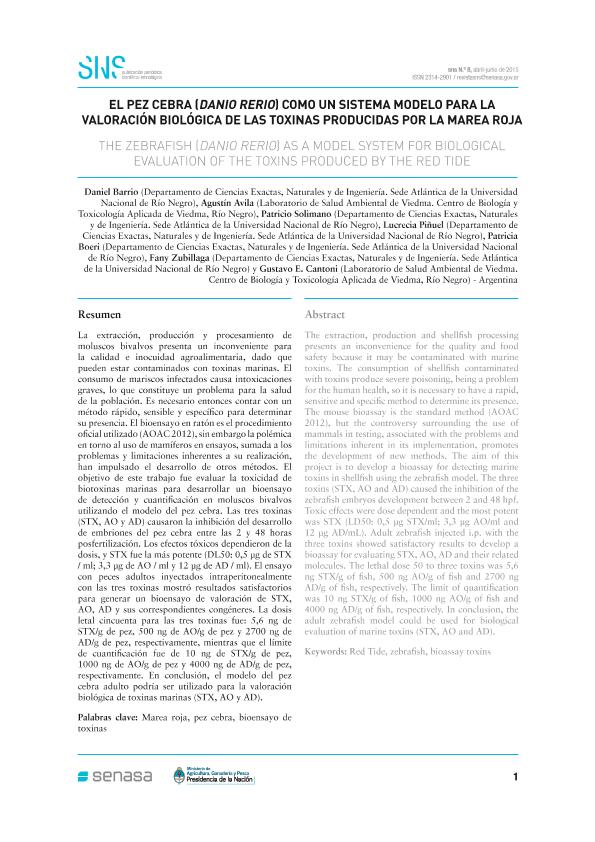
La extracción, producción y procesamiento de moluscos bivalvos presenta un inconveniente para la calidad e inocuidad agroalimentaria, dado que pueden estar contaminados con toxinas marinas. El consumo de mariscos infectados causa intoxicaciones graves, lo que constituye un problema para la salud de la población. Es necesario entonces contar con un método rápido, sensible y específico para determinar su presencia. El bioensayo en ratón es el procedimiento oficial utilizado (AOAC 2012), sin embargo la polémica en torno al uso de mamíferos en ensayos, sumada a los problemas y limitaciones inherentes a su realización, han impulsado el desarrollo de otros métodos. El objetivo de este trabajo fue evaluar la toxicidad de biotoxinas marinas para desarrollar un bioensayo de detección y cuantificación en moluscos bivalvos utilizando el modelo del pez cebra. Las tres toxinas (STX, AO y AD) causaron la inhibición del desarrollo de embriones del pez cebra entre las 2 y 48 horas posfertilización. Los efectos tóxicos dependieron de la dosis, y STX fue la más potente (DL50: 0,5 µg de STX / ml; 3,3 µg de AO / ml y 12 µg de AD / ml). El ensayo con peces adultos inyectados intraperitonealmente con las tres toxinas mostró resultados satisfactorios para generar un bioensayo de valoración de STX, AO, AD y sus correspondientes congéneres. La dosis letal cincuenta para las tres toxinas fue: 5,6 ng de STX/g de pez, 500 ng de AO/g de pez y 2700 ng de AD/g de pez, respectivamente, mientras que el límite de cuantificación fue de 10 ng de STX/g de pez, 1000 ng de AO/g de pez y 4000 ng de AD/g de pez, respectivamente. En conclusión, el modelo del pez cebra adulto podría ser utilizado para la valoración biológica de toxinas marinas (STX, AO y AD). The extraction, production and shellfish processing presents an inconvenience for the quality and food safety because it may be contaminated with marine toxins. The consumption of shellfish contaminated with toxins produce severe poisoning, being a problem for the human health, so it is necessary to have a rapid, sensitive and specific method to determine its presence. The mouse bioassay is the standard method (AOAC 2012), but the controversy surrounding the use of mammals in testing, associated with the problems and limitations inherent in its implementation, promotes the development of new methods. The aim of this project is to develop a bioassay for detecting marine toxins in shellfish using the zebrafish model. The three toxins (STX, AO and AD) caused the inhibition of the zebrafish embryos development between 2 and 48 hpf. Toxic effects were dose dependent and the most potent was STX (LD50: 0,5 µg STX/ml; 3,3 µg AO/ml and 12 µg AD/mL). Adult zebrafish injected i.p. with the three toxins showed satisfactory results to develop a bioassay for evaluating STX, AO, AD and their related molecules. The lethal dose 50 to three toxins was 5,6 ng STX/g of fish, 500 ng AO/g of fish and 2700 ng AD/g of fish, respectively. The limit of quantification was 10 ng STX/g of fish, 1000 ng AO/g of fish and 4000 ng AD/g of fish, respectively. In conclusion, the adult zebrafish model could be used for biological evaluation of marine toxins (STX, AO and AD).
El pez cebra (Danio rerio) como un sistema modelo para la valoración biológica de las toxinas producidas por la marea roja
Título:
The zebrafish (Danio rerio) as a model system for biological evaluation of the toxins produced by the red tide
Barrio, Daniel Alejandro ; Avila Maniero, Alejo Agustin; Solimano, Patricio José
; Piñuel, Maria Lucrecia
; Boeri, Patricia; Zubillaga, Maria Fany
; Cantoni, Gustavo E.
; Avila Maniero, Alejo Agustin; Solimano, Patricio José
; Piñuel, Maria Lucrecia
; Boeri, Patricia; Zubillaga, Maria Fany
; Cantoni, Gustavo E.
; Avila Maniero, Alejo Agustin; Solimano, Patricio José
; Piñuel, Maria Lucrecia
; Boeri, Patricia; Zubillaga, Maria Fany
; Cantoni, Gustavo E.
Fecha de publicación:
06/2015
Editorial:
Servicio Nacional de Sanidad y Calidad Agroalimentaria
Revista:
SNS
ISSN:
2314-2901
Idioma:
Español
Tipo de recurso:
Artículo publicado
Clasificación temática:
Resumen
Palabras clave:
Pez Cebra
,
Marea Roja
,
Bioensayo
,
Toxinas
Archivos asociados

Tamaño:
1.099Mb
Formato:
PDF
Licencia
 Excepto donde se diga explícitamente, este item se publica bajo la siguiente descripción:
Creative Commons Attribution-NonCommercial-ShareAlike 2.5 Unported (CC BY-NC-SA 2.5)
Excepto donde se diga explícitamente, este item se publica bajo la siguiente descripción:
Creative Commons Attribution-NonCommercial-ShareAlike 2.5 Unported (CC BY-NC-SA 2.5)
Identificadores
Colecciones
Articulos(CCT - PATAGONIA NORTE)
Articulos de CTRO.CIENTIFICO TECNOL.CONICET - PATAGONIA NORTE
Articulos de CTRO.CIENTIFICO TECNOL.CONICET - PATAGONIA NORTE
Citación
Barrio, Daniel Alejandro; Avila Maniero, Alejo Agustin; Solimano, Patricio José; Piñuel, Maria Lucrecia; Boeri, Patricia; et al.; El pez cebra (Danio rerio) como un sistema modelo para la valoración biológica de las toxinas producidas por la marea roja; Servicio Nacional de Sanidad y Calidad Agroalimentaria; SNS; 1; 8; 6-2015; 1-9
Compartir

