Artículo
Neuropsychological performance and affective temperaments in Euthymic patients with bipolar disorder type II
Romero, Ester; Holtzman, Jessica N.; Tannenhaus, Lucila; Monchablon, Romina; Rago, Carlo Mario; Lolich, Maria ; Vázquez, Gustavo H.
; Vázquez, Gustavo H.
Fecha de publicación:
04/2016
Editorial:
Elsevier Ireland
Revista:
Psychiatry Research
ISSN:
0165-1781
Idioma:
Inglés
Tipo de recurso:
Artículo publicado
Clasificación temática:
Resumen
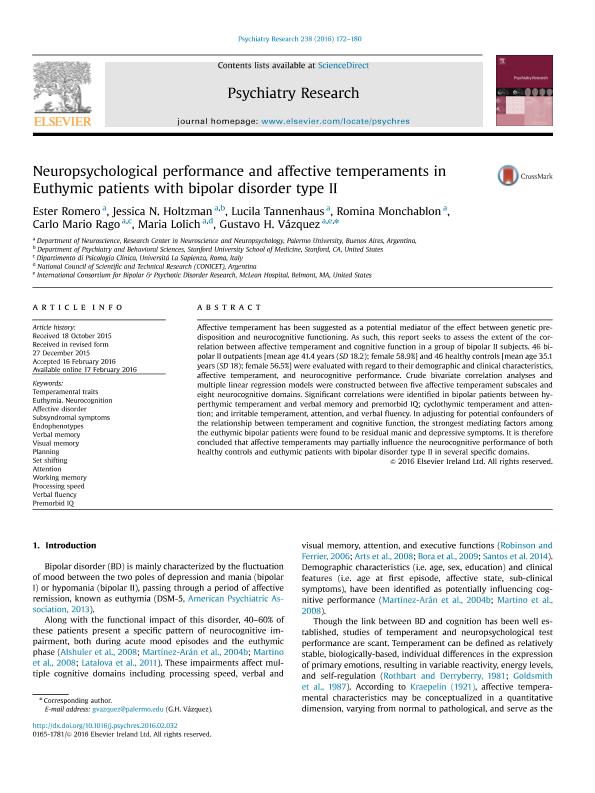
Affective temperament has been suggested as a potential mediator of the effect between genetic predisposition and neurocognitive functioning. As such, this report seeks to assess the extent of the correlation between affective temperament and cognitive function in a group of bipolar II subjects. 46 bipolar II outpatients [mean age 41.4 years (SD 18.2); female 58.9%] and 46 healthy controls [mean age 35.1 years (SD 18); female 56.5%] were evaluated with regard to their demographic and clinical characteristics, affective temperament, and neurocognitive performance. Crude bivariate correlation analyses and multiple linear regression models were constructed between five affective temperament subscales and eight neurocognitive domains. Significant correlations were identified in bipolar patients between hyperthymic temperament and verbal memory and premorbid IQ; cyclothymic temperament and attention; and irritable temperament, attention, and verbal fluency. In adjusting for potential confounders of the relationship between temperament and cognitive function, the strongest mediating factors among the euthymic bipolar patients were found to be residual manic and depressive symptoms. It is therefore concluded that affective temperaments may partially influence the neurocognitive performance of both healthy controls and euthymic patients with bipolar disorder type II in several specific domains.
Archivos asociados

Tamaño:
740.2Kb
Formato:
PDF
Licencia
 Excepto donde se diga explícitamente, este item se publica bajo la siguiente descripción:
Creative Commons Attribution-NonCommercial-ShareAlike 2.5 Unported (CC BY-NC-SA 2.5)
Excepto donde se diga explícitamente, este item se publica bajo la siguiente descripción:
Creative Commons Attribution-NonCommercial-ShareAlike 2.5 Unported (CC BY-NC-SA 2.5)
Identificadores
Colecciones
Articulos(SEDE CENTRAL)
Articulos de SEDE CENTRAL
Articulos de SEDE CENTRAL
Citación
Romero, Ester; Holtzman, Jessica N.; Tannenhaus, Lucila; Monchablon, Romina; Rago, Carlo Mario; et al.; Neuropsychological performance and affective temperaments in Euthymic patients with bipolar disorder type II; Elsevier Ireland; Psychiatry Research; 238; 4-2016; 172-180
Compartir


Altmétricas