Artículo
Effects of Conservation Method and Time on Fatty Acid Composition, Taste, and Microstructure of Southern King Crab (Lithodes santolla Molina, 1782) Meat

Fecha de publicación:
07/2017
Editorial:
Haworth Press Inc
Revista:
Journal of Aquatic Food Product Technology
ISSN:
1049-8850
Idioma:
Inglés
Tipo de recurso:
Artículo publicado
Clasificación temática:
Resumen
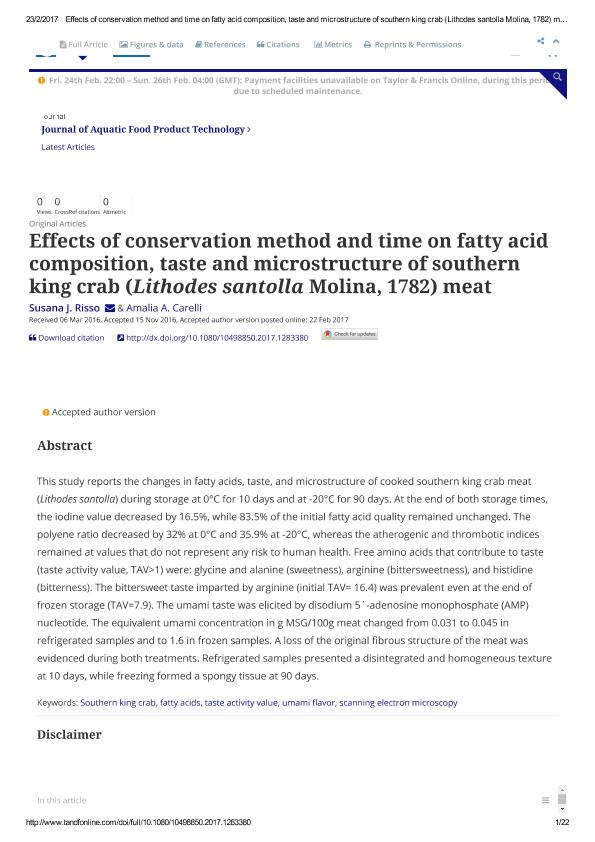
This study reports the changes in fatty acids, taste, and microstructure of cooked southern king crab meat (Lithodes santolla) during storage at 0°C for 10 days and at −20°C for 90 days. At the end of both storage times, the iodine value decreased by 16.5%, while 83.5% of the initial fatty acid quality remained unchanged. The polyene ratio decreased by 32% at 0°C and 35.9% at −20°C, whereas the atherogenic and thrombotic indices remained at values that do not represent any risk to human health. Free amino acids that contribute to taste (taste activity value, TAV > 1) were: glycine and alanine (sweetness), arginine (bittersweetness), and histidine (bitterness). The bittersweet taste imparted by arginine (initial TAV = 16.4) was prevalent even at the end of frozen storage (TAV = 7.9). The umami taste was elicited by disodium 5′-adenosine monophosphate (AMP) nucleotide. The equivalent umami concentration in g MSG/100 g meat changed from 0.031 to 0.045 in refrigerated samples and to 1.6 in frozen samples. A loss of the original fibrous structure of the meat was evidenced during both treatments. Refrigerated samples presented a disintegrated and homogeneous texture at 10 days, while freezing formed a spongy tissue at 90 days.
Archivos asociados

Tamaño:
435.0Kb
Formato:
PDF
Licencia
 Excepto donde se diga explícitamente, este item se publica bajo la siguiente descripción:
Creative Commons Attribution-NonCommercial-ShareAlike 2.5 Unported (CC BY-NC-SA 2.5)
Excepto donde se diga explícitamente, este item se publica bajo la siguiente descripción:
Creative Commons Attribution-NonCommercial-ShareAlike 2.5 Unported (CC BY-NC-SA 2.5)
Identificadores
Colecciones
Articulos(PLAPIQUI)
Articulos de PLANTA PILOTO DE INGENIERIA QUIMICA (I)
Articulos de PLANTA PILOTO DE INGENIERIA QUIMICA (I)
Citación
Risso, Susana Josefina; Carelli Albarracin, Amalia Antonia; Effects of Conservation Method and Time on Fatty Acid Composition, Taste, and Microstructure of Southern King Crab (Lithodes santolla Molina, 1782) Meat; Haworth Press Inc; Journal of Aquatic Food Product Technology; 26; 6; 7-2017; 731-743
Compartir


Altmétricas