Artículo
Genetically engineered Pseudomonas: a factory of new bioplastics with broad applications
Olivera, Elías R.; Carnicero, David; Jodra, Ruth; Miñambres, Baltasar; Garcia, Belén; Abraham, Gustavo Abel ; Gallardo, Alberto; San Roman, Julio; García, José; Naharro, Germán; Luengo, José M.
; Gallardo, Alberto; San Roman, Julio; García, José; Naharro, Germán; Luengo, José M.
Fecha de publicación:
07/07/2008
Editorial:
Wiley Blackwell Publishing, Inc
Revista:
Environmental Microbiology
ISSN:
1462-2912
Idioma:
Inglés
Tipo de recurso:
Artículo publicado
Clasificación temática:
Resumen
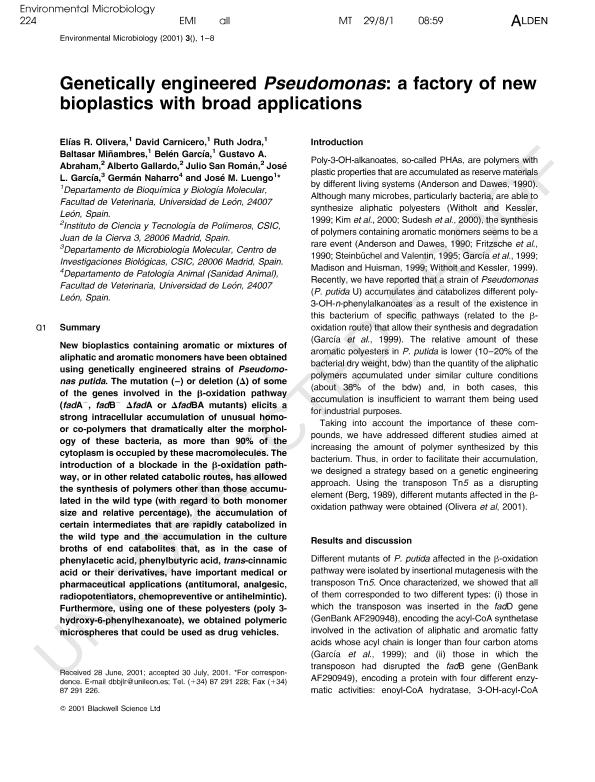
New bioplastics containing aromatic or mixtures of aliphatic and aromatic monomers have been obtained using genetically engineered strains of Pseudomonas putida. The mutation (–) or deletion (Δ) of some of the genes involved in the β-oxidation pathway (fadA−, fadB−ΔfadA or Δfad BA mutants) elicits a strong intracellular accumulation of unusual homo- or co-polymers that dramatically alter the morphology of these bacteria, as more than 90% of the cytoplasm is occupied by these macromolecules. The introduction of a blockade in the β-oxidation pathway, or in other related catabolic routes, has allowed the synthesis of polymers other than those accumulated in the wild type (with regard to both monomer size and relative percentage), the accumulation of certain intermediates that are rapidly catabolized in the wild type and the accumulation in the culture broths of end catabolites that, as in the case of phenylacetic acid, phenylbutyric acid, trans-cinnamic acid or their derivatives, have important medical or pharmaceutical applications (antitumoral, analgesic, radiopotentiators, chemopreventive or antihelmintic). Furthermore, using one of these polyesters (poly 3-hydroxy-6-phenylhexanoate), we obtained polymeric microspheres that could be used as drug vehicles.
Archivos asociados

Tamaño:
703.0Kb
Formato:
PDF
Licencia
 Excepto donde se diga explícitamente, este item se publica bajo la siguiente descripción:
Creative Commons Attribution-NonCommercial-ShareAlike 2.5 Unported (CC BY-NC-SA 2.5)
Excepto donde se diga explícitamente, este item se publica bajo la siguiente descripción:
Creative Commons Attribution-NonCommercial-ShareAlike 2.5 Unported (CC BY-NC-SA 2.5)
Identificadores
Colecciones
Articulos(INTEMA)
Articulos de INST.DE INV.EN CIENCIA Y TECNOL.MATERIALES (I)
Articulos de INST.DE INV.EN CIENCIA Y TECNOL.MATERIALES (I)
Citación
Olivera, Elías R.; Carnicero, David; Jodra, Ruth; Miñambres, Baltasar; Garcia, Belén; et al.; Genetically engineered Pseudomonas: a factory of new bioplastics with broad applications; Wiley Blackwell Publishing, Inc; Environmental Microbiology; 3; 10; 7-7-2008; 612-618
Compartir


Altmétricas