Artículo
Surface pauses in relation to dive duration in imperial cormorants; how much time for a breather?

Fecha de publicación:
2004
Editorial:
Company of Biologists
Revista:
Journal of Experimental Biology
ISSN:
0022-0949
Idioma:
Inglés
Tipo de recurso:
Artículo publicado
Clasificación temática:
Resumen
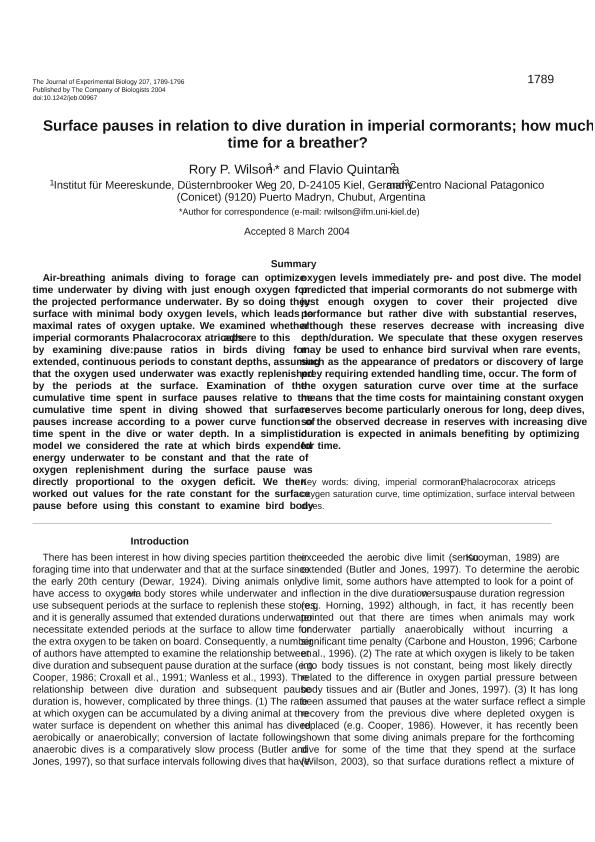
Air-breathing animals diving to forage can optimize time underwater by diving with just enough oxygen for the projected performance underwater. By so doing they surface with minimal body oxygen levels, which leads to maximal rates of oxygen uptake. We examined whether imperial cormorants Phalacrocorax atriceps adhere to this by examining dive: pause ratios in birds diving for extended, continuous periods to constant depths, assuming that the oxygen used underwater was exactly replenished by the periods at the surface. Examination of the cumulative time spent in surface pauses relative to the cumulative time spent in diving showed that surface pauses increase according to a power curve function of time spent in the dive or water depth. In a simplistic model we considered the rate at which birds expended energy underwater to be constant and that the rate of oxygen replenishment during the surface pause was directly proportional to the oxygen deficit. We then worked out values for the rate constant for the surface pause before using this constant to examine bird body oxygen levels immediately pre- and post dive. The model predicted that imperial cormorants do not submerge with just enough oxygen to cover their projected dive performance but rather dive with substantial reserves, although these reserves decrease with increasing dive depth/duration. We speculate that these oxygen reserves may be used to enhance bird survival when rare events, such as the appearance of predators or discovery of large prey requiring extended handling time, occur. The form of the oxygen saturation curve over time at the surface means that the time costs for maintaining constant oxygen reserves become particularly onerous for long, deep dives, so the observed decrease in reserves with increasing dive duration is expected in animals benefiting by optimizing for time
Archivos asociados

Tamaño:
595.6Kb
Formato:
PDF
Licencia
 Excepto donde se diga explícitamente, este item se publica bajo la siguiente descripción:
Creative Commons Attribution-NonCommercial-ShareAlike 2.5 Unported (CC BY-NC-SA 2.5)
Excepto donde se diga explícitamente, este item se publica bajo la siguiente descripción:
Creative Commons Attribution-NonCommercial-ShareAlike 2.5 Unported (CC BY-NC-SA 2.5)
Identificadores
Colecciones
Articulos(CCT-CENPAT)
Articulos de CTRO.CIENTIFICO TECNOL.CONICET - CENPAT
Articulos de CTRO.CIENTIFICO TECNOL.CONICET - CENPAT
Citación
Wilson, Rory P.; Quintana, Flavio Roberto; Surface pauses in relation to dive duration in imperial cormorants; how much time for a breather?; Company of Biologists; Journal of Experimental Biology; 207; 2004; 1789-1796
Compartir


Altmétricas