Mostrar el registro sencillo del ítem
dc.contributor.author
Ragone Figueroa, Cinthia Judith
dc.contributor.author
Plionis, M.
dc.contributor.author
Merchan, Manuel Enrique
dc.contributor.author
Gottlöber, S.
dc.contributor.author
Yepes, G.
dc.date.available
2025-12-09T14:54:02Z
dc.date.issued
2010-09
dc.identifier.citation
Ragone Figueroa, Cinthia Judith; Plionis, M.; Merchan, Manuel Enrique; Gottlöber, S.; Yepes, G.; The relation between halo shape, velocity dispersion and formation time; Wiley Blackwell Publishing, Inc; Monthly Notices of the Royal Astronomical Society; 407; 1; 9-2010; 581-589
dc.identifier.issn
0035-8711
dc.identifier.uri
http://hdl.handle.net/11336/277184
dc.description.abstract
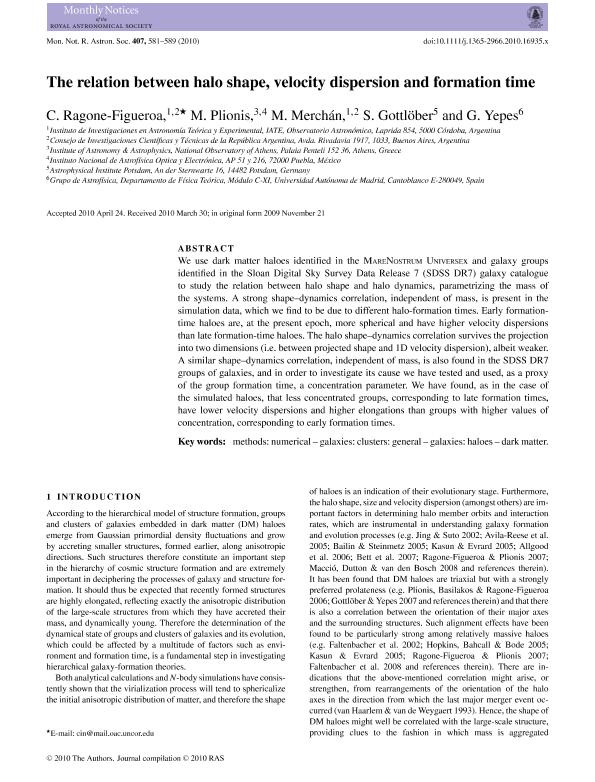
We use dark matter haloes identified in the MareNostrum Universe and galaxy groups identified in the Sloan Data Release 7 galaxy catalogue, to study the relation between halo shape and halo dynamics, parametrizing out the mass of the systems. A strong shape-dynamics, independent of mass, correlation is present in the simulation data, which we find it to be due to different halo formation times. Early formation time haloes are, at the present epoch, more spherical and have higher velocity dispersions than late forming-timehaloes. The halo shape-dynamics correlation, albeit weaker, survives the projection in 2D (ie., among projected shape and 1-D velocity dispersion). A similar shape-dynamics correlation, independent of mass, is also found in the SDSS DR7 groups of galaxies and in order to investigate its cause we have tested and used, as a proxy of the group formation time, a concentration parameter. We have found, as in the case of the simulated haloes, that less concentrated groups, corresponding to late formation times, have lower velocity dispersions and higher elongations than groups with higher values of concentration,corresponding to early formation times.
dc.format
application/pdf
dc.language.iso
eng
dc.publisher
Wiley Blackwell Publishing, Inc
dc.rights
info:eu-repo/semantics/openAccess
dc.rights.uri
https://creativecommons.org/licenses/by-nc-sa/2.5/ar/
dc.subject
GALAXIES: CLUSTERS: GENERAL
dc.subject
GALAXIES: HALOES
dc.subject
COSMOLOGY: DARK MATTER
dc.subject
METHODS: N-BODY SIMULATIONS
dc.subject.classification
Astronomía
dc.subject.classification
Ciencias Físicas
dc.subject.classification
CIENCIAS NATURALES Y EXACTAS
dc.title
The relation between halo shape, velocity dispersion and formation time
dc.type
info:eu-repo/semantics/article
dc.type
info:ar-repo/semantics/artículo
dc.type
info:eu-repo/semantics/publishedVersion
dc.date.updated
2025-12-09T13:53:19Z
dc.journal.volume
407
dc.journal.number
1
dc.journal.pagination
581-589
dc.journal.pais
Reino Unido
dc.journal.ciudad
Londres
dc.description.fil
Fil: Ragone Figueroa, Cinthia Judith. Consejo Nacional de Investigaciones Científicas y Técnicas. Centro Científico Tecnológico Conicet - Córdoba. Instituto de Astronomía Teórica y Experimental. Universidad Nacional de Córdoba. Observatorio Astronómico de Córdoba. Instituto de Astronomía Teórica y Experimental; Argentina
dc.description.fil
Fil: Plionis, M.. Instituto Nacional de Astrofísica Óptica y Electrónica; México
dc.description.fil
Fil: Merchan, Manuel Enrique. Consejo Nacional de Investigaciones Científicas y Técnicas. Centro Científico Tecnológico Conicet - Córdoba. Instituto de Astronomía Teórica y Experimental. Universidad Nacional de Córdoba. Observatorio Astronómico de Córdoba. Instituto de Astronomía Teórica y Experimental; Argentina
dc.description.fil
Fil: Gottlöber, S.. No especifíca;
dc.description.fil
Fil: Yepes, G.. Universidad Autónoma de Madrid; España
dc.journal.title
Monthly Notices of the Royal Astronomical Society
dc.relation.alternativeid
info:eu-repo/semantics/altIdentifier/url/https://academic.oup.com/mnras/article/407/1/581/986146
dc.relation.alternativeid
info:eu-repo/semantics/altIdentifier/doi/http://dx.doi.org/10.1111/j.1365-2966.2010.16935.x
Archivos asociados

Tamaño:
771.6Kb
Formato:
PDF