Artículo
The relation between halo shape, velocity dispersion and formation time

Fecha de publicación:
09/2010
Editorial:
Wiley Blackwell Publishing, Inc
Revista:
Monthly Notices of the Royal Astronomical Society
ISSN:
0035-8711
Idioma:
Inglés
Tipo de recurso:
Artículo publicado
Clasificación temática:
Resumen
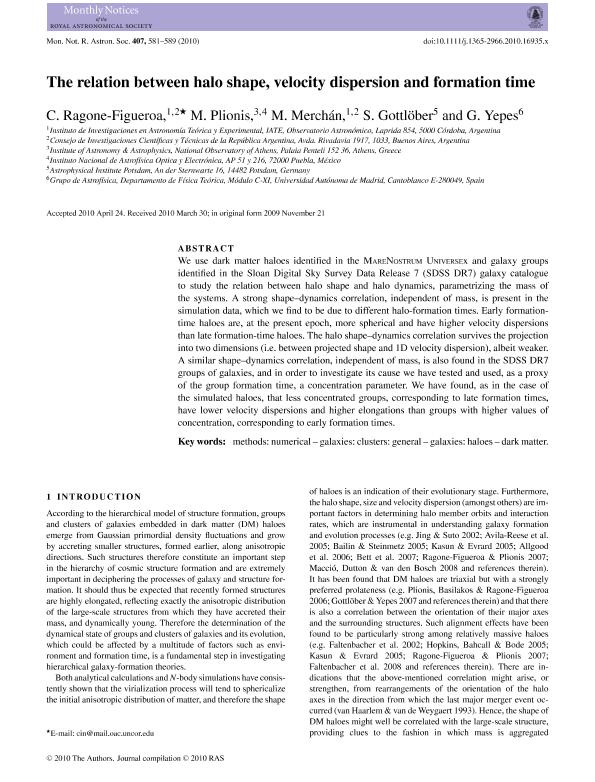
We use dark matter haloes identified in the MareNostrum Universe and galaxy groups identified in the Sloan Data Release 7 galaxy catalogue, to study the relation between halo shape and halo dynamics, parametrizing out the mass of the systems. A strong shape-dynamics, independent of mass, correlation is present in the simulation data, which we find it to be due to different halo formation times. Early formation time haloes are, at the present epoch, more spherical and have higher velocity dispersions than late forming-timehaloes. The halo shape-dynamics correlation, albeit weaker, survives the projection in 2D (ie., among projected shape and 1-D velocity dispersion). A similar shape-dynamics correlation, independent of mass, is also found in the SDSS DR7 groups of galaxies and in order to investigate its cause we have tested and used, as a proxy of the group formation time, a concentration parameter. We have found, as in the case of the simulated haloes, that less concentrated groups, corresponding to late formation times, have lower velocity dispersions and higher elongations than groups with higher values of concentration,corresponding to early formation times.
Archivos asociados

Tamaño:
771.6Kb
Formato:
PDF
Licencia
 Excepto donde se diga explícitamente, este item se publica bajo la siguiente descripción:
Creative Commons Attribution-NonCommercial-ShareAlike 2.5 Unported (CC BY-NC-SA 2.5)
Excepto donde se diga explícitamente, este item se publica bajo la siguiente descripción:
Creative Commons Attribution-NonCommercial-ShareAlike 2.5 Unported (CC BY-NC-SA 2.5)
Identificadores
Colecciones
Articulos(IATE)
Articulos de INST.DE ASTRONOMIA TEORICA Y EXPERIMENTAL
Articulos de INST.DE ASTRONOMIA TEORICA Y EXPERIMENTAL
Citación
Ragone Figueroa, Cinthia Judith; Plionis, M.; Merchan, Manuel Enrique; Gottlöber, S.; Yepes, G.; The relation between halo shape, velocity dispersion and formation time; Wiley Blackwell Publishing, Inc; Monthly Notices of the Royal Astronomical Society; 407; 1; 9-2010; 581-589
Compartir


Altmétricas