Artículo
Studying Rare Movement Disorders: From Whole-Exome Sequencing to New Diagnostic and Therapeutic Approaches in a Modern Genetic Clinic
Marsili, Luca; Duque, Kevin R.; Abanto, Jesus; Chinchihualpa Paredes, Nathaly O.; Duker, Andrew P.; Collins, Kathleen; Miranda, Marcelo; Bustamante, M. Leonor; Pauciulo, Michael; Dixon, Michael; Chaib, Hassan; Perez Maturo, Josefina ; Hill, Emily J.; Espay, Alberto J.; Kauffman, Marcelo Andres
; Hill, Emily J.; Espay, Alberto J.; Kauffman, Marcelo Andres
Fecha de publicación:
11/2024
Editorial:
Multidisciplinary Digital Publishing Institute
Revista:
Biomedicines
e-ISSN:
2227-9059
Idioma:
Inglés
Tipo de recurso:
Artículo publicado
Clasificación temática:
Resumen
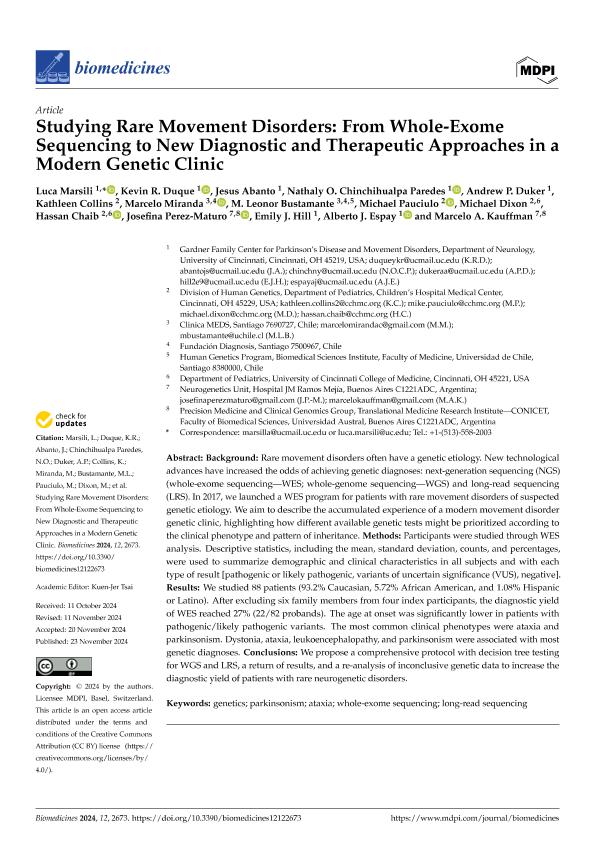
Background: Rare movement disorders often have a genetic etiology. New technological advances have increased the odds of achieving genetic diagnoses: next-generation sequencing (NGS) (whole-exome sequencing—WES; whole-genome sequencing—WGS) and long-read sequencing (LRS). In 2017, we launched a WES program for patients with rare movement disorders of suspected genetic etiology. We aim to describe the accumulated experience of a modern movement disorder genetic clinic, highlighting how different available genetic tests might be prioritized according to the clinical phenotype and pattern of inheritance. Methods: Participants were studied through WES analysis. Descriptive statistics, including the mean, standard deviation, counts, and percentages, were used to summarize demographic and clinical characteristics in all subjects and with each type of result [pathogenic or likely pathogenic, variants of uncertain significance (VUS), negative]. Results: We studied 88 patients (93.2% Caucasian, 5.72% African American, and 1.08% Hispanic or Latino). After excluding six family members from four index participants, the diagnostic yield of WES reached 27% (22/82 probands). The age at onset was significantly lower in patients with pathogenic/likely pathogenic variants. The most common clinical phenotypes were ataxia and parkinsonism. Dystonia, ataxia, leukoencephalopathy, and parkinsonism were associated with most genetic diagnoses. Conclusions: We propose a comprehensive protocol with decision tree testing for WGS and LRS, a return of results, and a re-analysis of inconclusive genetic data to increase the diagnostic yield of patients with rare neurogenetic disorders.
Palabras clave:
Movement disorders
,
Genomics
Archivos asociados

Tamaño:
990.1Kb
Formato:
PDF
Licencia
 Excepto donde se diga explícitamente, este item se publica bajo la siguiente descripción:
Creative Commons Attribution 2.5 Unported (CC BY 2.5)
Excepto donde se diga explícitamente, este item se publica bajo la siguiente descripción:
Creative Commons Attribution 2.5 Unported (CC BY 2.5)
Identificadores
Colecciones
Articulos(IIMT)
Articulos de INSTITUTO DE INVESTIGACIONES EN MEDICINA TRASLACIONAL
Articulos de INSTITUTO DE INVESTIGACIONES EN MEDICINA TRASLACIONAL
Citación
Marsili, Luca; Duque, Kevin R.; Abanto, Jesus; Chinchihualpa Paredes, Nathaly O.; Duker, Andrew P.; et al.; Studying Rare Movement Disorders: From Whole-Exome Sequencing to New Diagnostic and Therapeutic Approaches in a Modern Genetic Clinic; Multidisciplinary Digital Publishing Institute; Biomedicines; 12; 12; 11-2024; 1-13
Compartir


Altmétricas