Evento
Design of a real-time PCR tool to study cell wall stress in fungi
Da Cruz Cabral, Lucía Mariana ; Delgado, J.; Andrade, M.J.; Patriarca, Andrea Rosana
; Asensio, M.A.; Rodrigueiro, Marcela
; Delgado, J.; Andrade, M.J.; Patriarca, Andrea Rosana
; Asensio, M.A.; Rodrigueiro, Marcela
; Delgado, J.; Andrade, M.J.; Patriarca, Andrea Rosana
; Asensio, M.A.; Rodrigueiro, Marcela
Tipo del evento:
Congreso
Nombre del evento:
FEMS2017: 7th Congress of European Microbiologists
Fecha del evento:
09/07/2017
Institución Organizadora:
Federation of European Microbiological Societies;
Título del Libro:
FEMS 2017: Astract book
Editorial:
Federation of European Microbiological Societies
Idioma:
Inglés
Clasificación temática:
Resumen
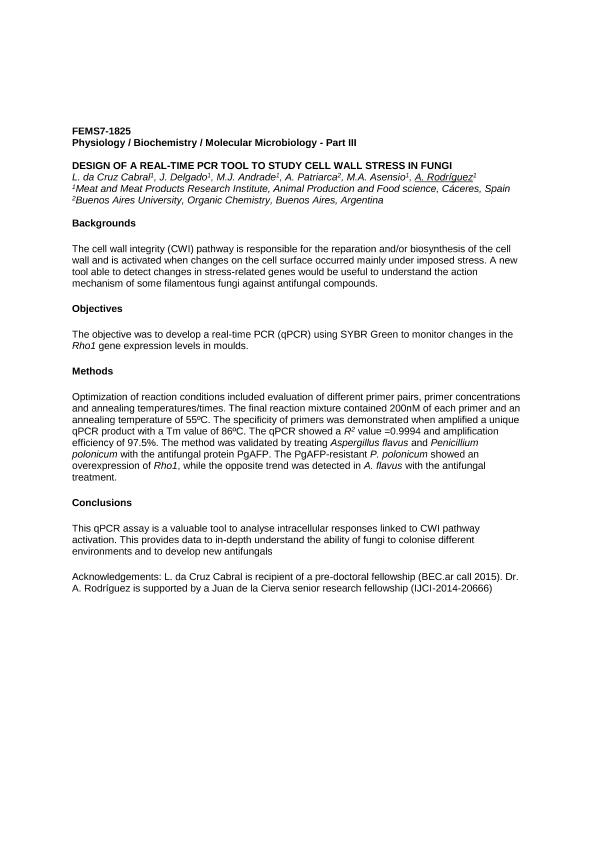
The cell wall integrity (CWI) pathway is responsible forthe reparation and/or biosynthesis of the cell wall and is activated whenchanges on the cell surface occurred mainly under imposed stress. A new toolable to detect changes in stress-related genes would be useful to understandthe action mechanism of some filamentous fungi against antifungal compounds. Theobjective was to develop a real-time PCR (qPCR) using SYBR Green to monitor changesin the Rho1 gene expression levels inmoulds. Optimization of reaction conditions includedevaluation of different primer pairs, primer concentrations and annealing temperatures/times.The final reaction mixture contained 200nM of each primer and an annealingtemperature of 55ºC. The specificity of primers was demonstrated when amplifieda unique qPCR product with a Tm value of 86ºC. The qPCR showed a R2 value =0.9994 and amplificationefficiency of 97.5%. The method was validated by treating Aspergillus flavus and Penicilliumpolonicum with the antifungal protein PgAFP. The PgAFP-resistant P. polonicum showed an overexpression ofRho1, while the opposite trend wasdetected in A. flavus with theantifungal treatment. This qPCR assay is a valuable tool to analyseintracellular responses linked to CWI pathway activation. This provides data toin-depth understand the ability of fungi to colonise different environments andto develop new antifungals.
Archivos asociados

Tamaño:
8.359Kb
Formato:
PDF
Licencia
 Excepto donde se diga explícitamente, este item se publica bajo la siguiente descripción:
Creative Commons Attribution-NonCommercial-ShareAlike 2.5 Unported (CC BY-NC-SA 2.5)
Excepto donde se diga explícitamente, este item se publica bajo la siguiente descripción:
Creative Commons Attribution-NonCommercial-ShareAlike 2.5 Unported (CC BY-NC-SA 2.5)
Identificadores
Colecciones
Eventos(INMIBO (EX - PROPLAME))
Eventos de INSTITUTO DE MICOLOGIA Y BOTANICA
Eventos de INSTITUTO DE MICOLOGIA Y BOTANICA
Citación
Design of a real-time PCR tool to study cell wall stress in fungi; FEMS2017: 7th Congress of European Microbiologists; Valencia; España; 2017; 1-1
Compartir

