Mostrar el registro sencillo del ítem
dc.contributor.author
Doná, Florencia
dc.contributor.author
Lorenz, Virginia
dc.contributor.author
Stegmayer, Georgina
dc.contributor.author
Ricardo, Tamara
dc.contributor.author
D'iorio, Stefanía
dc.contributor.author
Ponzo, Fernando Rodolfo
dc.contributor.author
Repetti, María Rosa
dc.contributor.author
Demonte, Luisina Delma
dc.contributor.author
Milesi, Maria Mercedes
dc.contributor.author
Varayoud, Jorgelina Guadalupe
dc.date.available
2025-11-07T14:02:51Z
dc.date.issued
2025-05
dc.identifier.citation
Doná, Florencia; Lorenz, Virginia; Stegmayer, Georgina; Ricardo, Tamara; D'iorio, Stefanía; et al.; Residential proximity to agricultural fields, urinary glyphosate levels and breast cancer risk: a case-control study in Argentina; Frontiers Media; Frontiers in Toxicology; 7; 5-2025; 1-15
dc.identifier.issn
2673-3080
dc.identifier.uri
http://hdl.handle.net/11336/275147
dc.description.abstract
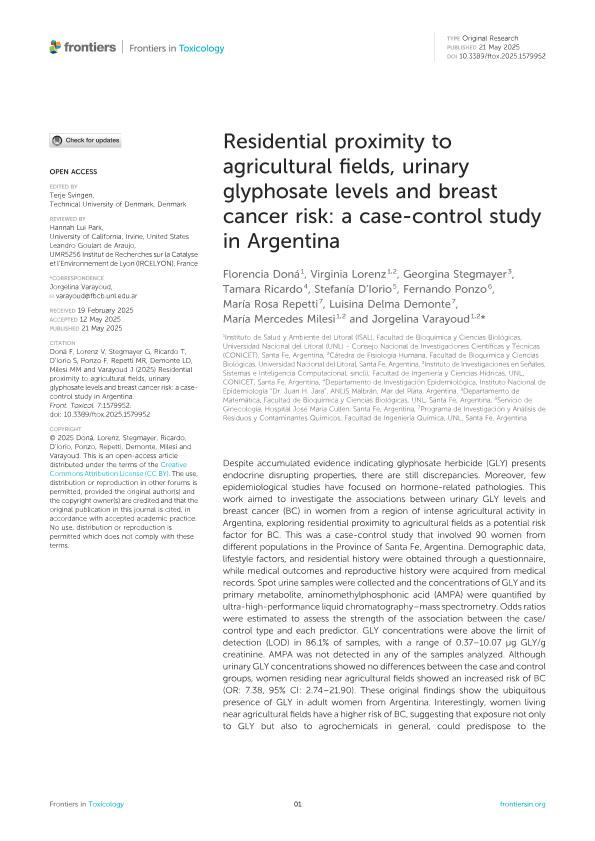
Despite accumulated evidence indicating glyphosate herbicide (GLY) presents endocrine disrupting properties, there are still discrepancies. Moreover, few epidemiological studies have focused on hormone-related pathologies. This work aimed to investigate the associations between urinary GLY levels and breast cancer (BC) in women from a region of intense agricultural activity in Argentina, exploring residential proximity to agricultural fields as a potential risk factor for BC. This was a case-control study that involved 90 women from different populations in the Province of Santa Fe, Argentina. Demographic data, lifestyle factors, and residential history were obtained through a questionnaire, while medical outcomes and reproductive history were acquired from medical records. Spot urine samples were collected and the concentrations of GLY and its primary metabolite, aminomethylphosphonic acid (AMPA) were quantified by ultra-high-performance liquid chromatography–mass spectrometry. Odds ratios were estimated to assess the strength of the association between the case/control type and each predictor. GLY concentrations were above the limit of detection (LOD) in 86.1% of samples, with a range of 0.37–10.07 µg GLY/g creatinine. AMPA was not detected in any of the samples analyzed. Although urinary GLY concentrations showed no differences between the case and control groups, women residing near agricultural fields showed an increased risk of BC (OR: 7.38, 95% CI: 2.74–21.90). These original findings show the ubiquitous presence of GLY in adult women from Argentina. Interestingly, women living near agricultural fields have a higher risk of BC, suggesting that exposure not only to GLY but also to agrochemicals in general, could predispose to the development of BC in Argentina. While this study provides valuable insights, further and broader assessments of BC distribution in relation to agrochemical exposure acroos different regions of Argentina are needed.
dc.format
application/pdf
dc.language.iso
eng
dc.publisher
Frontiers Media
dc.rights
info:eu-repo/semantics/openAccess
dc.rights.uri
https://creativecommons.org/licenses/by-nc-sa/2.5/ar/
dc.subject
unsupervised model
dc.subject
machine learning
dc.subject.classification
Ciencias de la Información y Bioinformática
dc.subject.classification
Ciencias de la Computación e Información
dc.subject.classification
CIENCIAS NATURALES Y EXACTAS
dc.title
Residential proximity to agricultural fields, urinary glyphosate levels and breast cancer risk: a case-control study in Argentina
dc.type
info:eu-repo/semantics/article
dc.type
info:ar-repo/semantics/artículo
dc.type
info:eu-repo/semantics/publishedVersion
dc.date.updated
2025-11-06T14:23:03Z
dc.journal.volume
7
dc.journal.pagination
1-15
dc.journal.pais
Suiza
dc.description.fil
Fil: Doná, Florencia. Consejo Nacional de Investigaciones Científicas y Técnicas. Centro Científico Tecnológico Conicet - Santa Fe. Instituto de Salud y Ambiente del Litoral. Universidad Nacional del Litoral. Instituto de Salud y Ambiente del Litoral; Argentina
dc.description.fil
Fil: Lorenz, Virginia. Consejo Nacional de Investigaciones Científicas y Técnicas. Centro Científico Tecnológico Conicet - Santa Fe. Instituto de Salud y Ambiente del Litoral. Universidad Nacional del Litoral. Instituto de Salud y Ambiente del Litoral; Argentina
dc.description.fil
Fil: Stegmayer, Georgina. Consejo Nacional de Investigaciones Científicas y Técnicas. Centro Científico Tecnológico Conicet - Santa Fe. Instituto de Investigación en Señales, Sistemas e Inteligencia Computacional. Universidad Nacional del Litoral. Facultad de Ingeniería y Ciencias Hídricas. Instituto de Investigación en Señales, Sistemas e Inteligencia Computacional; Argentina
dc.description.fil
Fil: Ricardo, Tamara. Dirección Nacional del Instituto de Investigación. Administración Nacional de Laboratorio e Instituto de Salud "Dr.C.G.Malbran". Instituto Nacional de Epidemiologia; Argentina. Consejo Nacional de Investigaciones Científicas y Técnicas; Argentina
dc.description.fil
Fil: D'iorio, Stefanía. Universidad Nacional del Litoral. Facultad de Bioquimica y Ciencias Biologicas. Departamento de Matematicas; Argentina
dc.description.fil
Fil: Ponzo, Fernando Rodolfo. Provincia de Santa Fe. Ministerio de Salud. Hospital "Dr. José María Cullen"; Argentina
dc.description.fil
Fil: Repetti, María Rosa. Universidad Nacional del Litoral. Facultad de Ingeniería Química; Argentina
dc.description.fil
Fil: Demonte, Luisina Delma. Universidad Nacional del Litoral. Facultad de Ingeniería Química; Argentina. Consejo Nacional de Investigaciones Científicas y Técnicas; Argentina
dc.description.fil
Fil: Milesi, Maria Mercedes. Consejo Nacional de Investigaciones Científicas y Técnicas. Centro Científico Tecnológico Conicet - Santa Fe. Instituto de Salud y Ambiente del Litoral. Universidad Nacional del Litoral. Instituto de Salud y Ambiente del Litoral; Argentina
dc.description.fil
Fil: Varayoud, Jorgelina Guadalupe. Consejo Nacional de Investigaciones Científicas y Técnicas. Centro Científico Tecnológico Conicet - Santa Fe. Instituto de Salud y Ambiente del Litoral. Universidad Nacional del Litoral. Instituto de Salud y Ambiente del Litoral; Argentina
dc.journal.title
Frontiers in Toxicology
dc.relation.alternativeid
info:eu-repo/semantics/altIdentifier/url/https://www.frontiersin.org/journals/toxicology/articles/10.3389/ftox.2025.1579952/full
dc.relation.alternativeid
info:eu-repo/semantics/altIdentifier/doi/http://dx.doi.org/10.3389/ftox.2025.1579952
Archivos asociados

Tamaño:
2.024Mb
Formato:
PDF