Artículo
Residential proximity to agricultural fields, urinary glyphosate levels and breast cancer risk: a case-control study in Argentina
Doná, Florencia; Lorenz, Virginia ; Stegmayer, Georgina
; Ricardo, Tamara
; D'iorio, Stefanía; Ponzo, Fernando Rodolfo; Repetti, María Rosa; Demonte, Luisina Delma
; Milesi, Maria Mercedes
; Varayoud, Jorgelina Guadalupe
; Stegmayer, Georgina
; Ricardo, Tamara
; D'iorio, Stefanía; Ponzo, Fernando Rodolfo; Repetti, María Rosa; Demonte, Luisina Delma
; Milesi, Maria Mercedes
; Varayoud, Jorgelina Guadalupe
; Stegmayer, Georgina
; Ricardo, Tamara
; D'iorio, Stefanía; Ponzo, Fernando Rodolfo; Repetti, María Rosa; Demonte, Luisina Delma
; Milesi, Maria Mercedes
; Varayoud, Jorgelina Guadalupe
Fecha de publicación:
05/2025
Editorial:
Frontiers Media
Revista:
Frontiers in Toxicology
ISSN:
2673-3080
Idioma:
Inglés
Tipo de recurso:
Artículo publicado
Clasificación temática:
Resumen
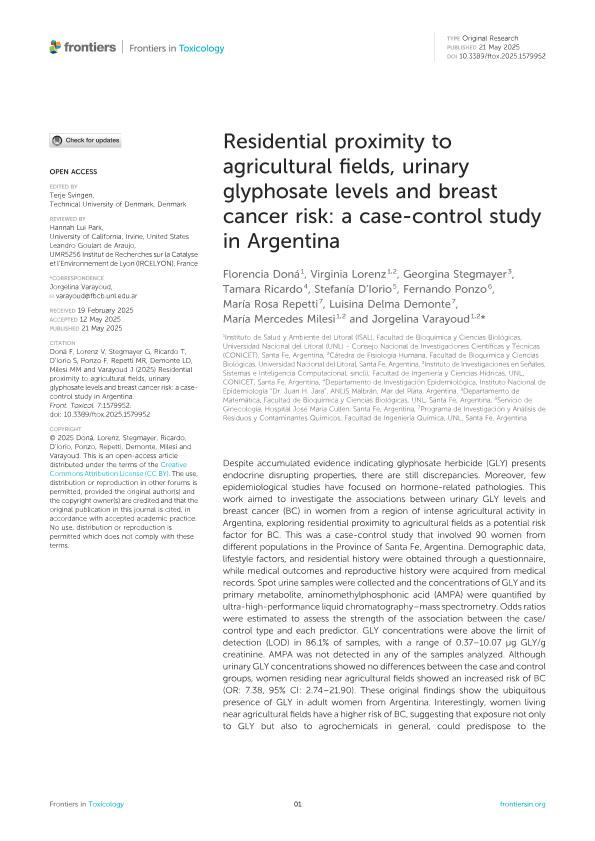
Despite accumulated evidence indicating glyphosate herbicide (GLY) presents endocrine disrupting properties, there are still discrepancies. Moreover, few epidemiological studies have focused on hormone-related pathologies. This work aimed to investigate the associations between urinary GLY levels and breast cancer (BC) in women from a region of intense agricultural activity in Argentina, exploring residential proximity to agricultural fields as a potential risk factor for BC. This was a case-control study that involved 90 women from different populations in the Province of Santa Fe, Argentina. Demographic data, lifestyle factors, and residential history were obtained through a questionnaire, while medical outcomes and reproductive history were acquired from medical records. Spot urine samples were collected and the concentrations of GLY and its primary metabolite, aminomethylphosphonic acid (AMPA) were quantified by ultra-high-performance liquid chromatography–mass spectrometry. Odds ratios were estimated to assess the strength of the association between the case/control type and each predictor. GLY concentrations were above the limit of detection (LOD) in 86.1% of samples, with a range of 0.37–10.07 µg GLY/g creatinine. AMPA was not detected in any of the samples analyzed. Although urinary GLY concentrations showed no differences between the case and control groups, women residing near agricultural fields showed an increased risk of BC (OR: 7.38, 95% CI: 2.74–21.90). These original findings show the ubiquitous presence of GLY in adult women from Argentina. Interestingly, women living near agricultural fields have a higher risk of BC, suggesting that exposure not only to GLY but also to agrochemicals in general, could predispose to the development of BC in Argentina. While this study provides valuable insights, further and broader assessments of BC distribution in relation to agrochemical exposure acroos different regions of Argentina are needed.
Palabras clave:
unsupervised model
,
machine learning
Archivos asociados

Tamaño:
2.024Mb
Formato:
PDF
Licencia
 Excepto donde se diga explícitamente, este item se publica bajo la siguiente descripción:
Creative Commons Attribution-NonCommercial-ShareAlike 2.5 Unported (CC BY-NC-SA 2.5)
Excepto donde se diga explícitamente, este item se publica bajo la siguiente descripción:
Creative Commons Attribution-NonCommercial-ShareAlike 2.5 Unported (CC BY-NC-SA 2.5)
Identificadores
Colecciones
Articulos(ISAL)
Articulos de INSTITUTO DE SALUD Y AMBIENTE DEL LITORAL
Articulos de INSTITUTO DE SALUD Y AMBIENTE DEL LITORAL
Articulos(SINC(I))
Articulos de INST. DE INVESTIGACION EN SEÑALES, SISTEMAS E INTELIGENCIA COMPUTACIONAL
Articulos de INST. DE INVESTIGACION EN SEÑALES, SISTEMAS E INTELIGENCIA COMPUTACIONAL
Citación
Doná, Florencia; Lorenz, Virginia; Stegmayer, Georgina; Ricardo, Tamara; D'iorio, Stefanía; et al.; Residential proximity to agricultural fields, urinary glyphosate levels and breast cancer risk: a case-control study in Argentina; Frontiers Media; Frontiers in Toxicology; 7; 5-2025; 1-15
Compartir


Altmétricas