Artículo
Haemorheological variables as a rheumatoid arthritis activity indicator
Luquita, A.; Urli, L.; Dominighini, A.; Svetaz, M. J.; Gennaro, Ana Maria ; Volpintesta, R.; Palatnik, S.; Rasia, M.
; Volpintesta, R.; Palatnik, S.; Rasia, M.
Fecha de publicación:
12/2004
Editorial:
IOS Press
Revista:
Clinical Hemorheology And Microcirculation
ISSN:
1386-0291
Idioma:
Inglés
Tipo de recurso:
Artículo publicado
Clasificación temática:
Resumen
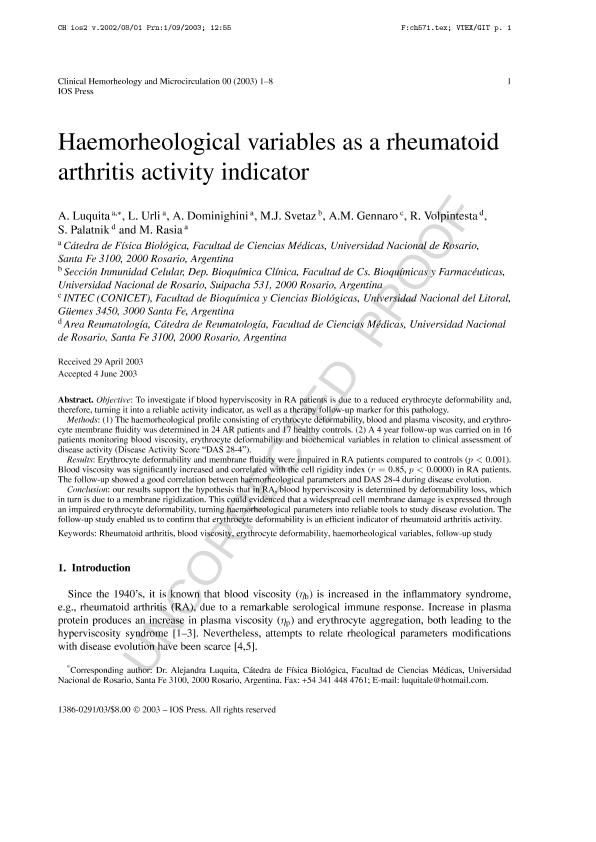
Objective: To investigate if blood hyperviscosity in RA patients is due to a reduced erythrocyte deformability and, therefore, turning it into a reliable activity indicator, as well as a therapy follow-up marker for this pathology. Methods: (1) The haemorheological profile consisting of erythrocyte deformability, blood and plasma viscosity, and erythrocyte membrane fluidity was determined in 24 AR patients and 17 healthy controls. (2) A 4 year follow-up was carried on in 16 patients monitoring blood viscosity, erythrocyte deformability and biochemical variables in relation to clinical assessment of disease activity (Disease Activity Score “DAS 28-4”). Results: Erythrocyte deformability and membrane fluidity were impaired in RA patients compared to controls (p<0.001). Blood viscosity was significantly increased and correlated with the cell rigidity index (r=0.85, p<0.0000) in RA patients. The follow-up showed a good correlation between haemorheological parameters and DAS 28-4 during disease evolution. Conclusion: our results support the hypothesis that in RA, blood hyperviscosity is determined by deformability loss, which in turn is due to a membrane rigidization. This could evidenced that a widespread cell membrane damage is expressed through an impaired erythrocyte deformability, turning haemorheological parameters into reliable tools to study disease evolution. The follow-up study enabled us to confirm that erythrocyte deformability is an efficient indicator of rheumatoid arthritis activity.
Archivos asociados

Tamaño:
121.6Kb
Formato:
PDF
Licencia
 Excepto donde se diga explícitamente, este item se publica bajo la siguiente descripción:
Creative Commons Attribution-NonCommercial-ShareAlike 2.5 Unported (CC BY-NC-SA 2.5)
Excepto donde se diga explícitamente, este item se publica bajo la siguiente descripción:
Creative Commons Attribution-NonCommercial-ShareAlike 2.5 Unported (CC BY-NC-SA 2.5)
Identificadores
Colecciones
Articulos(INTEC)
Articulos de INST.DE DES.TECNOL.PARA LA IND.QUIMICA (I)
Articulos de INST.DE DES.TECNOL.PARA LA IND.QUIMICA (I)
Citación
Luquita, A.; Urli, L.; Dominighini, A.; Svetaz, M. J.; Gennaro, Ana Maria; et al.; Haemorheological variables as a rheumatoid arthritis activity indicator; IOS Press; Clinical Hemorheology And Microcirculation; 30; 1; 12-2004; 9-16
Compartir

