Artículo
Boosting total electron content forecasting based on deep learning toward an operational service
Molina, Maria Graciela ; Namour, Jorge Habib; Cesaroni, Claudio; Spogli, Luca; Argüelles, Noelia Beatriz
; Asamoah, Eric N.
; Namour, Jorge Habib; Cesaroni, Claudio; Spogli, Luca; Argüelles, Noelia Beatriz
; Asamoah, Eric N.
; Namour, Jorge Habib; Cesaroni, Claudio; Spogli, Luca; Argüelles, Noelia Beatriz
; Asamoah, Eric N.
Fecha de publicación:
03/2025
Editorial:
Elsevier
Revista:
Journal of Atmospheric and Solar-Terrestrial Physics
ISSN:
1364-6826
Idioma:
Inglés
Tipo de recurso:
Artículo publicado
Clasificación temática:
Resumen
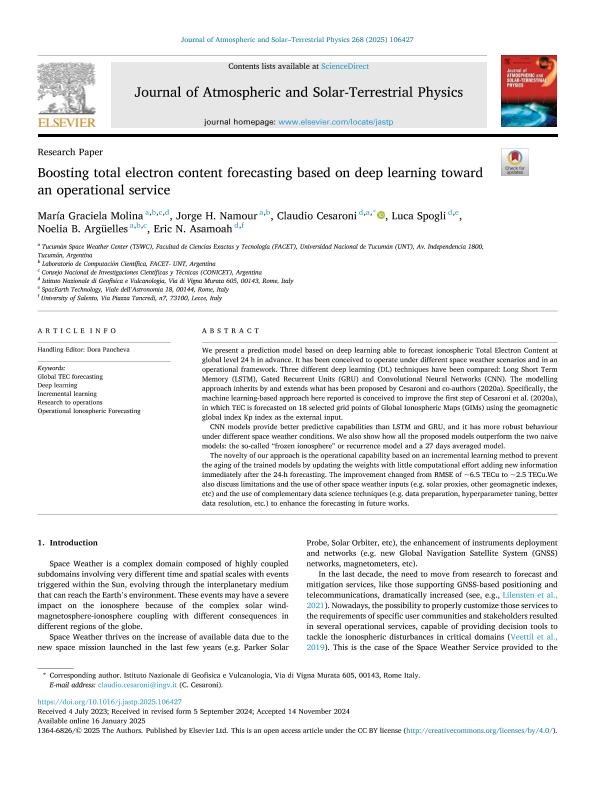
We present a prediction model based on deep learning able to forecast ionospheric Total Electron Content at global level 24 h in advance. It has been conceived to operate under different space weather scenarios and in an operational framework. Three different deep learning (DL) techniques have been compared: Long Short Term Memory (LSTM), Gated Recurrent Units (GRU) and Convolutional Neural Networks (CNN). The modelling approach inherits by and extends what has been proposed by Cesaroni and co-authors (2020a). Specifically, the machine learning-based approach here reported is conceived to improve the first step of Cesaroni et al. (2020a), in which TEC is forecasted on 18 selected grid points of Global Ionospheric Maps (GIMs) using the geomagnetic global index Kp index as the external input.CNN models provide better predictive capabilities than LSTM and GRU, and it has more robust behaviour under different space weather conditions. We also show how all the proposed models outperform the two naive models: the so-called “frozen ionosphere” or recurrence model and a 27 days averaged model.The novelty of our approach is the operational capability based on an incremental learning method to prevent the aging of the trained models by updating the weights with little computational effort adding new information immediately after the 24-h forecasting. The improvement changed from RMSE of ∼6.5 TECu to ∼2.5 TECu.We also discuss limitations and the use of other space weather inputs (e.g. solar proxies, other geomagnetic indexes, etc) and the use of complementary data science techniques (e.g. data preparation, hyperparameter tuning, better data resolution, etc.) to enhance the forecasting in future works.
Archivos asociados

Tamaño:
7.519Mb
Formato:
PDF
Licencia
 Excepto donde se diga explícitamente, este item se publica bajo la siguiente descripción:
Creative Commons Attribution 2.5 Unported (CC BY 2.5)
Excepto donde se diga explícitamente, este item se publica bajo la siguiente descripción:
Creative Commons Attribution 2.5 Unported (CC BY 2.5)
Identificadores
Colecciones
Articulos(CCT - NOA SUR)
Articulos de CTRO.CIENTIFICO TECNOL.CONICET - NOA SUR
Articulos de CTRO.CIENTIFICO TECNOL.CONICET - NOA SUR
Citación
Molina, Maria Graciela; Namour, Jorge Habib; Cesaroni, Claudio; Spogli, Luca; Argüelles, Noelia Beatriz; et al.; Boosting total electron content forecasting based on deep learning toward an operational service; Elsevier; Journal of Atmospheric and Solar-Terrestrial Physics; 268; 3-2025; 1-14
Compartir


Altmétricas