Mostrar el registro sencillo del ítem
dc.contributor.author
Gonzalez Guillot, Mauricio Alberto
dc.contributor.author
Escayola, Monica Patricia
dc.contributor.author
Acevedo, Rogelio Daniel
dc.date.available
2025-08-08T11:50:00Z
dc.date.issued
2011-02
dc.identifier.citation
Gonzalez Guillot, Mauricio Alberto; Escayola, Monica Patricia; Acevedo, Rogelio Daniel; Calc-alkaline rear-arc magmatism in the Fuegian Andes: Implications for the mid-cretaceous tectonomagmatic evolution of southernmost South America; Pergamon-Elsevier Science Ltd; Journal of South American Earth Sciences; 31; 1; 2-2011; 1-16
dc.identifier.issn
0895-9811
dc.identifier.uri
http://hdl.handle.net/11336/268434
dc.description.abstract
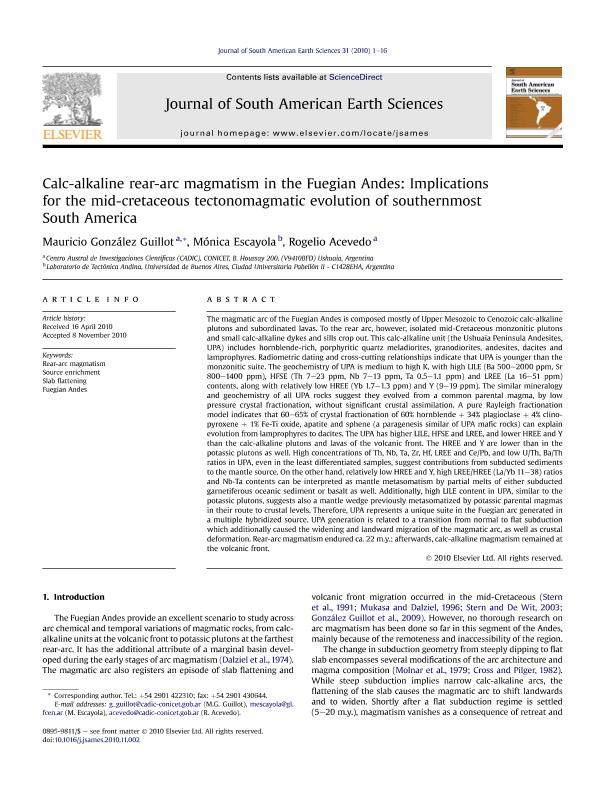
The magmatic arc of the Fuegian Andes is composed mostly of Upper Mesozoic to Cenozoic calc-alkaline plutons and subordinated lavas. To the rear arc, however, isolated mid-Cretaceous monzonitic plutons and small calc-alkaline dykes and sills crop out. This calc-alkaline unit (the Ushuaia Peninsula Andesites, UPA) includes hornblende-rich, porphyritic quartz meladiorites, granodiorites, andesites, dacites and lamprophyres. Radiometric dating and cross-cutting relationships indicate that UPA is younger than the monzonitic suite. The geochemistry of UPA is medium to high K, with high LILE (Ba 500–2000 ppm, Sr 800–1400 ppm), HFSE (Th 7–23 ppm, Nb 7–13 ppm, Ta 0.5–1.1 ppm) and LREE (La 16–51 ppm) contents, along with relatively low HREE (Yb 1.7–1.3 ppm) and Y (9–19 ppm). The similar mineralogy and geochemistry of all UPA rocks suggest they evolved from a common parental magma, by low pressure crystal fractionation, without significant crustal assimilation. A pure Rayleigh fractionation model indicates that 60–65% of crystal fractionation of 60% hornblende + 34% plagioclase + 4% clinopyroxene + 1% Fe-Ti oxide, apatite and sphene (a paragenesis similar of UPA mafic rocks) can explain evolution from lamprophyres to dacites. The UPA has higher LILE, HFSE and LREE, and lower HREE and Y than the calc-alkaline plutons and lavas of the volcanic front. The HREE and Y are lower than in the potassic plutons as well. High concentrations of Th, Nb, Ta, Zr, Hf, LREE and Ce/Pb, and low U/Th, Ba/Th ratios in UPA, even in the least differentiated samples, suggest contributions from subducted sediments to the mantle source. On the other hand, relatively low HREE and Y, high LREE/HREE (La/Yb 11–38) ratios and Nb-Ta contents can be interpreted as mantle metasomatism by partial melts of either subducted garnetiferous oceanic sediment or basalt as well. Additionally, high LILE content in UPA, similar to the potassic plutons, suggests also a mantle wedge previously metasomatized by potassic parental magmas in their route to crustal levels. Therefore, UPA represents a unique suite in the Fuegian arc generated in a multiple hybridized source. UPA generation is related to a transition from normal to flat subduction which additionally caused the widening and landward migration of the magmatic arc, as well as crustal deformation. Rear-arc magmatism endured ca. 22 m.y.; afterwards, calc-alkaline magmatism remained at the volcanic front.
dc.format
application/pdf
dc.language.iso
eng
dc.publisher
Pergamon-Elsevier Science Ltd
dc.rights
info:eu-repo/semantics/openAccess
dc.rights.uri
https://creativecommons.org/licenses/by-nc-sa/2.5/ar/
dc.subject
REAR-ARC MAGMATISM
dc.subject
SLAB MELTS
dc.subject
SLAB FLATTENING
dc.subject
FUEGIAN ANDES
dc.subject.classification
Geología
dc.subject.classification
Ciencias de la Tierra y relacionadas con el Medio Ambiente
dc.subject.classification
CIENCIAS NATURALES Y EXACTAS
dc.title
Calc-alkaline rear-arc magmatism in the Fuegian Andes: Implications for the mid-cretaceous tectonomagmatic evolution of southernmost South America
dc.type
info:eu-repo/semantics/article
dc.type
info:ar-repo/semantics/artículo
dc.type
info:eu-repo/semantics/publishedVersion
dc.date.updated
2025-08-07T15:03:27Z
dc.journal.volume
31
dc.journal.number
1
dc.journal.pagination
1-16
dc.journal.pais
Estados Unidos
dc.description.fil
Fil: Gonzalez Guillot, Mauricio Alberto. Consejo Nacional de Investigaciones Científicas y Técnicas. Centro Austral de Investigaciones Científicas; Argentina
dc.description.fil
Fil: Escayola, Monica Patricia. Consejo Nacional de Investigaciones Científicas y Técnicas. Oficina de Coordinación Administrativa Ciudad Universitaria. Instituto de Estudios Andinos "Don Pablo Groeber". Universidad de Buenos Aires. Facultad de Ciencias Exactas y Naturales. Instituto de Estudios Andinos "Don Pablo Groeber"; Argentina
dc.description.fil
Fil: Acevedo, Rogelio Daniel. Consejo Nacional de Investigaciones Científicas y Técnicas. Centro Austral de Investigaciones Científicas; Argentina
dc.journal.title
Journal of South American Earth Sciences
dc.relation.alternativeid
info:eu-repo/semantics/altIdentifier/url/https://www.sciencedirect.com/science/article/abs/pii/S0895981110000842
dc.relation.alternativeid
info:eu-repo/semantics/altIdentifier/doi/http://dx.doi.org/10.1016/j.jsames.2010.11.002
Archivos asociados

Tamaño:
2.387Mb
Formato:
PDF