Artículo
Quantifying the contribution of environmental variables to cyclists’ exposure to PM2.5 using machine learning techniques

Fecha de publicación:
01/2024
Editorial:
Elsevier
Revista:
Heliyon
ISSN:
2405-8440
Idioma:
Inglés
Tipo de recurso:
Artículo publicado
Clasificación temática:
Resumen
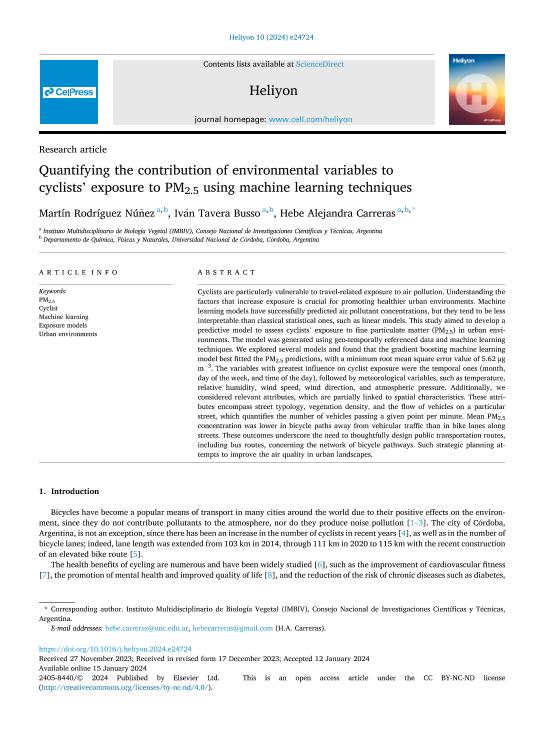
Cyclists are particularly vulnerable to travel-related exposure to air pollution. Understanding the actors that increase exposure is crucial for promoting healthier urban environments. Machine learning models have successfully predicted air pollutant concentrations, but they tend to be less interpretable than classical statistical ones, such as linear models. This study aimed to develop a predictive model to assess cyclists’ exposure to fine particulate matter (PM2.5) in urban environments. The model was generated using geo-temporally referenced data and machine learning techniques. We explored several models and found that the gradient boosting machine learning model best fitted the PM2.5 predictions, with a minimum root mean square error value of 5.62 μg m−3. The variables with greatest influence on cyclist exposure were the temporal ones (month, day of the week, and time of the day), followed by meteorological variables, such as temperature, relative humidity, wind speed, wind direction, and atmospheric pressure. Additionally, we considered relevant attributes, which are partially linked to spatial characteristics. These attributes encompass street typology, vegetation density, and the flow of vehicles on a particular street, which quantifies the number of vehicles passing a given point per minute. Mean PM2.5 concentration was lower in bicycle paths away from vehicular traffic than in bike lanes along streets. These outcomes underscore the need to thoughtfully design public transportation routes, including bus routes, concerning the network of bicycle pathways. Such strategic planning attempts to improve the air quality in urban landscapes.
Palabras clave:
PM2.5
,
CYCLIST
,
MACHINE LEARNING
,
EXPOSURE MODELS
,
URBAN ENVIRONMENTS
Archivos asociados

Tamaño:
4.044Mb
Formato:
PDF
Licencia
 Excepto donde se diga explícitamente, este item se publica bajo la siguiente descripción:
Creative Commons Attribution 2.5 Unported (CC BY 2.5)
Excepto donde se diga explícitamente, este item se publica bajo la siguiente descripción:
Creative Commons Attribution 2.5 Unported (CC BY 2.5)
Identificadores
Colecciones
Articulos(IMBIV)
Articulos de INST.MULTIDISCIPL.DE BIOLOGIA VEGETAL (P)
Articulos de INST.MULTIDISCIPL.DE BIOLOGIA VEGETAL (P)
Citación
Rodriguez Nuñez, Martin; Tavera Busso, Iván; Carreras, Hebe Alejandra; Quantifying the contribution of environmental variables to cyclists’ exposure to PM2.5 using machine learning techniques; Elsevier; Heliyon; 10; 2; 1-2024; 1-12
Compartir


Altmétricas