Artículo
Dorsolateral periaqueductal gray stimulation prior to retrieval potentiates a contextual fear memory in rats

Fecha de publicación:
09/2012
Editorial:
Elsevier Science
Revista:
Behavioural Brain Research
ISSN:
0166-4328
Idioma:
Inglés
Tipo de recurso:
Artículo publicado
Clasificación temática:
Resumen
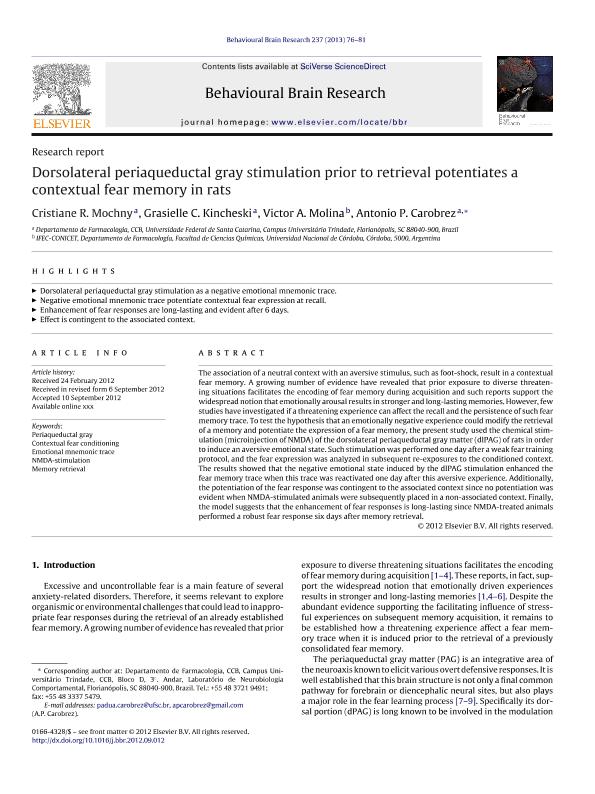
The association of a neutral context with an aversive stimulus, such as foot-shock, result in a contextual fear memory. A growing number of evidence have revealed that prior exposure to diverse threatening situations facilitates the encoding of fear memory during acquisition and such reports support the widespread notion that emotionally arousal results in stronger and long-lasting memories. However, few studies have investigated if a threatening experience can affect the recall and the persistence of such fear memory trace. To test the hypothesis that an emotionally negative experience could modify the retrieval of a memory and potentiate the expression of a fear memory, the present study used the chemical stimulation (microinjection of NMDA) of the dorsolateral periaqueductal gray matter (dlPAG) of rats in order to induce an aversive emotional state. Such stimulation was performed one day after a weak fear training protocol, and the fear expression was analyzed in subsequent re-exposures to the conditioned context. The results showed that the negative emotional state induced by the dlPAG stimulation enhanced the fear memory trace when this trace was reactivated one day after this aversive experience. Additionally, the potentiation of the fear response was contingent to the associated context since no potentiation was evident when NMDA-stimulated animals were subsequently placed in a non-associated context. Finally, the model suggests that the enhancement of fear responses is long-lasting since NMDA-treated animals performed a robust fear response six days after memory retrieval.
Palabras clave:
Sustancia Gris Periqueductal
,
Nmda
,
Fear Memory
Archivos asociados

Tamaño:
489.7Kb
Formato:
PDF
Licencia
 Excepto donde se diga explícitamente, este item se publica bajo la siguiente descripción:
Atribución-NoComercial-SinDerivadas 2.5 Argentina (CC BY-NC-ND 2.5 AR)
Excepto donde se diga explícitamente, este item se publica bajo la siguiente descripción:
Atribución-NoComercial-SinDerivadas 2.5 Argentina (CC BY-NC-ND 2.5 AR)
Identificadores
Colecciones
Articulos(IFEC)
Articulos de INST. DE FARMACOLOGIA EXPERIMENTAL DE CORDOBA
Articulos de INST. DE FARMACOLOGIA EXPERIMENTAL DE CORDOBA
Citación
Mochny, Cristiane R.; Kincheski, Grasielle C.; Molina, Víctor Alejandro; Carobrez, Antonio P.; Dorsolateral periaqueductal gray stimulation prior to retrieval potentiates a contextual fear memory in rats; Elsevier Science; Behavioural Brain Research; 237; 9-2012; 76-81
Compartir


Altmétricas