Mostrar el registro sencillo del ítem
dc.contributor.author
Pividori, Milton Damián
dc.contributor.author
Ritchie, Marylyn D.
dc.contributor.author
Milone, Diego Humberto
dc.contributor.author
Greene, Casey S.
dc.date.available
2025-04-08T12:33:42Z
dc.date.issued
2024-09
dc.identifier.citation
Pividori, Milton Damián; Ritchie, Marylyn D.; Milone, Diego Humberto; Greene, Casey S.; An efficient, not-only-linear correlation coefficient based on clustering; Cell Press; Cell Systems; 15; 9; 9-2024; 854-868.e3
dc.identifier.issn
2405-4712
dc.identifier.uri
http://hdl.handle.net/11336/258282
dc.description.abstract
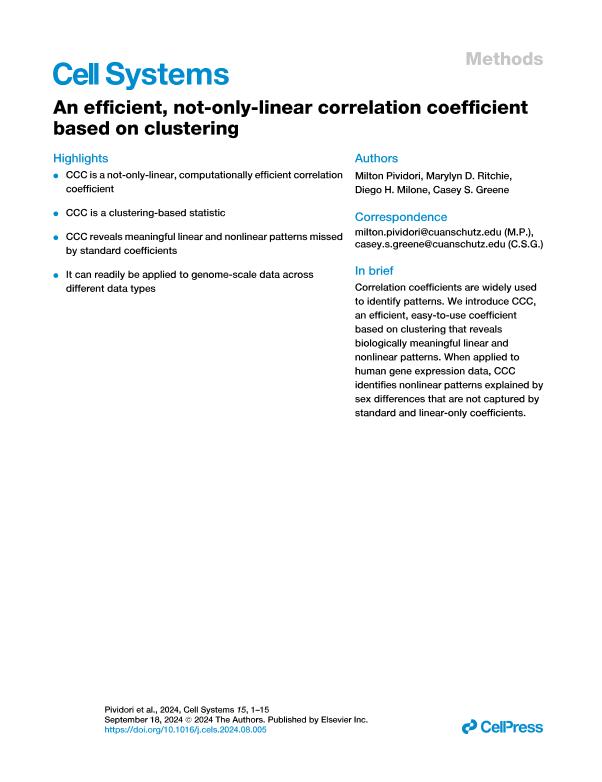
Identifying meaningful patterns in data is crucial for understanding complex biological processes, particularly in transcriptomics, where genes with correlated expression often share functions or contribute to disease mechanisms. Traditional correlation coefficients, which primarily capture linear relationships, may overlook important nonlinear patterns. We introduce the clustermatch correlation coefficient (CCC), a not-only-linear coefficient that utilizes clustering to efficiently detect both linear and nonlinear associations. CCC outperforms standard methods by revealing biologically meaningful patterns that linear-only coefficients miss and is faster than state-of-the-art coefficients such as the maximal information coefficient. When applied to human gene expression data from genotype-tissue expression (GTEx), CCC identified robust linear relationships and nonlinear patterns, such as sex-specific differences, that are undetectable by standard methods. Highly ranked gene pairs were enriched for interactions in integrated networks built from protein-protein interactions, transcription factor regulation, and chemical and genetic perturbations, suggesting that CCC can detect functional relationships missed by linear-only approaches. CCC is a highly efficient, next-generation, not-only-linear correlation coefficient for genome-scale data. A record of this paper’s transparent peer review process is included in the supplemental information.
dc.format
application/pdf
dc.language.iso
eng
dc.publisher
Cell Press
dc.rights
info:eu-repo/semantics/openAccess
dc.rights.uri
https://creativecommons.org/licenses/by/2.5/ar/
dc.subject
correlation coefficient
dc.subject
nonlinear relationships
dc.subject
clustering
dc.subject
gene expression
dc.subject.classification
Ciencias de la Información y Bioinformática
dc.subject.classification
Ciencias de la Computación e Información
dc.subject.classification
CIENCIAS NATURALES Y EXACTAS
dc.title
An efficient, not-only-linear correlation coefficient based on clustering
dc.type
info:eu-repo/semantics/article
dc.type
info:ar-repo/semantics/artículo
dc.type
info:eu-repo/semantics/publishedVersion
dc.date.updated
2025-04-07T10:35:33Z
dc.journal.volume
15
dc.journal.number
9
dc.journal.pagination
854-868.e3
dc.journal.pais
Estados Unidos
dc.description.fil
Fil: Pividori, Milton Damián. University of Colorado; Estados Unidos. University of Pennsylvania; Estados Unidos. Consejo Nacional de Investigaciones Científicas y Técnicas; Argentina
dc.description.fil
Fil: Ritchie, Marylyn D.. University of Pennsylvania; Estados Unidos
dc.description.fil
Fil: Milone, Diego Humberto. Consejo Nacional de Investigaciones Científicas y Técnicas. Centro Científico Tecnológico Conicet - Santa Fe. Instituto de Investigación en Señales, Sistemas e Inteligencia Computacional. Universidad Nacional del Litoral. Facultad de Ingeniería y Ciencias Hídricas. Instituto de Investigación en Señales, Sistemas e Inteligencia Computacional; Argentina
dc.description.fil
Fil: Greene, Casey S.. University of Colorado; Estados Unidos
dc.journal.title
Cell Systems
dc.relation.alternativeid
info:eu-repo/semantics/altIdentifier/url/https://linkinghub.elsevier.com/retrieve/pii/S2405471224002357
dc.relation.alternativeid
info:eu-repo/semantics/altIdentifier/doi/http://dx.doi.org/10.1016/j.cels.2024.08.005
Archivos asociados

Tamaño:
3.204Mb
Formato:
PDF