Artículo
Whole-brain turbulent dynamics predict responsiveness to pharmacological treatment in major depressive disorder
Escrichs, Anira; Sanz Perl Hernandez, Yonatan ; Fisher, Patrick M.; Martínez-Molina, Noelia; G-Guzman, Elvira; Frokjaer, Vibe G.; Kringelbach, Morten L.; Knudsen, Gitte M.; Deco, Gustavo
; Fisher, Patrick M.; Martínez-Molina, Noelia; G-Guzman, Elvira; Frokjaer, Vibe G.; Kringelbach, Morten L.; Knudsen, Gitte M.; Deco, Gustavo
Fecha de publicación:
09/2024
Editorial:
Nature Publishing Group
Revista:
Molecular Psychiatry
ISSN:
1359-4184
Idioma:
Inglés
Tipo de recurso:
Artículo publicado
Clasificación temática:
Resumen
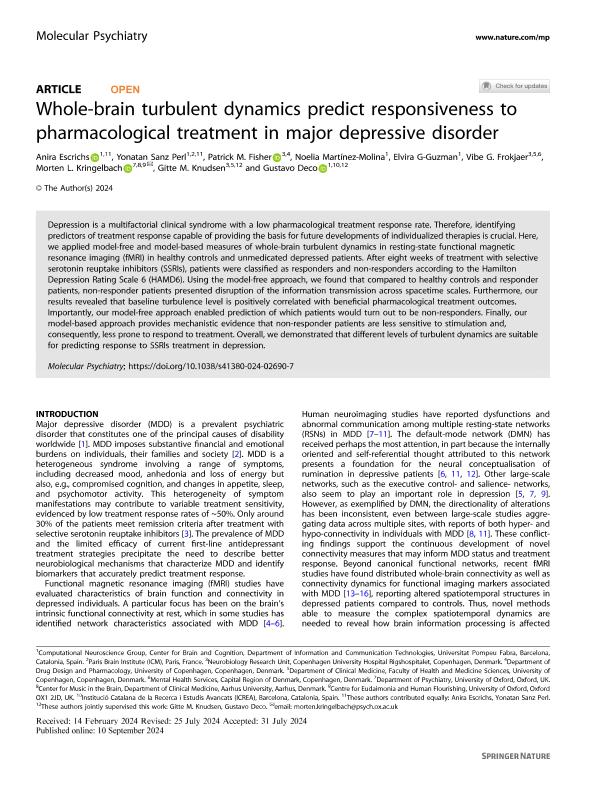
Depression is a multifactorial clinical syndrome with a low pharmacological treatment response rate. Therefore, identifying predictors of treatment response capable of providing the basis for future developments of individualized therapies is crucial. Here, we applied model-free and model-based measures of whole-brain turbulent dynamics in resting-state functional magnetic resonance imaging (fMRI) in healthy controls and unmedicated depressed patients. After eight weeks of treatment with selective serotonin reuptake inhibitors (SSRIs), patients were classified as responders and non-responders according to the Hamilton Depression Rating Scale 6 (HAMD6). Using the model-free approach, we found that compared to healthy controls and responder patients, non-responder patients presented disruption of the information transmission across spacetime scales. Furthermore, our results revealed that baseline turbulence level is positively correlated with beneficial pharmacological treatment outcomes. Importantly, our model-free approach enabled prediction of which patients would turn out to be non-responders. Finally, our model-based approach provides mechanistic evidence that non-responder patients are less sensitive to stimulation and, consequently, less prone to respond to treatment. Overall, we demonstrated that different levels of turbulent dynamics are suitable for predicting response to SSRIs treatment in depression.
Palabras clave:
Neuroimaging
,
Depression
,
Turbulence
,
Whole-brain modelling
Archivos asociados

Tamaño:
2.758Mb
Formato:
PDF
Licencia
 Excepto donde se diga explícitamente, este item se publica bajo la siguiente descripción:
Creative Commons Attribution 2.5 Unported (CC BY 2.5)
Excepto donde se diga explícitamente, este item se publica bajo la siguiente descripción:
Creative Commons Attribution 2.5 Unported (CC BY 2.5)
Identificadores
Colecciones
Articulos(SEDE CENTRAL)
Articulos de SEDE CENTRAL
Articulos de SEDE CENTRAL
Citación
Escrichs, Anira; Sanz Perl Hernandez, Yonatan; Fisher, Patrick M.; Martínez-Molina, Noelia; G-Guzman, Elvira; et al.; Whole-brain turbulent dynamics predict responsiveness to pharmacological treatment in major depressive disorder; Nature Publishing Group; Molecular Psychiatry; 9-2024; 1-11
Compartir


Altmétricas