Artículo
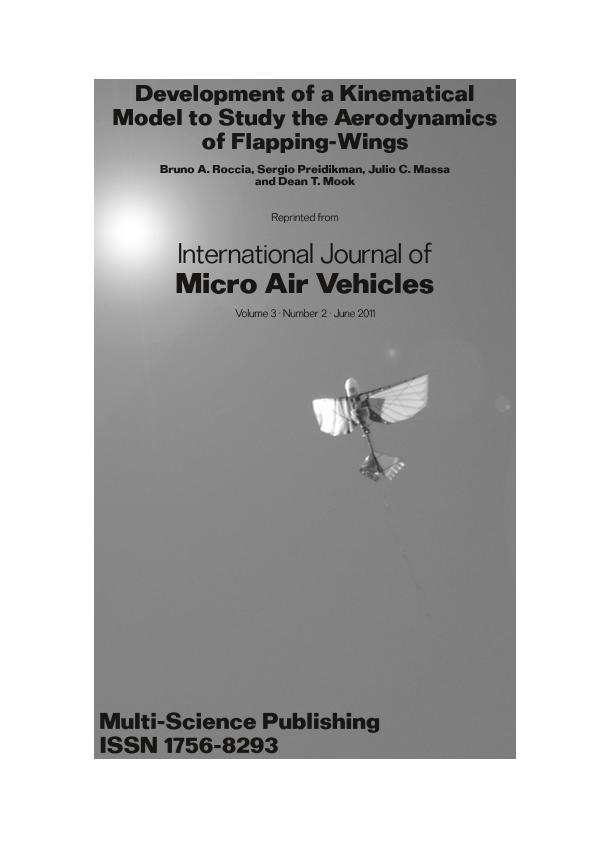
Development of a Kinematical Model to Study the Aerodynamics of Flapping-Wings

Fecha de publicación:
06/2011
Editorial:
SAGE Publications
Revista:
International Journal of Micro Air Vehicles
ISSN:
1756-8293
e-ISSN:
1756-8307
Idioma:
Inglés
Tipo de recurso:
Artículo publicado
Clasificación temática:
Resumen
The kinematics that characterizes the “natural flight” of insects is quite complex. It involves simultaneous rotations, oscillations and significant changes in the angle of attack. All this permits the wings to follow an extremely complex trajectory producing different flight mechanisms that are efficient at low to moderate Reynolds numbers. Some of these mechanisms, such as the delayed stall, the additional circulation generated by the rotation of the wing, and the wake capture amongst others, offer unique advantages with respect to the well-known fixed-wing aerial vehicles. Such advantages are better lift and thrust generation without the need to increase weight. This paper presents a general kinematical model that permits studying the movements of the wings of a scale robot of a house fly, the ‘RoboFly’, built at UC Berkeley, USA. Additionally, this general kinematical model allows studying the kinematics of the wings of a flying insect considering both the body orientation and the stroke plane orientation of the creature in the 3D space. This work provides a nexus between the descriptive language used by biologists and the predictive language used by engineers. This connection between scientific disciplines allows one to study and characterize the principal kinematic parameters that intervene in a stroke cycle, as well as to determine how these variables modify the trajectories of the material points on the wings.
Palabras clave:
FLAPPING WINGS
,
KINEMATICS
,
UNSTEADY AERODYNAMICS
,
BIO-INSPIRATION
Archivos asociados

Tamaño:
8.878Mb
Formato:
PDF
Licencia
 Excepto donde se diga explícitamente, este item se publica bajo la siguiente descripción:
Creative Commons Attribution-NonCommercial-ShareAlike 2.5 Unported (CC BY-NC-SA 2.5)
Excepto donde se diga explícitamente, este item se publica bajo la siguiente descripción:
Creative Commons Attribution-NonCommercial-ShareAlike 2.5 Unported (CC BY-NC-SA 2.5)
Identificadores
Colecciones
Articulos(CCT - CORDOBA)
Articulos de CTRO.CIENTIFICO TECNOL.CONICET - CORDOBA
Articulos de CTRO.CIENTIFICO TECNOL.CONICET - CORDOBA
Citación
Roccia, Bruno Antonio; Preidikman, Sergio; Massa, Julio Cesar; Mook, Dean T.; Development of a Kinematical Model to Study the Aerodynamics of Flapping-Wings; SAGE Publications; International Journal of Micro Air Vehicles; 3; 2; 6-2011; 61-88
Compartir


Altmétricas