Artículo
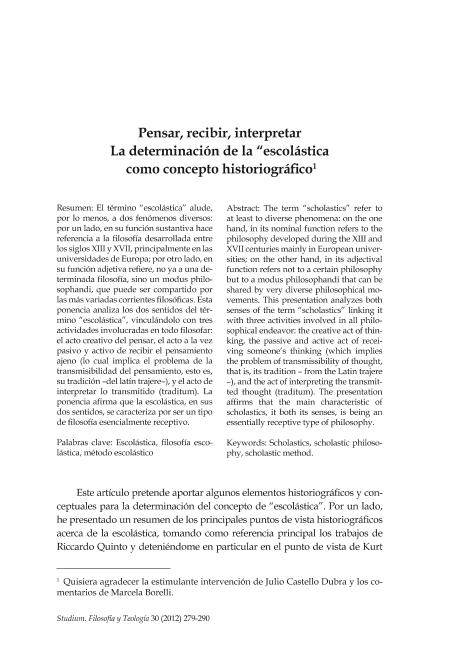
El término “escolástica” alude, por lo menos, a dos fenómenos diversos: por un lado, en su función sustantiva hace referencia a la filosofía desarrollada entre los siglos XIII y XVII, principalmente en las universidades de Europa; por otro lado, en su función adjetiva refiere, no ya a una determinada filosofía, sino un modus philosophandi, que puede ser compartido por las más variadas corrientes filosóficas. Esta ponencia analiza los dos sentidos del término “escolástica”, vinculándolo con tres actividades involucradas en todo filosofar: el acto creativo del pensar, el acto a la vez pasivo y activo de recibir el pensamiento ajeno (lo cual implica el problema de la transmisibilidad del pensamiento, esto es, su tradición –del latín trajere–), y el acto de interpretar lo transmitido (traditum). La ponencia afirma que la escolástica, en sus dos sentidos, se caracteriza por ser un tipo de filosofía esencialmente receptivo. The term “scholastics” refer to at least to diverse phenomena: on the one hand, in its nominal function refers to the philosophy developed during the XIII and XVII centuries mainly in European universities; on the other hand, in its adjectival function refers not to a certain philosophy but to a modus philosophandi that can be shared by very diverse philosophical movements. This presentation analyzes both senses of the term “scholastics” linking it with three activities involved in all philosophical endeavor: the creative act of thinking, the passive and active act of receiving someone’s thinking (which implies the problem of transmissibility of thought, that is, its tradition – from the Latin trajere –), and the act of interpreting the transmitted thought (traditum). The presentation affirms that the main characteristic of scholastics, it both its senses, is being an essentially receptive type of philosophy.
Pensar, recibir, interpretar. La determinación de la 'escolástica' como concepto historiográfico

Fecha de publicación:
11/2012
Editorial:
Universidad del Norte Santo Tomás de Aquino. Facultad de Humanidades
Revista:
Studium: filosofía y teología
ISSN:
0329-8930
Idioma:
Español
Tipo de recurso:
Artículo publicado
Clasificación temática:
Resumen
Palabras clave:
ESCOLÁSTICA
,
HISTORIOGRAFÍA
,
GÉNEROS LITERARIOS
,
MEDIOEVO
Archivos asociados

Tamaño:
580.8Kb
Formato:
PDF
Licencia
 Excepto donde se diga explícitamente, este item se publica bajo la siguiente descripción:
Creative Commons Attribution-NonCommercial-ShareAlike 2.5 Unported (CC BY-NC-SA 2.5)
Excepto donde se diga explícitamente, este item se publica bajo la siguiente descripción:
Creative Commons Attribution-NonCommercial-ShareAlike 2.5 Unported (CC BY-NC-SA 2.5)
Identificadores
Colecciones
Articulos(SEDE CENTRAL)
Articulos de SEDE CENTRAL
Articulos de SEDE CENTRAL
Citación
Perez Carrasco, Mariano; Pensar, recibir, interpretar. La determinación de la 'escolástica' como concepto historiográfico; Universidad del Norte Santo Tomás de Aquino. Facultad de Humanidades; Studium: filosofía y teología; 15; 30; 11-2012; 279-290
Compartir

