Artículo
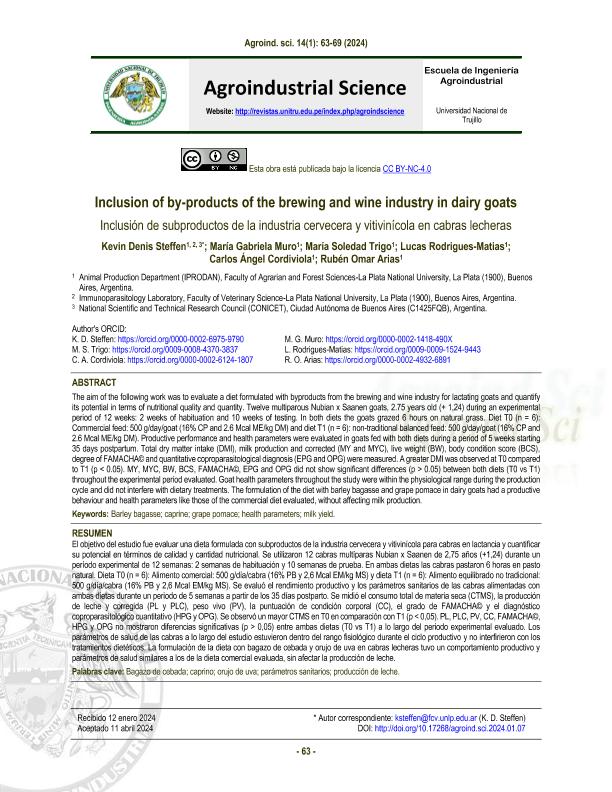
El objetivo del estudio fue evaluar una dieta formulada con subproductos de la industria cervecera y vitivinícola para cabras en lactancia y cuantificar su potencial en términos de calidad y cantidad nutricional. Se utilizaron 12 cabras multíparas Nubian x Saanen de 2,75 años (+1,24) durante un período experimental de 12 semanas: 2 semanas de habituación y 10 semanas de prueba. En ambas dietas las cabras pastaron 6 horas en pasto natural. Dieta T0 (n = 6): Alimento comercial: 500 g/día/cabra (16% PB y 2,6 Mcal EM/kg MS) y dieta T1 (n = 6): Alimento equilibrado no tradicional: 500 g/día/cabra (16% PB y 2,6 Mcal EM/kg MS). Se evaluó el rendimiento productivo y los parámetros sanitarios de las cabras alimentadas con ambas dietas durante un periodo de 5 semanas a partir de los 35 días postparto. Se midió el consumo total de materia seca (CTMS), la producción de leche y corregida (PL y PLC), peso vivo (PV), la puntuación de condición corporal (CC), el grado de FAMACHA© y el diagnóstico coproparasitológico cuantitativo (HPG y OPG). Se observó un mayor CTMS en T0 en comparación con T1 (p < 0,05). PL, PLC, PV, CC, FAMACHA©, HPG y OPG no mostraron diferencias significativas (p > 0,05) entre ambas dietas (T0 vs T1) a lo largo del periodo experimental evaluado. Los parámetros de salud de las cabras a lo largo del estudio estuvieron dentro del rango fisiológico durante el ciclo productivo y no interfirieron con los tratamientos dietéticos. La formulación de la dieta con bagazo de cebada y orujo de uva en cabras lecheras tuvo un comportamiento productivo y parámetros de salud similares a los de la dieta comercial evaluada, sin afectar la producción de leche. The aim of the following work was to evaluate a diet formulated with byproducts from the brewing and wine industry for lactating goats and quantify its potential in terms of nutritional quality and quantity. Twelve multiparous Nubian x Saanen goats, 2.75 years old (+ 1,24) during an experimental period of 12 weeks: 2 weeks of habituation and 10 weeks of testing. In both diets the goats grazed 6 hours on natural grass. Diet T0 (n = 6): Commercial feed: 500 g/day/goat (16% CP and 2.6 Mcal ME/kg DM) and diet T1 (n = 6): non-traditional balanced feed: 500 g/day/goat (16% CP and 2.6 Mcal ME/kg DM). Productive performance and health parameters were evaluated in goats fed with both diets during a period of 5 weeks starting 35 days postpartum. Total dry matter intake (DMI), milk production and corrected (MY and MYC), live weight (BW), body condition score (BCS), degree of FAMACHA© and quantitative coproparasitological diagnosis (EPG and OPG) were measured. A greater DMI was observed at T0 compared to T1 (p < 0.05). MY, MYC, BW, BCS, FAMACHA©, EPG and OPG did not show significant differences (p > 0.05) between both diets (T0 vs T1) throughout the experimental period evaluated. Goat health parameters throughout the study were within the physiological range during the production cycle and did not interfere with dietary treatments. The formulation of the diet with barley bagasse and grape pomace in dairy goats had a productive behaviour and health parameters like those of the commercial diet evaluated, without affecting milk production.
Inclusion of by-products of the brewing and wine industry in dairy goats
Título:
Inclusión de subproductos de la industria cervecera y vitivinícola en cabras lecheras
Steffen, Kevin Denis ; Muro, María Gabriela; Trigo, María Soledad; Rodrigues Matias, Lucas; Cordiviola, Carlos Ángel; Arias, Rubén Omar
; Muro, María Gabriela; Trigo, María Soledad; Rodrigues Matias, Lucas; Cordiviola, Carlos Ángel; Arias, Rubén Omar
Fecha de publicación:
04/2024
Editorial:
Universidad Nacional de Trujillo
Revista:
Agroindustrial Science
ISSN:
2226-2989
Idioma:
Inglés
Tipo de recurso:
Artículo publicado
Clasificación temática:
Resumen
Palabras clave:
BARLEY BAGASSE
,
CAPRINE
,
GRAPE POMACE
,
HEALTH PARAMETERS
,
MILK YIELD
Archivos asociados

Tamaño:
457.8Kb
Formato:
PDF
Licencia
 Excepto donde se diga explícitamente, este item se publica bajo la siguiente descripción:
Creative Commons Attribution-NonCommercial 2.5 Unported (CC BY-NC 2.5)
Excepto donde se diga explícitamente, este item se publica bajo la siguiente descripción:
Creative Commons Attribution-NonCommercial 2.5 Unported (CC BY-NC 2.5)
Identificadores
Colecciones
Articulos(CCT - LA PLATA)
Articulos de CTRO.CIENTIFICO TECNOL.CONICET - LA PLATA
Articulos de CTRO.CIENTIFICO TECNOL.CONICET - LA PLATA
Citación
Steffen, Kevin Denis; Muro, María Gabriela; Trigo, María Soledad; Rodrigues Matias, Lucas; Cordiviola, Carlos Ángel; et al.; Inclusion of by-products of the brewing and wine industry in dairy goats; Universidad Nacional de Trujillo; Agroindustrial Science; 14; 1; 4-2024; 63-69
Compartir


Altmétricas