Artículo
Toward the use of mixed microbial cultures for the biological production of adipic and levulinic acid
Pinto Ibieta, Fernanda; Cea, Mara; Serrano, Antonio; Felissia, Fernando Esteban; Area, Maria Cristina ; Cabrera, Francisco; Ciudad, Gustavo
; Cabrera, Francisco; Ciudad, Gustavo
Fecha de publicación:
06/2023
Editorial:
Frontiers Media
Revista:
Frontiers in Microbiology
e-ISSN:
1664-302X
Idioma:
Inglés
Tipo de recurso:
Artículo publicado
Clasificación temática:
Resumen
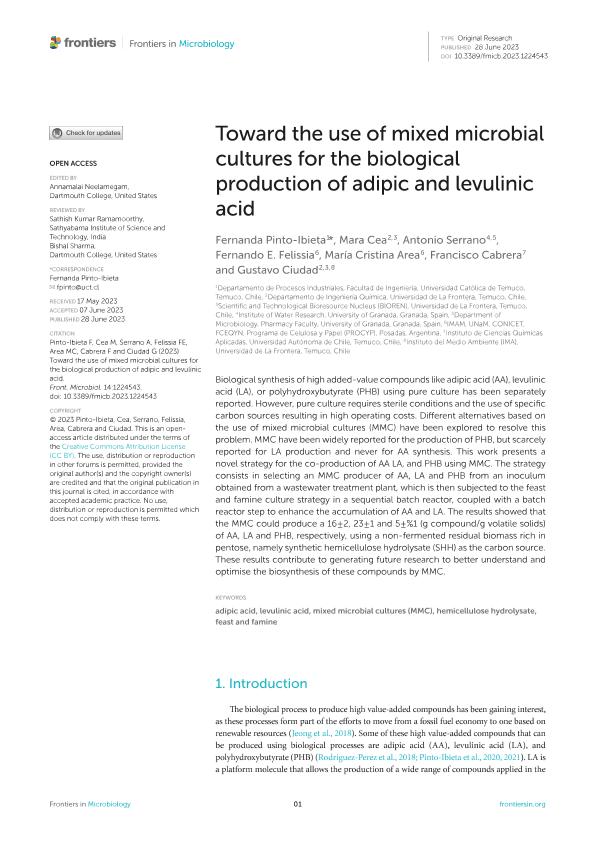
Biological synthesis of high added-value compounds like adipic acid (AA), levulinic acid (LA), or polyhydroxybutyrate (PHB) using pure culture has been separately reported. However, pure culture requires sterile conditions and the use of specific carbon sources resulting in high operating costs. Different alternatives based on the use of mixed microbial cultures (MMC) have been explored to resolve this problem. MMC have been widely reported for the production of PHB, but scarcely reported for LA production and never for AA synthesis. This work presents a novel strategy for the co-production of AA LA, and PHB using MMC. The strategy consists in selecting an MMC producer of AA, LA and PHB from an inoculum obtained from a wastewater treatment plant, which is then subjected to the feast and famine culture strategy in a sequential batch reactor, coupled with a batch reactor step to enhance the accumulation of AA and LA. The results showed that the MMC could produce a 16 ± 2, 23 ± 1 and 5 ± %1 (g compound/g volatile solids) of AA, LA and PHB, respectively, using a non-fermented residual biomass rich in pentose, namely synthetic hemicellulose hydrolysate (SHH) as the carbon source. These results contribute to generating future research to better understand and optimise the biosynthesis of these compounds by MMC.
Archivos asociados

Tamaño:
672.4Kb
Formato:
PDF
Licencia
 Excepto donde se diga explícitamente, este item se publica bajo la siguiente descripción:
Creative Commons Attribution 2.5 Unported (CC BY 2.5)
Excepto donde se diga explícitamente, este item se publica bajo la siguiente descripción:
Creative Commons Attribution 2.5 Unported (CC BY 2.5)
Identificadores
Colecciones
Articulos(CCT - NORDESTE)
Articulos de CTRO.CIENTIFICO TECNOL.CONICET - NORDESTE
Articulos de CTRO.CIENTIFICO TECNOL.CONICET - NORDESTE
Articulos(IMAM)
Articulos de INST.DE MATERIALES DE MISIONES
Articulos de INST.DE MATERIALES DE MISIONES
Citación
Pinto Ibieta, Fernanda; Cea, Mara; Serrano, Antonio; Felissia, Fernando Esteban; Area, Maria Cristina; et al.; Toward the use of mixed microbial cultures for the biological production of adipic and levulinic acid; Frontiers Media; Frontiers in Microbiology; 14; 6-2023; 1-8
Compartir


Altmétricas