Artículo
Decidual cells and decidualization in the carnivoran endotheliochorial placenta
Diessler, Mónica Elizabeth; Hernández, Rocío ; Gomez Castro, María Gimena
; Barbeito, Claudio Gustavo
; Gomez Castro, María Gimena
; Barbeito, Claudio Gustavo
; Gomez Castro, María Gimena
; Barbeito, Claudio Gustavo
Fecha de publicación:
03/2023
Editorial:
Frontiers Media S. A.
Revista:
Frontiers in Cell and Developmental Biology
ISSN:
2296-634X
Idioma:
Inglés
Tipo de recurso:
Artículo publicado
Clasificación temática:
Resumen
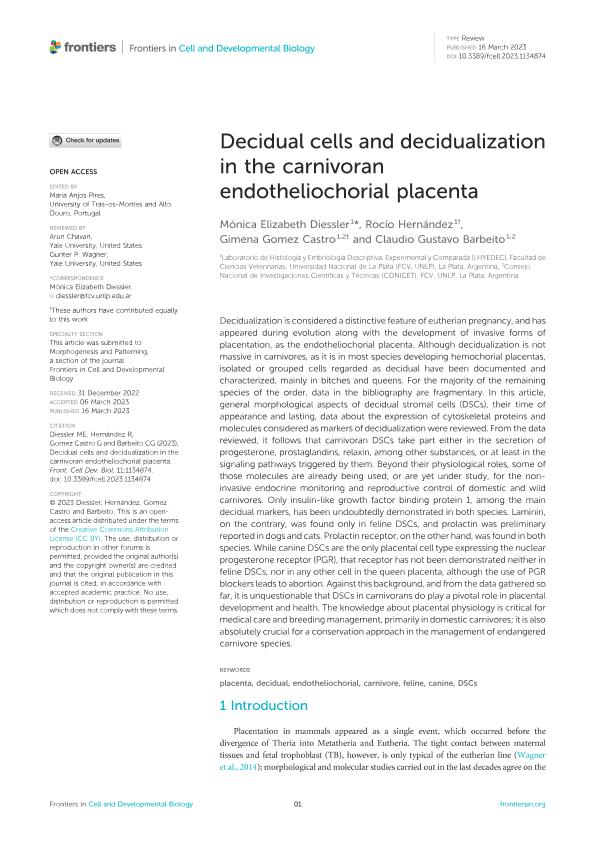
Decidualization is considered a distinctive feature of eutherian pregnancy, and has appeared during evolution along with the development of invasive forms of placentation, as the endotheliochorial placenta. Although decidualization is not massive in carnivores, as it is in most species developing hemochorial placentas, isolated or grouped cells regarded as decidual have been documented and characterized, mainly in bitches and queens. For the majority of the remaining species of the order, data in the bibliography are fragmentary. In this article, general morphological aspects of decidual stromal cells (DSCs), their time of appearance and lasting, data about the expression of cytoskeletal proteins and molecules considered as markers of decidualization were reviewed. From the data reviewed, it follows that carnivoran DSCs take part either in the secretion of progesterone, prostaglandins, relaxin, among other substances, or at least in the signaling pathways triggered by them. Beyond their physiological roles, some of those molecules are already being used, or are yet under study, for the non-invasive endocrine monitoring and reproductive control of domestic and wild carnivores. Only insulin-like growth factor binding protein 1, among the main decidual markers, has been undoubtedly demonstrated in both species. Laminin, on the contrary, was found only in feline DSCs, and prolactin was preliminary reported in dogs and cats. Prolactin receptor, on the other hand, was found in both species. While canine DSCs are the only placental cell type expressing the nuclear progesterone receptor (PGR), that receptor has not been demonstrated neither in feline DSCs, nor in any other cell in the queen placenta, although the use of PGR blockers leads to abortion. Against this background, and from the data gathered so far, it is unquestionable that DSCs in carnivorans do play a pivotal role in placental development and health. The knowledge about placental physiology is critical for medical care and breeding management, primarily in domestic carnivores; it is also absolutely crucial for a conservation approach in the management of endangered carnivore species.
Palabras clave:
CANINE
,
CARNIVORE
,
DECIDUAL
,
DSCS
,
ENDOTHELIOCHORIAL
,
FELINE
,
PLACENTA
Archivos asociados

Tamaño:
2.446Mb
Formato:
PDF
Licencia
 Excepto donde se diga explícitamente, este item se publica bajo la siguiente descripción:
Creative Commons Attribution 2.5 Unported (CC BY 2.5)
Excepto donde se diga explícitamente, este item se publica bajo la siguiente descripción:
Creative Commons Attribution 2.5 Unported (CC BY 2.5)
Identificadores
Colecciones
Articulos(CCT - LA PLATA)
Articulos de CTRO.CIENTIFICO TECNOL.CONICET - LA PLATA
Articulos de CTRO.CIENTIFICO TECNOL.CONICET - LA PLATA
Citación
Diessler, Mónica Elizabeth; Hernández, Rocío; Gomez Castro, María Gimena; Barbeito, Claudio Gustavo; Decidual cells and decidualization in the carnivoran endotheliochorial placenta; Frontiers Media S. A.; Frontiers in Cell and Developmental Biology; 11; 3-2023; 1-16
Compartir


Altmétricas