Artículo
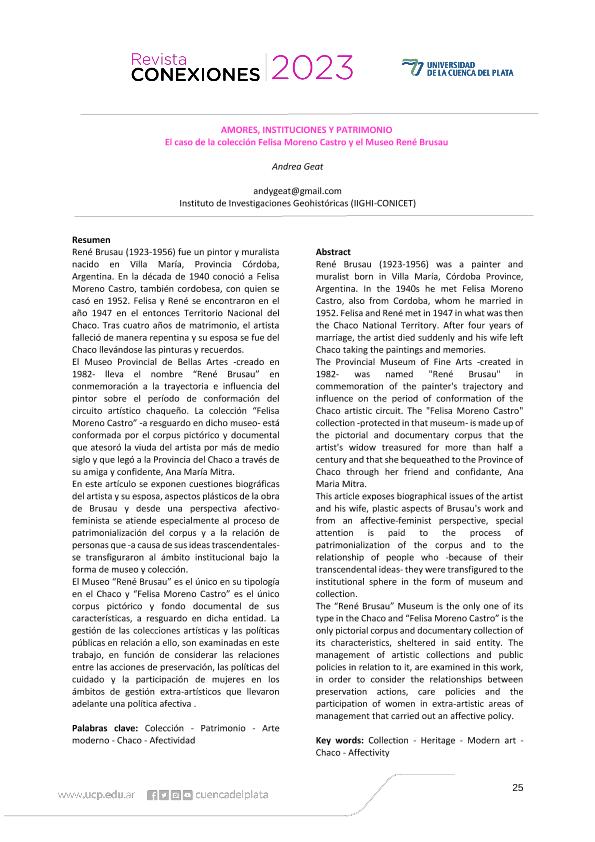
René Brusau (1923-1956) fue un pintor y muralista nacido en Villa María, Provincia Córdoba, Argentina. En la década de 1940 conoció a Felisa Moreno Castro, también cordobesa, con quien se casó en 1952. Felisa y René se encontraron en el año 1947 en el entonces Territorio Nacional del Chaco. Tras cuatro años de matrimonio, el artista falleció de manera repentina y su esposa se fue del Chaco llevándose las pinturas y recuerdos.El Museo Provincial de Bellas Artes -creado en 1982- lleva el nombre “René Brusau” en conmemoración a la trayectoria e influencia del pintor sobre el período de conformación del circuito artístico chaqueño. La colección “Felisa Moreno Castro” -a resguardo en dicho museo- está conformada por el corpus pictórico y documental que atesoró la viuda del artista por más de medio siglo y que legó a la Provincia del Chaco a través de su amiga y confidente, Ana María Mitra.En este artículo se exponen cuestiones biográficas del artista y su esposa, aspectos plásticos de la obra de Brusau y desde una perspectiva afectivofeminista se atiende especialmente al proceso de patrimonialización del corpus y a la relación de personas que -a causa de sus ideas trascendentalesse transfiguraron al ámbito institucional bajo la forma de museo y colección.El Museo “René Brusau” es el único en su tipología en el Chaco y “Felisa Moreno Castro” es el único corpus pictórico y fondo documental de sus características, a resguardo en dicha entidad. La gestión de las colecciones artísticas y las políticas públicas en relación a ello, son examinadas en este trabajo, en función de considerar las relaciones entre las acciones de preservación, las políticas del cuidado y la participación de mujeres en los ámbitos de gestión extra-artísticos que llevaron adelante una política afectiva . René Brusau (1923-1956) was a painter and muralist born in Villa María, Córdoba Province, Argentina. In the 1940s he met Felisa Moreno Castro, also from Cordoba, whom he married in 1952. Felisa and René met in 1947 in what was then the Chaco National Territory. After four years of marriage, the artist died suddenly and his wife left Chaco taking the paintings and memories. The Provincial Museum of Fine Arts -created in 1982- was named "René Brusau" in commemoration of the painter's trajectory and influence on the period of conformation of the Chaco artistic circuit. The "Felisa Moreno Castro" collection -protected in that museum- is made up of the pictorial and documentary corpus that the artist's widow treasured for more than half a century and that she bequeathed to the Province of Chaco through her friend and confidante, Ana Maria Mitra. This article exposes biographical issues of the artist and his wife, plastic aspects of Brusau's work and from an affective-feminist perspective, special attention is paid to the process of patrimonialization of the corpus and to the relationship of people who -because of their transcendental ideas- they were transfigured to the institutional sphere in the form of museum and collection. The “René Brusau” Museum is the only one of its type in the Chaco and “Felisa Moreno Castro” is the only pictorial corpus and documentary collection of its characteristics, sheltered in said entity. The management of artistic collections and public policies in relation to it, are examined in this work, in order to consider the relationships between preservation actions, care policies and the participation of women in extra-artistic areas of management that carried out an affective policy.
Amores, instituciones y patrimonio: El caso de la colección Felisa Moreno Castro y el Museo René Brusau

Fecha de publicación:
08/2023
Editorial:
Universidad de la Cuenca del Plata
Revista:
Revista Conexiones
ISSN:
2591-3344
Idioma:
Español
Tipo de recurso:
Artículo publicado
Clasificación temática:
Resumen
Palabras clave:
colección
,
patrimonio
,
arte moderno
,
Chaco
Archivos asociados

Tamaño:
1.276Mb
Formato:
PDF
Licencia
 Excepto donde se diga explícitamente, este item se publica bajo la siguiente descripción:
Creative Commons Attribution-NonCommercial 2.5 Unported (CC BY-NC 2.5)
Excepto donde se diga explícitamente, este item se publica bajo la siguiente descripción:
Creative Commons Attribution-NonCommercial 2.5 Unported (CC BY-NC 2.5)
Identificadores
Colecciones
Articulos(IIGHI)
Articulos de INST.DE INVEST.GEOHISTORICAS (I)
Articulos de INST.DE INVEST.GEOHISTORICAS (I)
Citación
Geat, Andrea Soledad; Amores, instituciones y patrimonio: El caso de la colección Felisa Moreno Castro y el Museo René Brusau; Universidad de la Cuenca del Plata; Revista Conexiones; 1; 9; 8-2023; 25-35
Compartir

