Mostrar el registro sencillo del ítem
dc.contributor.author
Vargas, Maia
dc.date.available
2023-11-06T12:56:40Z
dc.date.issued
2021-06
dc.identifier.citation
Vargas, Maia; Invocar los paisajes perdidos desde el exilio: Las obras de Elia Suleiman y Walid Raad; Universidad Nacional de Tres de Febrero; Diversidad.Net; 18; 6-2021; 48-70
dc.identifier.uri
http://hdl.handle.net/11336/217089
dc.description.abstract
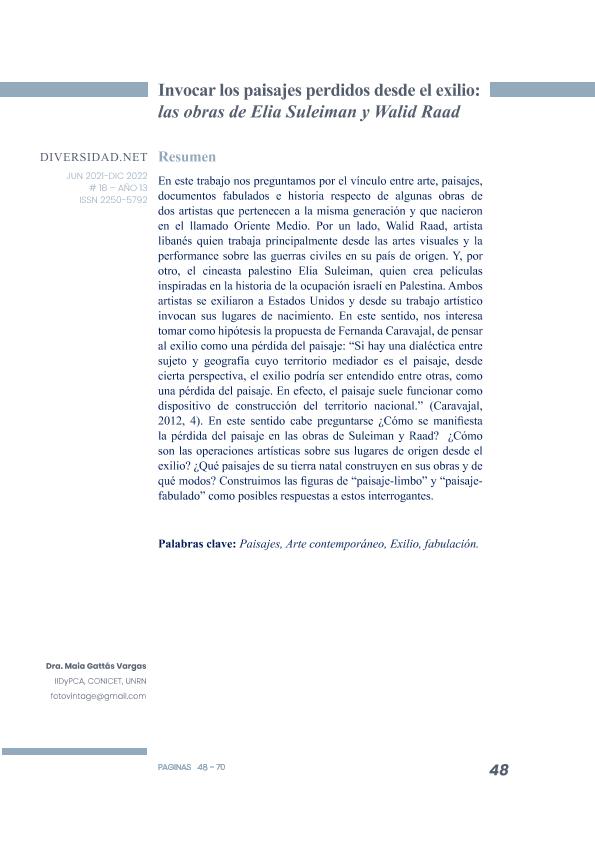
En este trabajo nos preguntamos por el vínculo entre arte, paisajes, documentos fabulados e historia respecto de algunas obras de dos artistas que pertenecen a la misma generación y que nacieron en el llamado Oriente Medio. Por un lado, Walid Raad, artista libanés quien trabaja principalmente desde las artes visuales y la performance sobre las guerras civiles en su país de origen. Y, por otro, el cineasta palestino Elia Suleiman, quien crea películas inspiradas en la historia de la ocupación israelí en Palestina. Ambos artistas se exiliaron a Estados Unidos y desde su trabajo artístico invocan sus lugares de nacimiento. En este sentido, nos interesa tomar como hipótesis la propuesta de Fernanda Caravajal, de pensar al exilio como una pérdida del paisaje: “Si hay una dialéctica entre sujeto y geografía cuyo territorio mediador es el paisaje, desde cierta perspectiva, el exilio podría ser entendido entre otras, como una pérdida del paisaje. En efecto, el paisaje suele funcionar como dispositivo de construcción del territorio nacional.” (Caravajal, 2012, 4). En este sentido cabe preguntarse ¿Cómo se manifiesta la pérdida del paisaje en las obras de Suleiman y Raad? ¿Cómo son las operaciones artísticas sobre sus lugares de origen desde el exilio? ¿Qué paisajes de su tierra natal construyen en sus obras y de qué modos? Construimos las figuras de “paisaje-limbo” y “paisajefabulado” como posibles respuestas a estos interrogantes.
dc.description.abstract
In this paper, we ask about the link between art, landscapes, fabulated documents, and history with respect to some works by two artists who belong to the same generation and who were born in the so-called Middle East. On the one hand, Walid Raad, Lebanese artist who works mainly from the visual arts and performance on the civil wars in his country of origin. On the other hand, the Palestinian filmmaker Elia Suleiman, who creates films inspired by the history of the Israeli occupation in Palestine. Both artists went into exile in the United States and from their artistic work they look at their places of birth. In this sense, we are interested in taking as a hypothesis Fernanda Caravajal’s proposal to think of exile as a loss of landscape: “If there is a dialectic between subject and geography whose mediating territory is the landscape, from a certain perspective, exile could be understood, among others, as a loss of landscape. Indeed, the landscape often functions as a device for the construction of the national territory.” (Caravajal, 2012, 4). In this sense, it is worth asking: How does the loss of the landscape manifest itself in the works of Suleiman and Raad? What are the artistic operations on their places of origin from exile? What landscapes of their homeland do they construct in their works and in what ways? We construct the figures of “landscape-limbo” and “landscape-fabulated” as possible answers to these questions.
dc.format
application/pdf
dc.language.iso
spa
dc.publisher
Universidad Nacional de Tres de Febrero
dc.rights
info:eu-repo/semantics/openAccess
dc.rights.uri
https://creativecommons.org/licenses/by-nc-sa/2.5/ar/
dc.subject
PAISAJES
dc.subject
ARTE CONTEMPORÁNEO
dc.subject
FABULACIÓN
dc.subject
DIÁSPORA
dc.subject.classification
Comunicación de Medios y Socio-cultural
dc.subject.classification
Comunicación y Medios
dc.subject.classification
CIENCIAS SOCIALES
dc.title
Invocar los paisajes perdidos desde el exilio: Las obras de Elia Suleiman y Walid Raad
dc.type
info:eu-repo/semantics/article
dc.type
info:ar-repo/semantics/artículo
dc.type
info:eu-repo/semantics/publishedVersion
dc.date.updated
2023-11-06T09:51:46Z
dc.identifier.eissn
2250-5792
dc.journal.number
18
dc.journal.pagination
48-70
dc.journal.pais
Argentina
dc.journal.ciudad
Buenos Aires
dc.description.fil
Fil: Vargas, Maia. Consejo Nacional de Investigaciones Científicas y Técnicas. Centro Científico Tecnológico Conicet - Patagonia Norte. Instituto de Investigaciones en Diversidad Cultural y Procesos de Cambio. Universidad Nacional de Río Negro. Instituto de Investigaciones en Diversidad Cultural y Procesos de Cambio; Argentina
dc.journal.title
Diversidad.Net
dc.relation.alternativeid
info:eu-repo/semantics/altIdentifier/url/http://www.diversidadcultural.net/articulos/nro018/02-Dra-MaiaGattasVargas(IIDyPCA-CONICET-UNRN).pdf
Archivos asociados

Tamaño:
382.3Kb
Formato:
PDF