Artículo
Machine Learning Toxicity Prediction: Latest Advances by Toxicity End Point

Fecha de publicación:
12/2022
Editorial:
American Chemical Society
Revista:
ACS Omega
ISSN:
2470-1343
e-ISSN:
2470-1343
Idioma:
Inglés
Tipo de recurso:
Artículo publicado
Clasificación temática:
Resumen
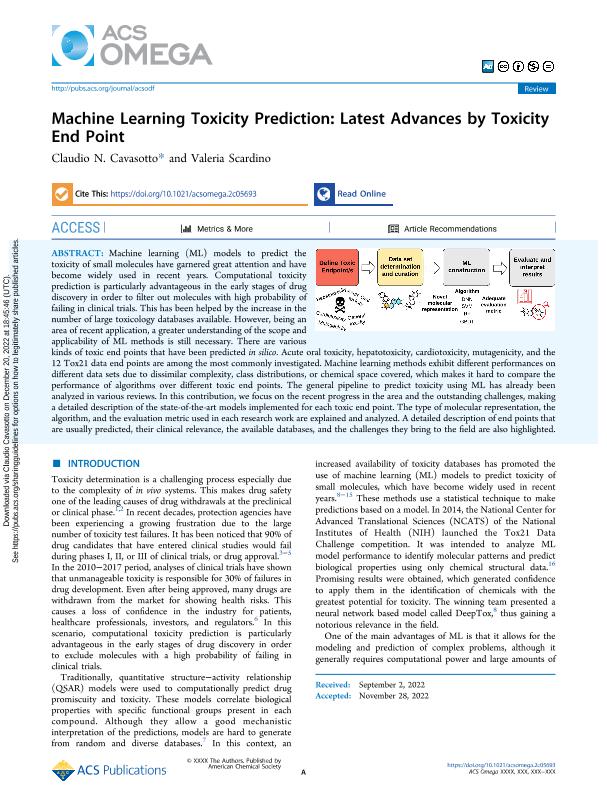
Machine learning (ML) models to predict the toxicity of small molecules have garnered great attention and have become widely used in recent years. Computational toxicity prediction is particularly advantageous in the early stages of drug discovery in order to filter out molecules with high probability of failing in clinical trials. This has been helped by the increase in the number of large toxicology databases available. However, being an area of recent application, a greater understanding of the scope and applicability of ML methods is still necessary. There are various kinds of toxic end points that have been predicted in silico. Acute oral toxicity, hepatotoxicity, cardiotoxicity, mutagenicity, and the 12 Tox21 data end points are among the most commonly investigated. Machine learning methods exhibit different performances on different data sets due to dissimilar complexity, class distributions, or chemical space covered, which makes it hard to compare the performance of algorithms over different toxic end points. The general pipeline to predict toxicity using ML has already been analyzed in various reviews. In this contribution, we focus on the recent progress in the area and the outstanding challenges, making a detailed description of the state-of-the-art models implemented for each toxic end point. The type of molecular representation, the algorithm, and the evaluation metric used in each research work are explained and analyzed. A detailed description of end points that are usually predicted, their clinical relevance, the available databases, and the challenges they bring to the field are also highlighted.
Palabras clave:
Toxicology
,
Machine Learning
Archivos asociados

Tamaño:
2.426Mb
Formato:
PDF
Licencia
 Excepto donde se diga explícitamente, este item se publica bajo la siguiente descripción:
Atribución-NoComercial-SinDerivadas 2.5 Argentina (CC BY-NC-ND 2.5 AR)
Excepto donde se diga explícitamente, este item se publica bajo la siguiente descripción:
Atribución-NoComercial-SinDerivadas 2.5 Argentina (CC BY-NC-ND 2.5 AR)
Identificadores
Colecciones
Articulos(IIMT)
Articulos de INSTITUTO DE INVESTIGACIONES EN MEDICINA TRASLACIONAL
Articulos de INSTITUTO DE INVESTIGACIONES EN MEDICINA TRASLACIONAL
Citación
Cavasotto, Claudio Norberto; Scardino, Valeria; Machine Learning Toxicity Prediction: Latest Advances by Toxicity End Point; American Chemical Society; ACS Omega; 7; 51; 12-2022; 47536-47546
Compartir


Altmétricas