Artículo
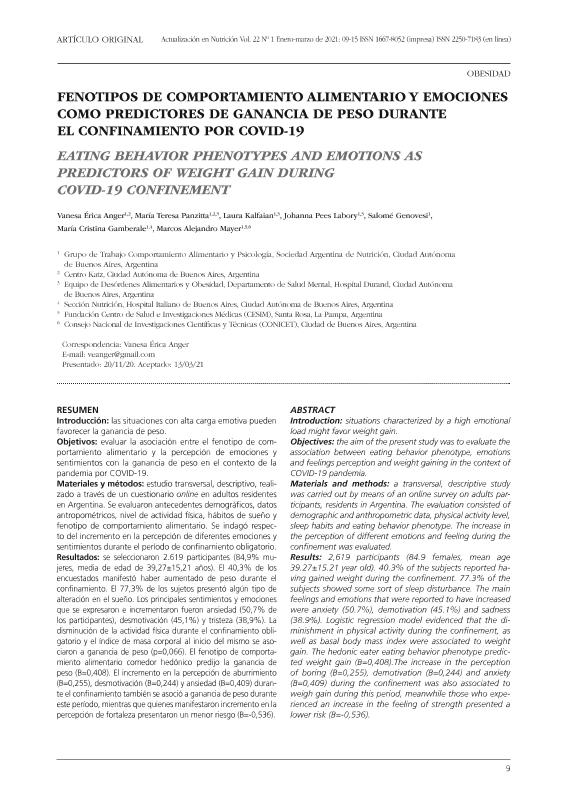
Introducción: las situaciones con alta carga emotiva pueden favorecer la ganancia de peso. Objetivos: evaluar la asociación entre el fenotipo de comportamiento alimentario y la percepción de emociones y sentimientos con la ganancia de peso en el contexto de la pandemia por COVID-19.Materiales y métodos: estudio transversal, descriptivo, realizado a través de un cuestionario online en adultos residentes en Argentina. Se evaluaron antecedentes demográficos, datos antropométricos, nivel de actividad física, hábitos de sueño y fenotipo de comportamiento alimentario. Se indagó respecto del incremento en la percepción de diferentes emociones y sentimientos durante el período de confinamiento obligatorio. Resultados: se seleccionaron 2.619 participantes (84,9% mujeres, media de edad de 39,27±15,21 años). El 40,3% de los encuestados manifestó haber aumentado de peso durante el confinamiento. El 77,3% de los sujetos presentó algún tipo de alteración en el sueño. Los principales sentimientos y emociones que se expresaron e incrementaron fueron ansiedad (50,7% delos participantes), desmotivación (45,1%) y tristeza (38,9%). La disminución de la actividad física durante el confinamiento obligatorio y el índice de masa corporal al inicio del mismo se asociaron a ganancia de peso (p=0,066). El fenotipo de comportamiento alimentario comedor hedónico predijo la ganancia de peso (B=0,408). El incremento en la percepción de aburrimiento(B=0,255), desmotivación (B=0,244) y ansiedad (B=0,409) durante el confinamiento también se asoció a ganancia de peso durante este período, mientras que quienes manifestaron incremento en la percepción de fortaleza presentaron un menor riesgo (B=-0,536).Conclusiones: el fenotipo de comportamiento alimentario comedor hedónico y la percepción de emociones negativas se asociaron a ganancia de peso en el contexto de confinamiento obligatorio. Esto resalta la importancia del abordaje delos aspectos emocionales y la identificación de los fenotipos comportamentales de ingesta individual a fin de promover estrategias de prevención adecuadas. Introduction: situations characterized by a high emotional load might favor weight gain. Objectives: the aim of the present study was to evaluate the association between eating behavior phenotype, emotions and feelings perception and weight gaining in the context of COVID-19 pandemia. Materials and methods: a transversal, descriptive study was carried out by means of an online survey on adults participants, residents in Argentina. The evaluation consisted of demographic and anthropometric data, physical activity level, sleep habits and eating behavior phenotype. The increase in the perception of different emotions and feeling during the confinement was evaluated. Results: 2,619 participants (84.9 females, mean age 39.27±15.21 year old). 40.3% of the subjects reported having gained weight during the confinement. 77.3% of the subjects showed some sort of sleep disturbance. The main feelings and emotions that were reported to have increased were anxiety (50.7%), demotivation (45.1%) and sadness (38.9%). Logistic regression model evidenced that the diminishment in physical activity during the confinement, as well as basal body mass index were associated to weight gain. The hedonic eater eating behavior phenotype predicted weight gain (B=0,408).The increase in the perception of boring (B=0,255), demotivation (B=0,244) and anxiety (B=0,409) during the confinement was also associated to weigh gain during this period, meanwhile those who experienced an increase in the feeling of strength presented a lower risk (B=-0,536). Conclusions: the hedonic eater eating behavior phenotype and the perception of negative emotions were associated to weight gaining in the context of the confinement. This remarks the importance of the addressing emotional aspects and identifying individual eating behavior phenotypes in order to promote adequate preventive strategies.
Fenotipos de comportamiento alimentario y emociones como predictores de ganancia de peso durante el confinamiento por Covid-19
Título:
Eating behavior phenotypes and emotions as predictors of weight gain during Covid-19 confinement
Anger, Vanesa Érica; Panzitta, María Teresa; Kalfaian, Laura; Pees Labory, Johana; Genovesi, Salomé; Gamberale. María Cristina; Mayer, Marcos Alejandro
Fecha de publicación:
03/2021
Editorial:
Sociedad Argentina de Nutrición
Revista:
Actualización en Nutrición
ISSN:
1667-8052
e-ISSN:
2250-7183
Idioma:
Español
Tipo de recurso:
Artículo publicado
Clasificación temática:
Resumen
Palabras clave:
COVID-19
,
OBESIDAD
,
COMEDOR HEDÓNICO
,
FENOTIPO COMPORTAMENTAL ALIMENTARIO
Archivos asociados

Tamaño:
151.3Kb
Formato:
PDF
Licencia
 Excepto donde se diga explícitamente, este item se publica bajo la siguiente descripción:
Creative Commons Attribution-NonCommercial-ShareAlike 2.5 Unported (CC BY-NC-SA 2.5)
Excepto donde se diga explícitamente, este item se publica bajo la siguiente descripción:
Creative Commons Attribution-NonCommercial-ShareAlike 2.5 Unported (CC BY-NC-SA 2.5)
Identificadores
Colecciones
Articulos(CCT - PATAGONIA CONFLUENCIA)
Articulos de CTRO.CIENTIFICO TECNOL.CONICET - PATAGONIA CONFLUENCIA
Articulos de CTRO.CIENTIFICO TECNOL.CONICET - PATAGONIA CONFLUENCIA
Citación
Anger, Vanesa Érica; Panzitta, María Teresa; Kalfaian, Laura; Pees Labory, Johana; Genovesi, Salomé; et al.; Fenotipos de comportamiento alimentario y emociones como predictores de ganancia de peso durante el confinamiento por Covid-19; Sociedad Argentina de Nutrición; Actualización en Nutrición; 22; 1; 3-2021; 9-15
Compartir

